

No, a standard permanent magnet will not stick to aluminum.
Aluminum is a paramagnetic material. It’s not ferromagnetic like iron, nickel, or cobalt. Its magnetic attraction is incredibly weak.
But does this mean there is no interaction between aluminum and magnets? The answer is more complex and fascinating. It has significant implications for engineering and manufacturing. This guide explores the underlying physics, the hidden magnetic effects of eddy currents, and the real-world industrial applications that arise from aluminum’s unique properties
Table of Contents
Fundamental Physics Explained
To understand the relationship between magnets and aluminum, we must first differentiate between the primary types of magnetism. A material’s response to an external magnetic field is determined by its atomic structure and electron configuration.
Types of Magnetism
Materials are generally classified into three categories based on their magnetic behavior. These are ferromagnetism, paramagnetism, and diamagnetism.
Ferromagnetism is a powerful attraction to magnetic fields. Materials like iron and nickel possess atomic magnetic moments that align spontaneously in regions called magnetic domains. An external field can easily align these domains. This creates a strong magnet.
Paramagnetism is a very weak attraction to magnetic fields. In materials like aluminum and titanium, atoms have unpaired electrons that act as tiny magnets. However, these are randomly oriented. They only partially align under the influence of a very strong external field.
Diamagnetism is a weak repulsion from magnetic fields. Materials such as copper and carbon have no unpaired electrons. When exposed to a magnetic field, they generate an internal field that weakly opposes the external one.
Property | Ferromagnetism | Paramagnetism | Diamagnetism |
Example Materials | Iron, Nickel, Cobalt, Neodymium alloys | Aluminum, Titanium, Platinum, Magnesium | Copper, Carbon (Graphite), Gold, Water |
Interaction | Strong Attraction | Very Weak Attraction | Very Weak Repulsion |
Strength of Interaction | Very Strong | Thousands of times weaker than ferromagnetic | Millions of times weaker than ferromagnetic |
Retains Magnetism? | Yes, can be permanently magnetized. | No, magnetism disappears when field is removed. | No, effect only present in an external field. |
Cause | Aligned magnetic domains of unpaired electrons. | Randomly oriented unpaired electrons. | Orbital motion of electrons creating opposing field. |
Aluminum's Atomic Structure
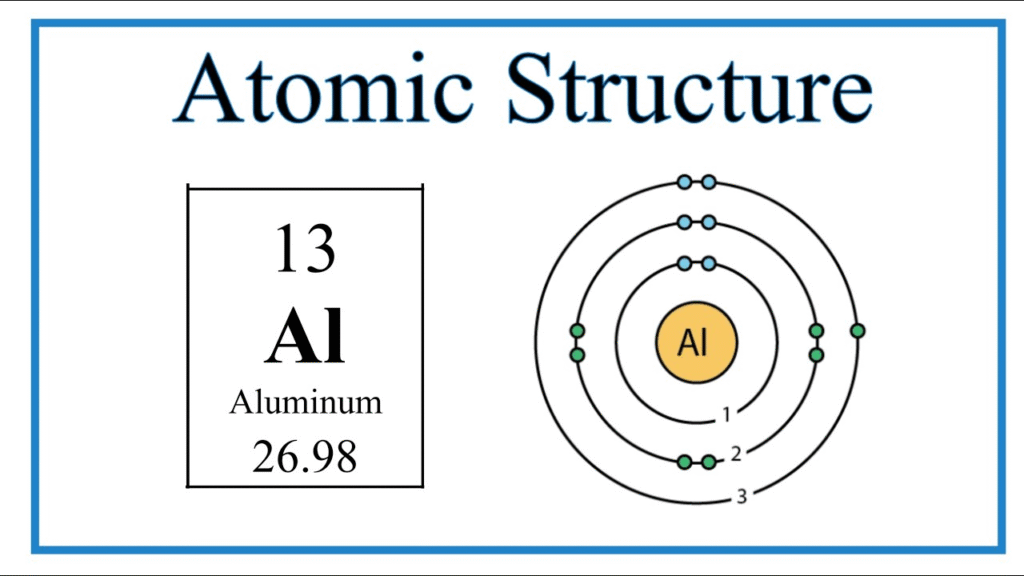
Aluminum’s atomic number is 13. It has an electron configuration of [Ne] 3s² 3p¹. The single, unpaired electron in its 3p orbital is the source of its paramagnetism.
This unpaired electron gives each aluminum atom a tiny magnetic moment. Without an external magnetic field, these moments are randomly oriented due to thermal agitation. The net magnetic effect is zero.
When a strong magnet is brought near, these atomic moments weakly align with the field. This creates a minuscule attraction.
Crucially, this paramagnetic attraction is thousands of times weaker than the ferromagnetic force you feel with iron. To quantify this, we use magnetic susceptibility. Aluminum’s volume magnetic susceptibility is a tiny +2.2 x 10⁻⁵.
In contrast, a ferromagnetic material like annealed iron has a susceptibility of around 200,000. This immense difference is why a refrigerator magnet snaps onto a steel door but shows no discernible pull towards an aluminum panel.
The "Hidden" Interaction
While aluminum doesn’t “stick” to a magnet, a powerful and useful interaction occurs when there is relative motion between them. This phenomenon is governed by electromagnetic induction. It creates a force you can feel.
What Are Eddy Currents?
This dynamic interaction is explained by Faraday’s Law of Induction. This law states that a changing magnetic field within a conductor will induce an electrical current.
When a magnet moves past a conductor like aluminum, the aluminum experiences a changing magnetic field. This change induces localized, circular flows of electrons within the material.
These circulating flows are called eddy currents. They’re named for their resemblance to eddies or whirlpools in a fluid. They are real electrical currents that flow in closed loops within the body of the conductor.
Lenz's Law in Action
The direction and effect of these eddy currents are described by Lenz’s Law. This fundamental principle states that the induced current will flow in a direction that creates its own magnetic field. This new field will oppose the original change that produced it.
This is the key takeaway for dynamic interactions.
When a magnet moves towards an aluminum plate, the induced eddy currents create a magnetic field with the same polarity. This generates a repulsive force that pushes the magnet away.
Conversely, when the magnet moves away from the aluminum, the eddy currents reverse direction. They create a magnetic field with opposite polarity. This generates an attractive force that tries to pull the magnet back.
In both cases, the force created by the eddy currents opposes the motion. This results in a “braking” or “damping” effect, not a static attraction.
A Classic Demonstration
A compelling visualization of this principle is the magnet-in-a-tube experiment. This demonstration provides a clear, firsthand look at the power of eddy currents.
Imagine you have two identical-looking pipes. One is made of clear plastic and the other of thick-walled aluminum. You also have two small objects of the same size and weight: a non-magnetic steel ball and a powerful neodymium magnet.
When you drop the steel ball through the aluminum tube, it falls freely under gravity. It clatters at the bottom in a fraction of a second.
Now, drop the neodymium magnet through the same aluminum tube. The result is dramatically different. The magnet descends at a slow, controlled, and eerily silent speed. It’s as if it were floating through a thick, invisible fluid like honey. It takes many seconds to emerge from the bottom.
This profound slowing effect is a direct visualization of the braking force generated by eddy currents. As the magnet falls, it induces strong eddy currents in the conductive aluminum wall. These in turn create a magnetic field that opposes the magnet’s downward motion.
How to Observe This
You can feel this effect yourself with a simple setup. This small experiment makes the abstract physics tangible.
First, gather your materials. You will need a strong magnet, such as a neodymium rare-earth magnet. You’ll also need a thick, flat piece of non-ferrous conductor. A solid block of aluminum (at least 1/4 inch or 6mm thick) works perfectly. A thin aluminum foil will not produce a noticeable effect as it cannot support significant eddy currents.
Next, perform the test. Place the magnet on the surface of the aluminum block. As we established, it will not stick.
Now, quickly slide the magnet across the surface. You will feel a distinct “drag” or resistance. This syrupy, viscous feeling is the tactile sensation of the eddy current braking force. The faster you try to move the magnet, the stronger the resistance will feel.
Industrial Applications
The principles of paramagnetism and eddy currents are not just scientific curiosities. They are the foundation for critical industrial technologies. Engineers leverage these properties to solve complex challenges in sorting, heating, braking, and design.
Non-Ferrous Metal Sorting
In large-scale recycling facilities, separating valuable non-ferrous metals like aluminum cans from other waste is a crucial task. This includes plastic, paper, and glass. This is accomplished with remarkable efficiency using eddy current separators.
The mechanism involves a conveyor belt carrying a stream of mixed waste towards a rapidly rotating drum embedded with powerful permanent magnets.
As the conductive aluminum cans pass over the spinning magnetic drum, the intense and rapidly changing magnetic field induces powerful eddy currents within the metal.
According to Lenz’s Law, these eddy currents create their own magnetic fields that strongly repel the magnetic drum. This repulsive force is strong enough to “kick” or “eject” the aluminum cans off the primary conveyor belt and into a separate collection bin.
Non-conductive materials like plastic and glass are unaffected. They simply fall off the end of the conveyor. Modern eddy current separators can achieve over 95% recovery rates for aluminum cans from municipal solid waste streams. This is a testament to this technology’s effectiveness.
Induction Heating and Forging
Induction heating is a clean, fast, and precise method for heating conductive materials like aluminum without any physical contact. It relies entirely on the principle of eddy currents.
The process uses a high-frequency alternating current passed through a copper coil. This generates a powerful and rapidly changing magnetic field around the coil.
When an aluminum billet or part is placed within this field, massive eddy currents are induced inside the material.
The aluminum’s natural electrical resistance opposes the flow of these currents. This results in intense resistive heating (known as I²R losses). The heat is generated directly within the part itself. This makes the process incredibly efficient and controllable.
This technology is widely used for forging, pre-heating for welding, heat treating to alter metallurgical properties, and brazing. Its benefits include speed, energy efficiency, precise temperature control, and a cleaner work environment compared to traditional furnaces.
Electromagnetic Braking
The braking effect observed in the magnet-in-a-tube experiment is scaled up for heavy-duty industrial applications. Electromagnetic brakes are frictionless, wear-free, and exceptionally reliable.
High-speed trains often use this technology as a supplementary braking system. Large electromagnets positioned on the train’s undercarriage are lowered near the steel rails or dedicated aluminum fins. When activated, they induce powerful eddy currents. This creates a strong braking force without any physical contact or wear.
Modern roller coasters use arrays of strong permanent magnets on the track and conductive fins on the cars to provide smooth, failsafe braking at the end of the ride. The braking force naturally increases with speed. This ensures a controlled stop.
This damping effect is also used in high-precision laboratory balances. A small piece of aluminum moving through a magnetic field quickly damps any oscillations of the balance arm. This allows for faster and more stable readings.
Design Advantages
In many advanced technology fields, aluminum’s non-ferromagnetic nature is not a limitation but a critical design feature.
For sensitive electronics, aluminum is an ideal material for enclosures and chassis. As a conductor, it provides excellent RFI/EMI shielding (acting as a Faraday cage). But because it is non-ferromagnetic, it does not distort nearby magnetic fields from components like inductors or transformers.
This property is paramount in medical imaging. Components of Magnetic Resonance Imaging (MRI) machines, especially those near the main superconducting magnet, must be non-ferromagnetic. Using aluminum prevents these parts from becoming dangerous projectiles in the intense magnetic field. It also ensures the field remains homogenous for clear imaging.
Other applications include housings for navigational equipment like compasses and GPS units. In these applications, a magnetic material would interfere with their operation.
Comparative Analysis
For engineers and purchasing agents, selecting the right material often involves comparing the properties of different metals. Understanding how aluminum’s magnetic response compares to other common industrial metals is essential for proper specification and quality control.
A Head-to-Head Comparison
The following table provides a practical comparison for material selection. It focuses on magnetic and physical properties relevant to engineering design.
Metal | Magnetic Type | Relative Permeability | Will a Magnet Stick? | Electrical Conductivity (% IACS¹) | Density (g/cm³) | Notes for Engineers |
Aluminum (6061) | Paramagnetic | ≈ 1.000022 | No | 43% | 2.70 | Excellent for eddy current applications. Non-magnetic for enclosures. |
Mild Steel (1018) | Ferromagnetic | > 1,000 | Yes, strongly | 15% | 7.87 | Magnetic. Used for structures and magnetic cores. Prone to corrosion. |
Austenitic SS (304/316) | Paramagnetic | ≈ 1.003 | No² | 2.4% | 8.00 | Generally non-magnetic and corrosion-resistant. Poor conductor. |
Ferritic SS (430) | Ferromagnetic | > 500 | Yes | 2.8% | 7.75 | Magnetic and corrosion-resistant. Often used in appliances. |
Copper (C110) | Diamagnetic | ≈ 0.999994 | No (weakly repels) | 101% | 8.96 | Best practical conductor. Ideal for eddy current induction coils. |
Titanium (Ti-6Al-4V) | Paramagnetic | ≈ 1.00018 | No | 1% | 4.43 | Non-magnetic, high strength-to-weight ratio, excellent corrosion resistance. |
¹ IACS: International Annealed Copper Standard.
² Austenitic stainless steel can become weakly magnetic after significant cold working.
The Stainless Steel Exception

A common point of confusion is the magnetic properties of stainless steel. A simple magnet test can lead to incorrect material identification if the underlying metallurgy is not understood.
The key difference lies in the material’s crystal structure. This is determined by its alloy composition, particularly the nickel content.
Austenitic stainless steels, like the common 304 and 316 grades, have a crystal structure called austenite. This structure is non-ferromagnetic. These are the most widely used types for food processing, chemical, and medical applications.
Ferritic and martensitic stainless steels, such as the 400 series (e.g., 430), have a ferrite crystal structure. This is similar to carbon steel. This structure is ferromagnetic, and a magnet will stick to it. These are often used in automotive exhaust systems and home appliances.
A critical detail for technicians is that heavily cold-working an austenitic stainless steel can cause a partial phase transformation. This includes bending, drawing, or stamping. It can change from non-magnetic austenite to weakly magnetic martensite. This can result in a part that was originally non-magnetic becoming slightly magnetic in the worked areas.
Conclusion and Key Takeaways
Understanding the nuanced interaction between aluminum and magnets moves beyond a simple yes/no question. It unlocks a deeper appreciation for the principles of electromagnetism and their application in modern engineering.
Final Summary of Principles
The interaction can be summarized by two key conditions.
In a static situation, a standard magnet will not stick to aluminum. This is because aluminum is a paramagnetic material with an attraction force too weak to overcome the magnet’s weight.
In a dynamic situation, a moving magnet near aluminum will induce powerful eddy currents. These currents create a magnetic field that always opposes the motion. This results in a strong braking or repulsive force.
Actionable Insights
This knowledge translates into practical takeaways for various professional roles.
For Engineers and Designers:
- Leverage aluminum’s non-ferromagnetic nature for applications requiring magnetic transparency. These include electronics enclosures, scientific instruments, and MRI equipment.
- Utilize the principles of eddy currents to design innovative solutions for frictionless braking, material damping, non-contact heating, and automated sorting.
For Technicians and Manufacturing Professionals:
- You cannot use standard magnetic bases or fixtures for holding or positioning aluminum workpieces.
- Be aware of the potential for intense induction heating when aluminum parts are exposed to strong, rapidly changing magnetic fields from nearby equipment.
For Students and Hobbyists:
- The interaction between a moving magnet and aluminum is a perfect real-world demonstration of Faraday’s Law of Induction and Lenz’s Law.
- The distinction between weak, static paramagnetism and strong, dynamic eddy current effects is a critical concept in physics.
For Purchasing and Quality Control:
- A simple magnet test is a fast and effective way to differentiate aluminum from carbon steel or ferritic/martensitic stainless steel.
- This test is not a reliable method for differentiating aluminum from austenitic (300-series) stainless steel, titanium, copper, or other non-ferrous metals. None of them will stick to a magnet.