

Yes, iron is strongly magnetic. It’s the classic example of a material that gets powerfully attracted to a magnetic field.
Hold a magnet near a piece of iron. You’ll feel a distinct and forceful pull. This property makes iron a cornerstone material in the world of magnetism.
Scientists classify this behavior as “ferromagnetic.” We’ll explore this term in detail. Iron shares this property with only a few other elements, like nickel and cobalt.
This article will guide you through exactly why iron is magnetic. You’ll learn how its properties are used and how it compares to other common metals you encounter every day.
Table of Contents
Your Journey to Understanding
We’ll provide a complete picture of iron’s magnetic properties. Here’s the path we’ll follow to build your understanding from the ground up:
- The science behind iron’s magnetic pull.
- How iron compares to other common metals.
- Real-world applications you see every day.
- Practical tips and advanced concepts.
The Science Behind It
To truly understand why iron is magnetic, we need to look deep inside its structure. We’ll start at the level of a single atom.
The magnetic properties of any material are determined by its electrons. Imagine electrons not only orbiting the nucleus of an atom but also spinning on their own axis. They’re like tiny spinning tops.
This spin creates a minuscule magnetic field. Each electron becomes a microscopic magnet.
It Starts at the Atomic Level
In many materials, electrons exist in pairs. When two electrons are paired, they’re forced to spin in opposite directions.
Their opposite spins cause their tiny magnetic fields to cancel each other out. The result? The atom has no overall magnetic moment.
Iron atoms are different. Their specific electron configuration results in four unpaired electrons in one of their outer shells.
The spins of these unpaired electrons are all aligned in the same direction. Instead of canceling out, their individual magnetic fields add up. This gives each iron atom a significant net magnetic moment.
This atomic-level property is the fundamental reason iron has the potential to be strongly magnetic.
Scaling Up: Magnetic Domains
Having magnetically charged atoms is only the first step. For a piece of bulk iron to exhibit magnetism, these atoms need to work together.
Within a piece of iron, atoms group themselves into microscopic regions called magnetic domains. Inside each domain, all the individual atomic magnets are aligned, pointing in the same direction.
Think of a magnetic domain as a neighborhood where all the residents have agreed to face the same way. The entire domain acts as one single, albeit tiny, magnet.
In a common, unmagnetized piece of iron like a nail, these domains are arranged randomly. One domain might point up. The next might point left. Another points down.
This chaotic orientation means their magnetic fields cancel each other out on a large scale. The piece of iron doesn’t act like a magnet because there’s no overall, unified magnetic direction.
When you bring an external magnet close to the iron, its powerful field influences these domains. The domains that are already somewhat aligned with the external field grow larger. Those pointing in other directions shrink.
The magnetic orientation of entire domains can rotate to align with the external field. This is the physical process that causes the strong attraction you feel. The iron temporarily becomes a magnet itself, aligned with the external magnet.
Remove the external magnet, and most of the domains in a piece of soft iron will return to their random orientations. The iron will lose most of its induced magnetism.
Iron vs. Other Metals
Not all metals respond to magnets in the same way. Understanding “is iron magnetic” requires context. Metal magnetism exists on a spectrum. It’s typically broken down into three main categories.
This knowledge is critical for anyone selecting materials. Whether for an engineering project, a construction job, or a simple DIY task.
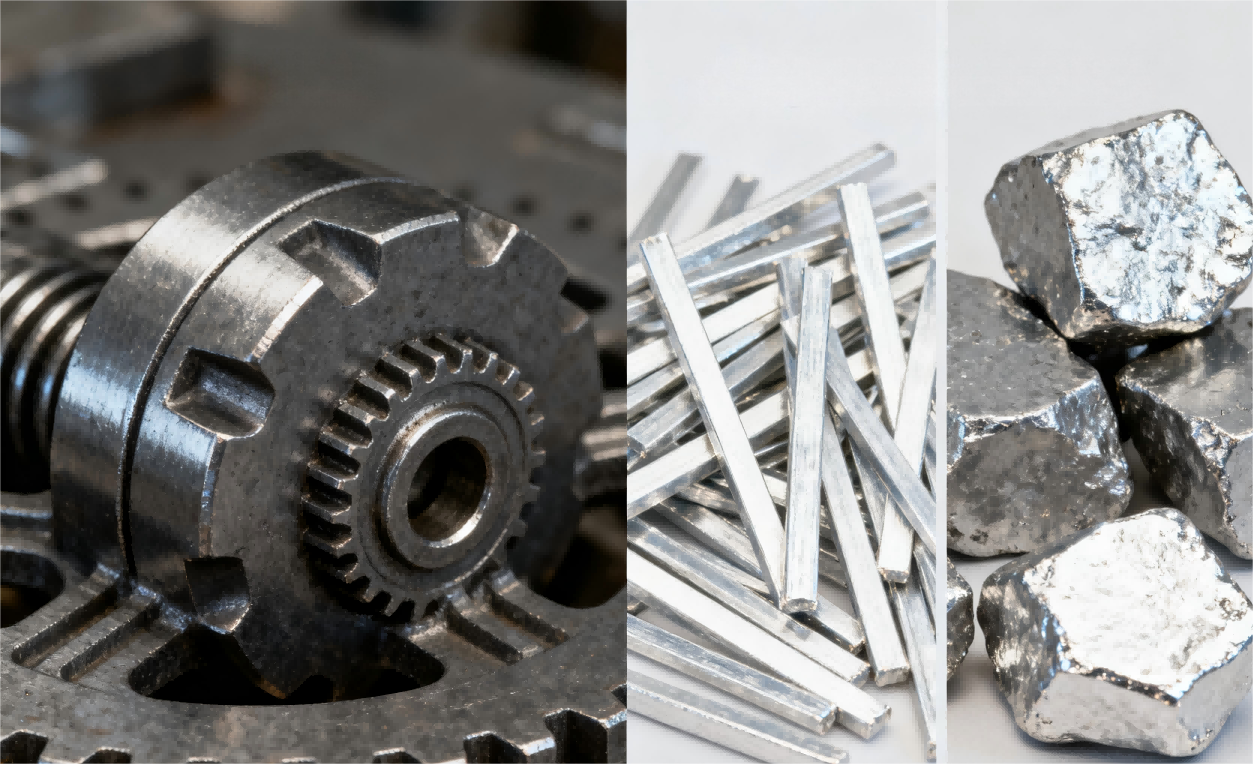
Three Categories of Magnetism
The primary classifications for how materials interact with magnetic fields are ferromagnetic, paramagnetic, and diamagnetic.
Ferromagnetic materials are what we typically think of as “magnetic.” They’re strongly attracted to magnets and can be magnetized themselves. Iron, nickel, and cobalt are the primary examples.
Paramagnetic materials are very weakly attracted to a magnetic field. This attraction is so faint that it’s usually undetectable without sensitive laboratory equipment. Aluminum, platinum, and titanium are paramagnetic.
Diamagnetic materials are weakly repelled by a magnetic field. This is a subtle property that all materials possess. It’s only noticeable in materials that aren’t ferromagnetic or paramagnetic. Copper, gold, silver, and lead are common examples.
At-a-Glance Comparison
The differences between these magnetic types are best understood in a simple table. This provides a quick reference for comparing common metals.
Magnetic Type | Behavior with a Magnet | Common Metal Examples | Key Characteristic |
Ferromagnetic | Strongly Attracted | Iron, *Steel*, *Nickel*, Cobalt | Can be made into permanent magnets. |
Paramagnetic | Weakly Attracted | Aluminum, *Platinum*, Magnesium | Attraction is temporary and very weak. |
Diamagnetic | Weakly Repelled | Copper, *Gold*, *Silver*, Bismuth | All materials have some diamagnetism. |
As the table shows, iron stands in a class of its own compared to metals like aluminum or copper. An engineer might consider the weak paramagnetism of aluminum in a high-intensity MRI machine. But for all everyday purposes, it’s considered non-magnetic.
Iron's Magnetism in Action
The science of iron’s magnetism is fascinating. But its true importance comes from its application in the world around us.
From massive industrial generators that power cities to the simple devices in your kitchen, iron’s ability to manipulate and respond to magnetic fields is indispensable.
We’ll explore how this single property is leveraged by professionals and how it impacts your daily life.

Engineering & Manufacturing
For engineers and manufacturers, iron isn’t just one material. It’s a family of materials with tunable magnetic properties. The distinction between “soft” and “hard” magnetic materials is critical.
Soft iron is used in the cores of electromagnets, solenoids, and transformers. Its high magnetic permeability allows it to be easily magnetized. Just as importantly, it can be easily demagnetized.
This ability to switch its magnetic state with minimal energy loss is what makes an AC transformer possible. The high magnetic permeability of soft iron can concentrate magnetic field lines by a factor of several thousand. This makes it indispensable for efficient transformers.
“Hard” magnetic materials are alloys of iron designed to retain their magnetism. Steel, which is an alloy of iron and carbon, is a prime example.
Specific alloys like neodymium-iron-boron (NdFeB) create the most powerful permanent magnets known. These are essential components in high-performance electric motors, computer hard drives, and modern wind turbine generators.
Iron’s influence also extends to magnetic shielding. Alloys like Mu-metal, which is primarily nickel and iron, are used to protect sensitive electronic equipment from stray magnetic fields. They redirect the field lines around the shielded space.
Home, DIY & Everyday Life
You don’t need to be an engineer to encounter the practical effects of iron’s magnetism. It’s at work in your home in ways you might not expect.
Consider the modern induction cooktop. We’ve all been there—wondering if a new pan will work on our induction stove. The answer lies in magnetism.
The cooktop’s surface conceals a coil of copper wire. When activated, an alternating current flows through this coil. This generates a rapidly changing magnetic field.
Place a pan with an iron base on top. This magnetic field induces powerful electrical currents, known as eddy currents, directly within the iron of the pan. The pan’s own electrical resistance causes these currents to generate heat, cooking your food.
Here’s the simple test: If a refrigerator magnet sticks firmly to the bottom of your pan, it contains iron or magnetic steel. It will work perfectly on an induction cooktop. A copper or aluminum pan won’t.
Another practical tool is the magnetic stud finder. The simplest versions of these devices contain no electronics at all. They’re simply a powerful, encased magnet.
These stud finders don’t detect the wood stud itself. Instead, they detect the ferromagnetic materials used to attach the drywall to the stud: the iron or steel screws and nails. By sweeping the device across the wall, you can pinpoint the fasteners and thus the location of the stud.
In the workshop, the utility of magnetism is even more direct. Magnetic tool strips, bowls for holding screws, and magnetized screwdriver tips all rely on the ferromagnetic nature of steel tools. They keep a workspace organized and efficient.
Beyond the Basics: Temperature
A material’s magnetic properties aren’t always constant. For ferromagnetic materials like iron, magnetism is highly dependent on temperature.
There’s a distinct point at which the powerful magnetic ordering within iron breaks down completely. Understanding this threshold is crucial in many high-temperature industrial processes.
Introducing the Curie Point
For every ferromagnetic material, there exists a specific temperature known as the Curie Point, or Curie Temperature.
Above this temperature, the material loses its ordered ferromagnetic properties. It becomes merely paramagnetic. The strong attraction to a magnet vanishes.
This transition happens because the thermal energy within the material becomes too great. The atoms vibrate so violently that the cooperative alignment of the magnetic domains is disrupted. They revert to a random, disordered state.
The heat provides enough energy to overcome the forces that hold the magnetic domains in alignment.
Specifics for Iron
For pure iron, the Curie Point is 770 °C (1418 °F).
Below this temperature, iron is ferromagnetic. A magnet will stick to iron. Above this temperature, the thermal agitation is too intense. The domains become randomized, and a magnet will no longer stick to it.
If the iron is cooled back down below its Curie Point, its ferromagnetic properties will return. It will once again be strongly attracted to a magnet.
This property is a critical design consideration for engineers. Any application that requires iron or steel to remain magnetic must operate well below the material’s Curie Temperature to function reliably. This includes certain types of sensors or motors.
This is also a fascinating phenomenon to witness in blacksmithing. A piece of glowing red-hot steel won’t be attracted to a magnet until it cools below a certain temperature.
From Magnetic to Magnetized
A common point of confusion is the difference between a material being “magnetic” and being “a magnet.”
A piece of iron is magnetic. This means it’s attracted to a magnetic field. However, a standard iron nail isn’t a magnet. It doesn’t generate its own persistent magnetic field to pick up other objects.
With a little knowledge, you can bridge this gap. You can temporarily turn a piece of iron or steel into a magnet yourself.

The Crucial Difference
We can use a simple analogy. A regular piece of iron is like a quiet audience in an auditorium. The potential to make a lot of coordinated noise is there. But the individuals (the magnetic domains) are all in a random, uncoordinated state.
A strong permanent magnet is like a charismatic speaker who steps on stage. When the speaker directs the audience, they can all be made to cheer in unison. The magnet aligns the domains in the iron, making it act as a magnet.
When the speaker leaves (the magnet is removed), the audience (the domains in the iron) gradually falls back into random chatter.
This analogy also helps explain the difference between “soft” and “hard” magnetic materials. Soft iron is like an easily excited but forgetful audience. It aligns easily but quickly loses that alignment. This makes it great for electromagnets.
Steel, an iron alloy, is a “harder” magnetic material. It’s like a more disciplined audience that’s tougher to get organized. But once aligned, it will hold that formation for much longer. This makes it suitable for creating more permanent magnets.
Step-by-Step Magnetization
You can easily demonstrate this principle by temporarily magnetizing a common steel object like a screwdriver. This is a safe and simple activity that makes the abstract concept of domain alignment tangible.
- Gather Your Materials: You’ll need a strong permanent magnet, like a neodymium magnet from a hardware store, and an iron or steel object. A long screwdriver or a large steel nail works perfectly.
- The Stroking Method: Lay the screwdriver flat on a non-metallic surface. Take one pole of your permanent magnet (it doesn’t matter which one) and place it at the base of the screwdriver’s metal shaft, near the handle.
- Stroke in One Direction: Firmly stroke the magnet along the entire length of the shaft, all the way to the tip. Maintain consistent pressure throughout the stroke. When you reach the tip, lift the magnet away from the screwdriver completely. It’s critical that you don’t drag the magnet back along the shaft.
- Repeat the Process: Bring the magnet back to the starting point at the base of the shaft. Repeat the exact same one-way stroke. Go from handle to tip, then lift away. Do this 20 to 30 times. Each pass helps to align more of the magnetic domains within the steel, all pointing in the same direction.
- Test Your New Magnet: After sufficient strokes, your screwdriver should now be weakly magnetized. Try to pick up a small paperclip, a staple, or a steel screw with the tip. You’ve successfully created a temporary magnet.
This induced magnetism will fade over time. It can also be destroyed quickly by giving the screwdriver a sharp knock or by heating it. This provides the energy for the domains to return to their random state.
The Enduring Attraction of Iron
Our exploration began with a simple question: Is iron magnetic? We’ve established the answer is a definitive yes. But the story is far more intricate and important than that simple fact suggests.
From the quantum spin of electrons to the alignment of vast industrial motors, iron’s magnetism is a property that has fundamentally shaped our technological world.
Key Takeaways on Magnetism
Let’s review the most critical points about iron’s magnetic properties.
- Iron is strongly magnetic. It’s the most well-known example of a ferromagnetic material. This property originates from its unique atomic structure and unpaired electrons.
- This property is harnessed in countless industrial and household applications. From transformers and electric motors to induction cooktops and data storage.
- Iron’s strong ferromagnetism is distinct from the behavior of other metals. Aluminum is only weakly paramagnetic. Copper is weakly diamagnetic, meaning it’s slightly repelled by magnets.
- You can temporarily magnetize a piece of steel yourself. Repeatedly stroke it in one direction with a permanent magnet. This process aligns its internal magnetic domains.
We are a manufacturer specializing in the research and development of magnets with years of industry experience. Our product offerings include NdFeB magnets, ferrite magnets, and custom magnetic components. Our goal is to provide high-quality magnetic solutions to customers worldwide, and we also offer OEM/ODM customization services. If you have any questions about magnets or custom applications, please feel free to contact our team of experts.
Facebook
LinkedIn
WhatsApp
X