
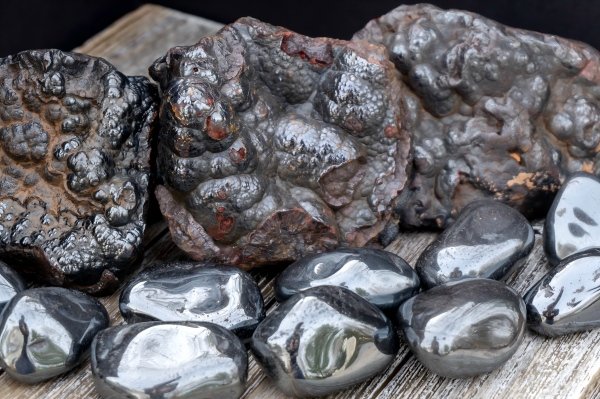
The question “is hematite magnetic” has a complex answer. This confusion is common in the marketplace. We’ll give you the definitive answer right away.
Natural hematite is only very weakly magnetic. It won’t stick to a regular magnet.
The strongly magnetic, shiny black beads and stones often sold as “magnetic hematite” are completely different. They’re man-made materials.
This widespread confusion is exactly why we created this comprehensive guide. Many buyers get misled by the naming. This includes everyone from industrial procurement staff to jewelry makers.
In this article, we’ll explore the science behind natural hematite’s unique magnetic properties. We’ll reveal what “magnetic hematite” really is. You’ll also get simple, reliable tests to tell them apart.
By the end, you’ll have expert knowledge to confidently identify each material. You’ll know how to select the right one for your specific needs.
Table of Contents
Understanding Natural Hematite

What is Hematite?
Natural hematite is the mineral form of iron(III) oxide. Its chemical formula is Fe₂O₃. It’s one of the most abundant minerals on Earth’s surface and in the shallow subsurface.
The name comes from the Greek word “haima,” meaning blood. This refers to the vibrant red color of its powdered form.
This mineral is the most important ore of iron. The vast majority of iron and steel production starts here. This includes the backbone of modern infrastructure – the mining and processing of hematite.
Hematite occurs in many different forms and habits. Each has a unique appearance. Here are some of the most common varieties:
- Kidney Ore: This form has a massive, botryoidal (grape-like) or reniform (kidney-shaped) habit with a radiating fibrous structure.
- Specularite: A variety consisting of shiny, metallic, mica-like flakes or scales of hematite. When consolidated, it forms a rock known as specular hematite.
- Oolitic Hematite: Composed of small, rounded grains called ooids, which are cemented together. These formations often have a reddish-brown, earthy appearance.
- Earthy Hematite (Red Ochre): A soft, fine-grained, earthy form used as a pigment for thousands of years.
Despite its varied appearance—from metallic grey to dull red—natural hematite has two defining characteristics. It has a Mohs hardness of 5.5 to 6.5. This makes it quite durable.
Most importantly, it has a characteristic reddish-brown streak. This is the color of the mineral in powdered form. It’s a consistent identifier regardless of the specimen’s surface color. For more in-depth mineralogical data, a resource like Mindat.org is an excellent reference.
The Science of Magnetism
Primer on Mineral Magnetism
To understand why “is hematite magnetic” isn’t a simple yes or no, we need to understand how materials interact with magnetic fields.
In simple terms, magnetism in minerals comes from the magnetic moments of electrons within their atoms. The way these tiny atomic magnets align determines the material’s overall magnetic character.
Ferromagnetism is what most people think of as “magnetic.” In these materials, like iron or nickel, the atomic magnets align parallel to each other. This creates a strong, combined magnetic field. They’re strongly attracted to magnets.
Paramagnetism and diamagnetism are much weaker forms. Paramagnetic materials are weakly attracted to magnets. Diamagnetic materials are weakly repelled. In both cases, the effect is usually too faint to notice without sensitive instruments.
Hematite’s Special Case
Natural hematite doesn’t fit neatly into these common categories. Its magnetic behavior is governed by a fascinating property called antiferromagnetism.
In an antiferromagnetic material, the magnetic moments of adjacent atoms align in opposite directions. Imagine a line of tiny compasses arranged in an alternating “north-up, north-down, north-up, north-down” pattern.
This “up-down” arrangement is the crucial point. The opposing magnetic fields of the adjacent iron ions effectively cancel each other out on a large scale.
The result is a material with almost no net external magnetic field. This is the primary scientific reason why natural hematite isn’t strongly magnetic like iron or a ferrite magnet.
Source of Weak Magnetism
The story doesn’t end with perfect cancellation. The antiparallel alignment in hematite isn’t perfectly 180 degrees. There’s a very slight tilt, or “canting,” in the alignment of the atomic spins.
This slight imperfection is known as spin canting or Dzyaloshinskii-Moriya interaction. It means the cancellation isn’t absolute. A tiny, residual magnetic moment remains.
This weak residual magnetism is why a natural hematite specimen might show a very faint attraction to an extremely powerful magnet. This includes neodymium magnets. However, it’s far too weak to be considered magnetic in any practical sense.
For those in scientific fields, it’s also useful to know about the Morin transition. Below a certain temperature (around -13°C or 9°F), the spin orientation in hematite shifts. This weak magnetism disappears entirely. Above its Curie temperature (around 675°C or 1247°F), the ordered antiferromagnetic structure breaks down. It becomes paramagnetic.
This complex behavior is rooted in quantum mechanics. It’s a key area of study in materials science. For a deeper dive into the physics, educational resources from university physics departments on antiferromagnetism provide excellent explanations.
The Impostor Unmasked

A Man-Made Material
Now we turn to the material that causes all the confusion. These are the shiny, strongly magnetic stones commonly labeled “magnetic hematite.”
Let us be clear: this material is not natural hematite.
It’s often sold under trade names like Hematine™ or Hemalyke™. These are synthetic, man-made materials designed to mimic the look of polished hematite. They possess strong magnetic properties.
Believing this material is a natural mineral is the most common mistake buyers and hobbyists make. It’s a product of industrial manufacturing, not geological processes.
The Real Composition
So, what is this impostor material actually made of? “Magnetic hematite” is a type of ceramic magnet.
Specifically, it’s a sintered ferrite. This material is a perfect example of how the properties of raw materials can be transformed through manufacturing.
The production process involves taking a powder of iron oxide. This can be derived from natural hematite or magnetite. It’s mixed with a binder and powders of other metals, typically strontium or barium.
This composite mixture is then pressed into the desired shape under high pressure. This includes beads, spheres, and blocks. Finally, it’s fired in a kiln at very high temperatures in a process called sintering.
Sintering fuses the particles together. This creates a hard, dense, and permanently magnetic ceramic. This material is a type of hard ferrite magnet. It’s a class of magnets widely used in motors, speakers, and magnetic latches due to their good magnetic strength and low cost.
The final product is a ferromagnetic material. It’s fundamentally different from the antiferromagnetic nature of the mineral it’s named after.
A Head-to-Head Comparison
To eliminate any remaining confusion, we’ve compiled a direct comparison of the key attributes. This covers natural hematite and its man-made counterpart. This table serves as a quick-reference guide for buyers, students, and enthusiasts.
Attribute | Natural Hematite | “Magnetic Hematite” |
Magnetic Strength | Very Weakly Magnetic (Antiferromagnetic) | Strongly Magnetic (Ferromagnetic) |
Origin | Natural Mineral | Man-Made Ceramic |
Composition | Iron(III) Oxide (Fe₂O₃) | Sintered Iron Oxides + Barium/Strontium |
Color | Varies: Metallic grey, black, dull red | Uniform, shiny dark grey or black |
Streak Test | Reddish-brown | Black or dark grey |
Hardness (Mohs) | 5.5 – 6.5 | Varies, often softer (approx. 5.0 – 6.0) |
Common Uses | Iron Ore, Pigments, Polishing Compound | Jewelry, Crafts, “Magnetic Therapy” Items |
Nickname | “Bloodstone” (archaic term) | “Hematine”, “Hemalyke” |
This side-by-side view makes the differences starkly clear. The most definitive and accessible distinguishing features for a non-expert are the magnetic strength and the streak test.
The Home Test
You don’t need a geology lab to determine if your item is natural hematite or the synthetic version. We’ll walk you through a simple, two-step process you can perform at home. This will help you identify your material with confidence. This is a practical application of the knowledge we’ve discussed.
What You’ll Need
Gather a few simple items for this experiment:
- The hematite or “magnetic hematite” item in question.
- A common, weak magnet (like a refrigerator magnet).
- A strong magnet, such as a neodymium magnet (if available).
- An unglazed ceramic surface (the back of a ceramic tile or the bottom ring of a coffee mug works perfectly).
Step 1: Magnet Test
This test immediately reveals the most obvious difference.
First, bring the weak refrigerator magnet close to your item. A piece of “magnetic hematite” will snap to the magnet with a strong, audible click. It will be firmly attached.
In contrast, natural hematite will show absolutely no reaction. It won’t be attracted to the weak magnet in any way.
Next, if you have a powerful magnet, repeat the test. A strong neodymium magnet is ideal for this. The “magnetic hematite” will be very strongly attracted and can be difficult to pull off.
When you bring the strong magnet near natural hematite, you might feel a slight, gentle drag or pull. You need to be very sensitive to notice it. It will not, however, “stick” or support its own weight. This subtle interaction is the weak, canted antiferromagnetism in action. This test provides a clear and practical answer to “will hematite stick to a magnet?”
Step 2: Streak Test
The streak test is a classic mineralogical technique. It’s the most definitive way to identify natural hematite.
Find an unglazed portion of your ceramic tile or mug. Vigorously scrape a small, inconspicuous edge of your stone across this surface. You’re essentially creating a fine powder of the mineral.
Observe the color of the streak left behind.
Natural hematite will always leave a distinct reddish-brown or “blood-red” streak. This happens no matter its surface color (even if it’s shiny and metallic grey). This is its defining characteristic.
“Magnetic hematite,” being a different material, will leave a dark grey or black streak.
This simple, two-step process will give you a conclusive identification every time. It involves a magnet test followed by a streak test. For a visual guide, many geology websites and videos demonstrate how to properly perform a streak test.
Practical Applications

Understanding the difference between these two materials is critical. Their real-world applications are completely different. Their distinct properties make them suitable for entirely separate industries and uses.
Industrial Might of Hematite
Natural hematite is an industrial titan. Its primary role is as the world’s most important source of iron.
Over 90% of all iron mined globally is extracted from hematite-rich ores. This iron is then used to produce steel. It forms the foundation of everything from skyscrapers and bridges to vehicles and appliances. For detailed statistics, government agencies like the U.S. Geological Survey (USGS) provide comprehensive data.
Beyond its role as an ore, hematite has other significant uses. In its powdered form (red ochre), it has been used for millennia as a durable red pigment. This includes paints, glazes, and cosmetics.
A fine-grained form of hematite is also processed to create “jeweler’s rouge.” This is a very fine polishing compound used to put a final, mirror-like polish on precious metals and lenses.
The Niche of “Magnetic Hematite”
The applications for “magnetic hematite” are centered on the one property it has that natural hematite lacks: strong magnetism.
Its primary market is in the creation of jewelry, crafts, and novelty items. The strong magnetic attraction between beads allows for clasp-less necklaces and bracelets. The material’s low cost and shiny appearance make it popular for these uses.
This material is also heavily marketed for “magnetic therapy.” Bracelets, insoles, and other items are sold with claims that the magnetic field provides health benefits. These include pain relief or improved circulation.
It’s crucial to approach these claims with a scientific perspective. Major health organizations have weighed in on this. The National Center for Complementary and Integrative Health (NCCIH) states that there is no reliable scientific evidence to support the use of static magnets for treating pain or any other health condition.
Finally, while it is a magnet, “magnetic hematite” isn’t a high-performance material. For demanding industrial, technical, or scientific applications requiring high field strength, specific temperature stability, or demagnetization resistance, engineers and designers rely on advanced materials.
For these needs, a look at a professional selection of powerful magnets is necessary to choose the correct grade of neodymium, samarium-cobalt, or alnico magnet.
Conclusion
Throughout this guide, we’ve dismantled a common and persistent point of confusion. The question “is hematite magnetic” doesn’t have a simple answer. But by understanding the two materials involved, the answer becomes clear.
We’ve established the core facts. It’s worth summarizing them one last time to ensure clarity.
- Natural Hematite is a naturally occurring iron oxide mineral. It’s only very weakly magnetic due to its antiferromagnetic crystal structure. It won’t stick to a common magnet.
- “Magnetic Hematite” is a man-made ceramic material—a sintered ferrite. It’s strongly magnetic and is designed to mimic the appearance, but not the properties, of the natural mineral.
- The Streak Test is definitive. Natural hematite will always leave a reddish-brown streak. Its synthetic counterpart will leave a black or grey one.
Whether you’re a procurement professional sourcing materials, a student of geology, or a creator of beautiful jewelry, you’re now equipped with the knowledge to distinguish fact from marketing.
Knowing the difference between these two distinct materials is the key to avoiding costly errors, conducting accurate research, and selecting the perfect material for your needs.
We are a manufacturer specializing in the research and development of magnets with years of industry experience. Our product offerings include NdFeB magnets, ferrite magnets, and custom magnetic components. Our goal is to provide high-quality magnetic solutions to customers worldwide, and we also offer OEM/ODM customization services. If you have any questions about magnets or custom applications, please feel free to contact our team of experts.
Facebook
Twitter
LinkedIn
WhatsApp