

Have you ever relied on a magnet to perform a critical task, only to suddenly find that its “gripping force” is much weaker than before? Whether it’s a precision fixture on the production line, an important instrument in the laboratory, or your proud DIY project, the failure of a magnet can bring trouble and additional costs.
As a long-time “Magnet Manufacturer” who has dealt with magnets for years, I am well aware of this concern. Today, we will delve into a core question: How long do magnets actually last? The answer is not simple, but understanding the science behind it can help you make more informed choices and extend the lifespan of your magnet companions.
Table of Contents
Theoretical "Eternity" and Realistic "Wear and Tear"
Physically speaking, once the alignment of magnetic domains (tiny magnetic regions) inside an ideal permanent magnet is oriented, its magnetism is very stable. In a perfect vacuum environment, without any external interference, its magnetic force can indeed last for hundreds or even thousands of years with minimal decay – almost “eternal”.
However, we live in an imperfect world. Magnets in real-world applications face three major “nemeses” every day: high temperature, physical damage, and corrosion. Their lifespan depends on how you help them fight these enemies.
The Three Core Factors Affecting the Lifespan of Magnets (Why They "Die")
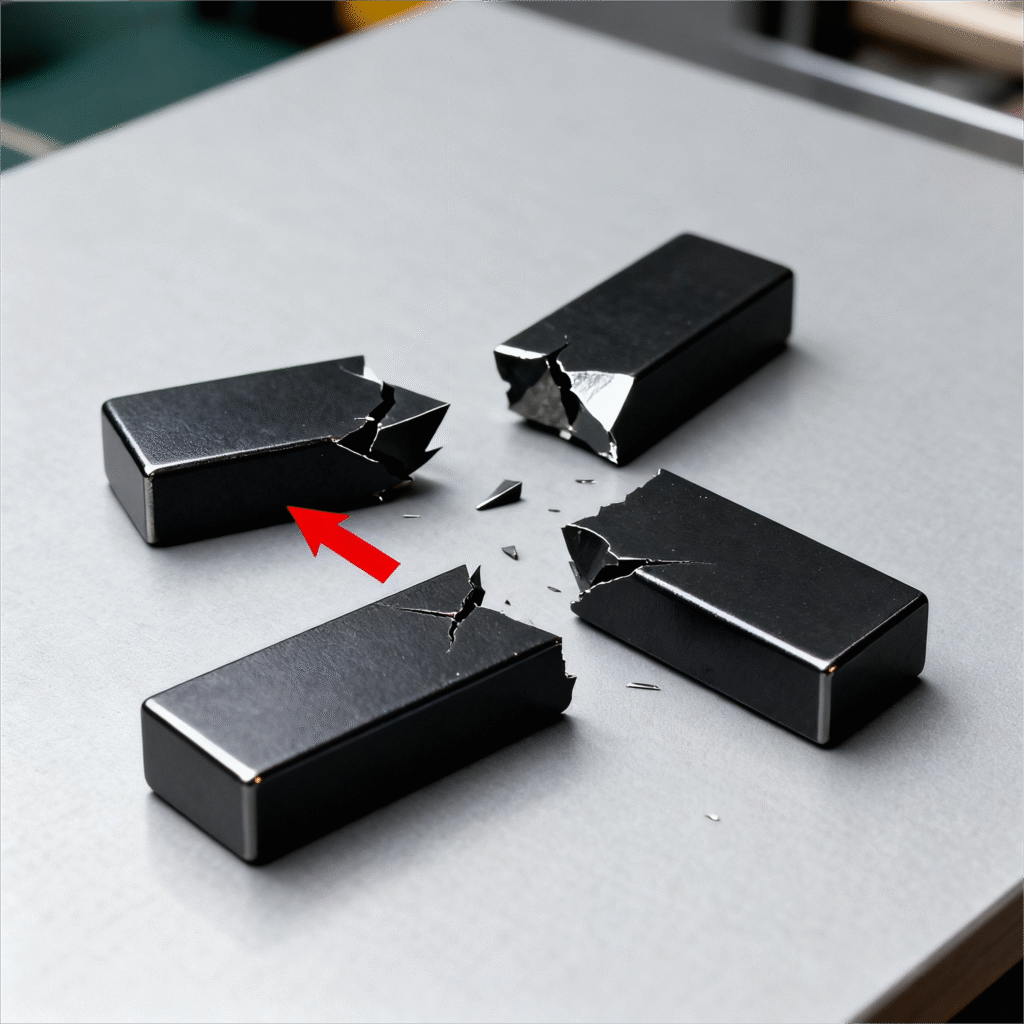
1. High Temperature: The Invisible Magnetic Killer High temperature is the most insidious and deadly enemy of magnets. Each magnet material has its own maximum operating temperature (Max Operating Temperature) and Curie temperature (Curie Temperature).
- Exceeding the operating temperature: The magnet will begin to experience reversible magnetic force loss. That is, after cooling, the magnetic force can only be partially restored.
- Reaching the Curie temperature: the thermal motion of magnetic domains becomes intense, completely disrupting the ordered arrangement, and the magnetic force willpermanently and irreversiblydisappear.
- Neodymium Iron Boron (NdFeB) magnets : Most sensitive to heat, with an operating temperature typically between 80°C – 200°C (depending on the grade) and a Curie temperature of approximately 310°C – 400°C.
- Ferrite (Ceramic) Magnets : They have much better heat resistance, with a working temperature reaching over 250°C.
- Samarium Cobalt (SmCo) Magnets : Excellent high temperature resistance, with a working temperature of up to 250°C – 350°C.
Personal Experience: I once saw an engineer place a high-performance neodymium magnet on a motor housing, and the high temperature during the motor’s operation unknowingly rendered this magnet “paralyzed.” Understanding the temperature limit of the magnet you use is the first step in protecting it.
2. Corrosion and Oxidation: Disintegration from the Inside Out Especially for neodymium iron boron magnets, which are rich in iron and neodymium, their chemical properties are very active, making them highly susceptible to oxidation and rusting. If the surface coating (such as nickel, zinc, epoxy resin) is scratched or has inherent defects, moist air will seep in. Rust will gradually corrode from the surface inward, not only damaging the structural strength but also directly leading to magnetic force attenuation.
- Countermeasures : Select a robust surface coating (such as a three-layer nickel-copper-nickel plating) for neodymium magnets, and avoid using them in harsh environments such as humidity, acid-base salt spray, etc.
3. Physical Damage: The Fragile “Hercules” The powerful neodymium magnet itself is very brittle and hard . Severe impacts, drops, or improper application of shear forces can cause it to crack or chip . Once the structure is damaged, the internal magnetic circuit will change, and the magnetic force will significantly decrease. Even more dangerous is that when two large neodymium magnets attract each other, improper handling can cause the huge impact force to even make them shatter instantly , and the flying fragments are extremely dangerous.
4. Other factors
- External Reverse Magnetic Field: A sufficiently strong reverse magnetic field can demagnetize a magnet.
- Radiation : Extremely strong radiation can affect the arrangement of magnetic domains, but it is rarely encountered in daily environments.
- Vibration : Long-term intense vibration may theoretically have a minor impact, but for modern sintered magnets, this is far less important than the top three factors.
Lifespan Expectations of Different Types of Magnets
- Neodymium Iron Boron (NdFeB) Magnets: “High-performance but delicate sports cars”. Under ideal conditions (room temperature, dry, and no physical damage), its annual natural magnetic decay rate is less than 1%, and the theoretical lifespan exceeds 10 years. However, if exposed to harsh environments, it may severely fail within a few months. It is a combination of performance and maintenance requirements.
- Ferrite (ceramic) magnets: “The tough and durable tool cart”. They are highly corrosion-resistant, extremely stable, and have strong anti-demagnetization capabilities. Their natural decay rate is extremely low, and their lifespan often reaches several decades. They are the most “worry-free” among all magnets.
- Samarium Cobalt (SmCo) Magnets: “The Sturdy Luxury SUV”. Combining high magnetic performance with excellent corrosion resistance and high-temperature resistance. It is the most stable among all rare-earth magnets, with an extremely long lifespan, but also the most expensive.
- Alnico magnets: “The classic vintage car”. They are heat-resistant but have poor demagnetization resistance and are prone to losing magnetism under the interference of an external magnetic field. Their lifespan is long, but their magnetic properties may change due to the external environment.
Six major professional techniques significantly extend the lifespan of magnets
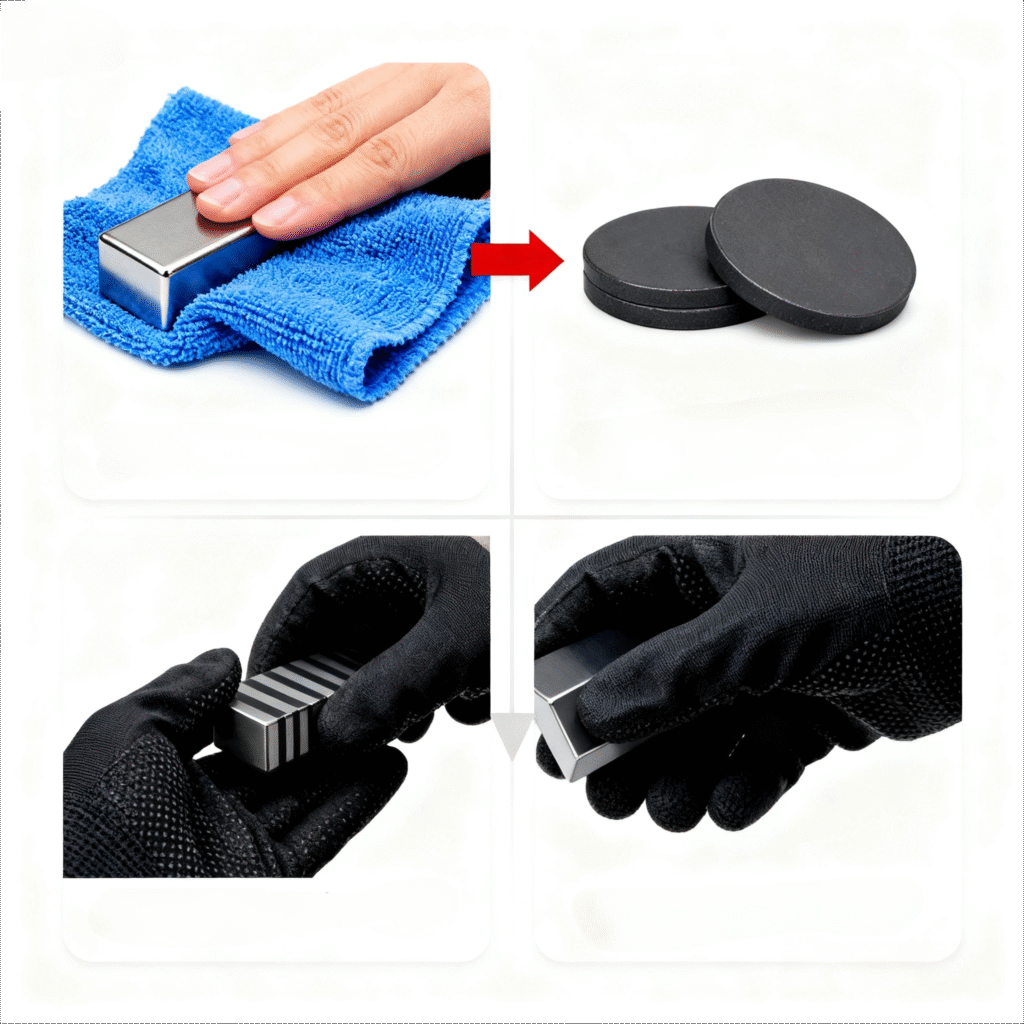
Once we know who the enemy is, we can formulate countermeasures. The following are professional suggestions for you and your team:
- Strictly avoid high temperatures:
- Action : When using and storing magnets, always keep them away from heat sources. Refer to the data sheet of the magnets you purchased, remember their maximum operating temperature , and leave at least a 20% safety margin.
- Welding : When performing welding operations, be sure to first remove nearby magnets. Flying sparks and conducted heat are both deadly.
- Prevent moisture and corrosion:
- Actions: For neodymium magnets, try to choose high-quality plating . When used in a humid environment or for liquid sealing, consider using epoxy-coated magnets.
- Cleaning: If cleaning is required, wipe with a soft cloth and dry thoroughly. Do not use corrosive chemical solvents.
- Gentle operation to prevent “hard collision” :
- Action : When handling large or powerful neodymium magnets, always wear safety goggles and gloves .
- Adsorption Technique: Allow the magnets to approach each other in a “sliding” manner rather than directly “slapping” together. When separating, they should also be slid apart in parallel rather than forcefully pried apart.
- Storage : Store separately to avoid strong mutual attraction.
- Scientific storage to avoid “internal friction” :
- Action: When storing magnets for a long time, they should be placedin pairs with their north and south poles facing each other(i.e., in an attracting state), with a piece of soft iron (called a “keeper”) sandwiched in between. This helps to form a closed magnetic circuit and slow down natural demagnetization.
- Environment : Store in a dry, room temperature, and free from strong magnetic field interference cabinet or container.
- Choose according to needs, without blindly pursuing high performance:
- Action : If your working environment is high temperature, dusty, and humid, high-performance neodymium magnets may not be the best choice . In this case, ferrite magnets may be a more economical and durable solution. Choosing the right tool for the right application is itself a strategy for extending lifespan.
- Regular inspection and replacement:
- Action : For critical industrial applications, establish a system for regular inspection and replacement of magnets . Use a new magnet with a known magnetic force as a reference to compare and test the suction force of the old magnet, thereby determining the degree of its performance degradation.

Conclusion
Magnets are not immortal, but they are by no means fragile. Their lifespan is largely determined from the moment you purchase them , and is written in every subsequent use and storage .
In summary, a high-quality magnet, with proper use and careful care, can easily last more than a decade, or even have the same lifespan as your project or equipment. Conversely, neglecting its characteristics may cause it to “perish” in an instant.
We hope this guide can act as a reliable “keeper”, safeguarding the magnetic force of your project, as well as your efficiency and costs. If you have any questions, feel free to communicate in the comment section – the issues you encounter are likely to be of concern to others as well.
We are a manufacturer specializing in the research and development of magnets with years of industry experience. Our product offerings include NdFeB magnets, ferrite magnets, and custom magnetic components. Our goal is to provide high-quality magnetic solutions to customers worldwide, and we also offer OEM/ODM customization services. If you have any questions about magnets or custom applications, please feel free to contact our team of experts.
Facebook
Twitter
LinkedIn
WhatsApp