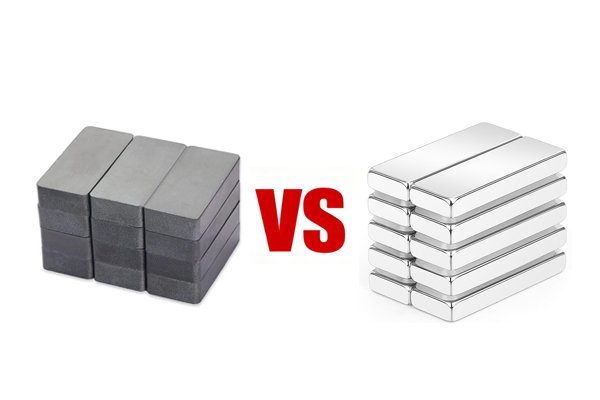
Choosing between ferrite and neodymium magnets is crucial in modern engineering. It affects manufacturing and advanced DIY projects alike. This decision shapes performance, size, durability, and cost.
The ferrite magnet vs neodymium debate centers on a key trade-off. You get cost and stability with one option. You get raw magnetic power with the other. Understanding this difference helps you pick the right material.
Neodymium magnets pack incredible strength into small spaces. This enables compact designs and high-performance uses. Ferrite magnets offer great value instead. They resist corrosion better and work reliably in hot conditions.
This guide covers technical specs and real-world uses. We’ll look at costs and handling tips too. Our goal is simple: help you make the best choice for your project.
Need a quick answer? The table below shows the main differences between ferrite and neodymium magnets.
Feature | Ferrite (Ceramic) Magnets | Neodymium (NdFeB) Magnets |
Magnetic Strength | Lower | Highest Commercially Available |
Cost | Low | High |
Temp. Resistance | High (up to 250°C) | Lower (starts degrading at 80°C) |
Corrosion Resistance | Excellent | Poor (Requires Coating) |
Common Name | Ceramic Magnet | Rare Earth Magnet |
Magnet Overview
You need to understand each magnet type to make smart choices. Their makeup and how they’re made determines their performance. It also affects how they look and what limits them.
Understanding Ferrite Magnets
Ferrite magnets are also called ceramic magnets. They’re permanent magnets made from ceramic composite. This includes iron oxide (Fe₂O₃) and strontium carbonate (SrCO₃).
Their main ingredients are chemically stable and plentiful. This makes them very affordable. The raw materials get mixed and fired in a kiln. Then they’re magnetized.
You can spot ferrite magnets by their dark gray color. They look like charcoal. They’re hard but very brittle, like unglazed pottery. Drop them and they might chip or break.
Their low cost and reliability make them common. You’ll find them in fridge magnets, small motors, and speakers. You can find many ferrite magnets for industrial and personal use.
Key Characteristics:
- Composition: Strontium Carbonate, Iron Oxide (SrFe₁₂O₁₉)
- Appearance: Dark gray, matte finish
- Common Nicknames: Ceramic magnet, Hard Ferrite
Understanding Neodymium Magnets
Neodymium magnets are the strongest permanent magnets you can buy. They belong to the rare earth magnet family. This group is known for amazing magnetic properties.
They’re made from an alloy of three elements. Neodymium (Nd), Iron (Fe), and Boron (B) form the NdFeB structure. This specific arrangement creates their incredible magnetic strength.
Neodymium magnets usually look bright and metallic. This isn’t the raw material though. It’s a protective coating, often Nickel-Copper-Nickel (Ni-Cu-Ni). This coating is essential for survival.
Without coating, the iron would rust quickly. The magnet would crumble and lose its power fast.
Key Characteristics:
- Composition: Neodymium, Iron, Boron (Nd₂Fe₁₄B)
- Appearance: Shiny, metallic silver (due to coating)
- Common Nicknames: Neo, NdFeB, Rare Earth Magnet
Technical Comparison
Engineers and technical buyers need data-driven analysis. This section breaks down the key performance metrics. These define the ferrite magnet vs neodymium magnet comparison.
Magnetic Strength
Magnetic strength is measured by Maximum Energy Product. This is shown as (BH)max. The value is measured in MegaGauss-Oersteds (MGOe). It represents stored energy in the magnet. This is the best indicator of overall power.
Neodymium magnets lead this category by far. Their (BH)max values range from 30 MGOe for lower grades. Top grades reach a powerful 55 MGOe. No other permanent magnet material matches this power density.
Ferrite magnets have much lower energy products. Their (BH)max values fall between 1 MGOe and 5 MGOe.
This difference matters a lot in practice. A small, coin-sized neodymium magnet often provides more holding force than a ferrite magnet many times its size. This is why neodymium magnets are chosen when space and weight matter most.
Temperature Resistance
Heat is a major enemy of permanent magnets. Too much heat makes magnets lose strength. This is called demagnetization. The loss can be temporary or permanent if critical temperature is exceeded.
Ferrite magnets work great in hot environments. They operate at temperatures up to 250°C (482°F) without major performance loss. Their Curie temperature is even higher at around 450°C (842°F). This is when they lose all magnetism. Ferrite is the better choice for high-temperature uses.
Standard neodymium magnets are much more heat-sensitive. They start losing strength noticeably above 80°C (176°F). This loss can become permanent.
Special high-temperature neodymium grades exist. These are marked with letters like M, H, SH, UH, EH. They resist higher temperatures but cost much more. They often trade off some peak magnetic strength too. The HyperPhysics project by Georgia State University explains Curie Temperature well.
Corrosion Resistance
A magnet’s ability to handle moisture and oxygen affects its long-term reliability.
Ferrite magnets are basically ceramic iron oxide. This makes them naturally resistant to corrosion and rust. They don’t rust and work in humid places. You can even submerge them in water without protective coating. Their chemical stability is a major advantage in many industrial and outdoor uses.
Neodymium magnets are completely different. The iron content makes them rust extremely easily. Without coating, a neodymium magnet will corrode quickly in humid air. The rust causes flaking, swelling, and loss of structure and magnetism.
All commercial neodymium magnets come with protective coating for this reason. The quality of this coating determines the magnet’s lifespan.
Coercivity
Coercivity measures a magnet’s resistance to being demagnetized by external magnetic fields. High coercivity means strong “magnetic memory.” It’s hard to demagnetize.
Neodymium magnets have very high intrinsic coercivity. They’re magnetically very stable. They resist demagnetization from strong, opposing magnetic fields. This property is essential in electric motors. The magnet faces constantly changing magnetic fields there.
Ferrite magnets have lower coercivity than neodymium magnets. They’re still fine for many uses. But they’re more likely to weaken if exposed to powerful external fields. This could happen near a large neodymium magnet.
Physical Properties
The mechanical traits of magnets affect handling and assembly. This includes hardness, brittleness, and density. These affect how you integrate them into products.
Ferrite magnets are very hard but extremely brittle. They’re like ceramic dinner plates. They chip easily and can shatter on sharp impact. You must account for this brittleness during assembly.
Neodymium magnets are also hard and brittle. They’re usually less brittle than ferrite though. They can still chip or break if they snap together or hit hard surfaces. Impact can damage the protective coating too. This compromises corrosion resistance.
Neodymium magnets are denser than ferrite magnets. About 7.5 g/cm³ vs. 5.0 g/cm³. But you need much smaller neodymium magnets for the same force. So the final component is almost always lighter than its ferrite equivalent.
Application Selection Guide
Technical specs are only part of the story. The best magnet choice depends entirely on your specific needs and application requirements.
For Engineers
Engineers in motor design, sensors, and medical devices must balance performance, size, and environmental limits.
Choose neodymium magnets when making things smaller is a top goal. Their high power density allows smaller, lighter, more efficient designs. This matters in high-performance brushless DC motors and compact actuators. It’s critical in modern headphones and hard disk drive voice coil motors. The power density of neodymium magnets changes everything. But it requires careful heat management to prevent overheating.
Choose ferrite magnets when cost is the main design driver. Also pick them when operating environment exceeds 80°C. Choose them when you need extreme corrosion resistance without extra coating. Common examples include automotive DC motors like windshield wipers and cooling fans. Traditional loudspeaker drivers use them, especially larger woofers. Many holding or separation equipment uses them when maximum force isn’t the top priority. In motor design experience, ferrite magnets provide reliable and cost-effective solutions for many mainstream applications.
For Industrial Buyers
Purchasing personnel and industrial buyers must consider more than unit price. Total Cost of Ownership (TCO) and supply chain stability matter too.
Ferrite magnets offer low unit cost and highly stable supply chains. The raw materials, iron oxide and strontium carbonate, are abundant. They’re not subject to price volatility seen in other magnetic materials. No required coating further reduces cost and complexity. This makes them ideal for high-volume, cost-sensitive production runs.
Neodymium magnets cost significantly more per unit. More importantly, their price changes due to rare earth element market fluctuations. The neodymium supply chain faces market volatility. Reports from geological surveys like the USGS detail this. Added coating costs and specialized handling procedures contribute to higher TCO. The value proposition for neodymium lies in the premium performance and features it enables.
For DIY Makers
For hobbyists, makers, and DIY enthusiasts, choice often comes down to strength requirements and budget. A common mistake is underestimating neodymium magnet power.
Neodymium magnets are perfect for projects needing incredible strength from small, hidden sources. Examples include powerful magnetic knife racks and invisible cabinet latches. The magnet gets embedded in wood. They’re great for magnetizing miniature wargaming models for easy transport. Advanced projects like small-scale magnetic levitation or Gauss rifles use them too. For high-strength projects, small but powerful Neodymium Disc Magnets are often the best choice.
Ferrite magnets work great for beginner projects. Use them when magnets might get wet. They’re perfect when you need many magnets on a tight budget. They’re excellent for custom refrigerator magnets and science fair levitation trains using magnetic tracks. Workshop tool holders and custom speaker builds use them well. Their lower strength also makes them generally safer to handle.
Critical Considerations
The spec sheet doesn’t tell the whole story. Several practical factors matter for successfully using either magnet type. These include manufacturing, handling, and safety considerations.
Machining and Manufacturing
People often ask if these magnets can be drilled or cut. The answer is almost always no. At least not with standard tools.
Both ferrite and neodymium magnets are extremely hard and brittle. Trying to drill them with standard metal drill bits will likely shatter the magnet. It will also dull the bit.
In industrial settings, these materials get shaped or cut using specialized diamond-tooled grinding wheels. This happens under constant liquid coolant flow. This process always happens before magnetization. Once magnetized, heat and stress from grinding can demagnetize the material. Users should always order magnets in the final required size and shape.
Neodymium Magnet Coatings
The coating on neodymium magnets isn’t just for looks. It’s a critical functional component. Breaking the coating leads to rapid magnet failure.
Understanding different coating options is vital for ensuring longevity in your intended environment.
- Nickel-Copper-Nickel (Ni-Cu-Ni): This is the most common and cost-effective coating. It provides shiny silver finish and good corrosion resistance in most indoor environments. It has three protective layers.
- Black Epoxy: This coating offers excellent protection against moisture and chemicals. It provides a strong barrier. It’s often used in outdoor or marine applications. However, it’s less resistant to impact and abrasion than Ni-Cu-Ni.
- Zinc (Zn): Zinc provides good corrosion resistance. It’s often more economical than Ni-Cu-Ni. It has a duller, bluish-gray finish. It’s slightly less durable against physical wear.
- Gold (Au): Gold plating is used primarily for medical and biocompatibility applications. A very thin gold layer goes over standard Ni-Cu-Ni underlayer. This provides excellent corrosion resistance and a surface suitable for biological contact.
Coating choice is vital. For demanding environments, exploring options like custom magnet solutions can prevent early failure. This matches the coating to specific operational hazards.
Handling and Safety
The safety considerations between the two magnet types are very different.
Ferrite magnets are relatively safe to handle. Their main hazard is brittleness. If dropped, they can shatter and create sharp fragments. Safety glasses are recommended when handling them, especially during assembly.
Neodymium magnets, particularly larger ones, are extremely dangerous. They must be handled with great care. They can attract each other over large distances. They snap together with immense, crushing force. This can cause serious pinching injuries to fingers and hands caught between them. The impact can also shatter the magnets themselves. This sends sharp, high-velocity pieces flying.
The powerful magnetic field from neodymium magnets can permanently damage electronic devices. This includes smartphones, laptops, and pacemakers. They will also erase data on magnetic media like credit cards and ID badges. Always follow strict safety protocols when handling large rare-earth magnets. Use guidelines similar to those provided for industrial settings by bodies like OSHA.
Essential Safety Tips for Neodymium Magnets:
- Always wear safety glasses and protective gloves.
- Keep large magnets far from each other and from any ferrous metals.
- To separate magnets, slide them apart sideways rather than pulling them directly apart.
- Never allow children to play with neodymium magnets.
- Keep them away from all electronics, medical implants, and magnetic storage media.
Making The Right Choice
The ferrite magnet vs neodymium magnet decision doesn’t have one “best” answer. The right choice aligns with your project’s specific priorities.
The core trade-off remains clear. Ferrite magnets offer robust, reliable, and highly cost-effective solutions. This is especially true for high-temperature applications or moisture exposure. Their magnetic force works for a vast range of industrial and consumer products.
Neodymium magnets are the choice when performance is most important. They deliver maximum magnetic strength in the smallest possible size and weight. This enables innovation and miniaturization. This power comes at higher cost and with important temperature and corrosion limitations.
Your Final Checklist
To simplify your decision, use this final checklist.
Choose FERRITE if:
- Budget is your top priority.
- The magnet will be in environments over 80°C (176°F).
- The magnet will face moisture or outdoor elements.
- You need good magnetic performance, but not the absolute maximum.
Choose NEODYMIUM if:
- You need the highest possible magnetic strength.
- Size and weight must be minimized.
- Cost is secondary to performance.
- Operating temperature is below 80°C (or you can budget for high-temp grades).
Explore Magnet Solutions
Now that you understand the critical differences, you can confidently select the right material for your needs.
If your application demands ultimate strength and efficiency, browse our extensive collection of Neodymium Magnets.
For robust, cost-effective solutions ideal for motors and high-temperature applications, explore our range of Ferrite Magnets.
Have a unique project with specific requirements for shape, size, or coating? Our team can help you design the perfect Custom Magnet for your needs.
We are a manufacturer specializing in the research and development of magnets with years of industry experience. Our product offerings include NdFeB magnets, ferrite magnets, and custom magnetic components. Our goal is to provide high-quality magnetic solutions to customers worldwide, and we also offer OEM/ODM customization services. If you have any questions about magnets or custom applications, please feel free to contact our team of experts.

cnmmagnet
Facebook
LinkedIn
WhatsApp
Twitter