

Choosing the right partner is everything. For brands, OEM/ODM procurement managers, and product developers in consumer electronics, this decision can make or break your project.
Success starts with finding the right Custom MagSafe Magnets Accessories Factory. You need a partner with proven technical skills, strong quality control, and a clear manufacturing process from start to finish. This guide gives you a complete framework for finding and choosing a supplier that meets your exact needs for Custom MagSafe Magnets. It will help you reduce supply chain risks and scale from a single prototype to full production.
In this guide, we will cover:
- Why choosing the right factory partner matters so much.
- All the ways you can customize MagSafe magnets.
- A detailed checklist for checking potential manufacturing partners.
- A step-by-step look at the entire production process.
- The benefits of working directly with factories.
- Our recommendation for a trusted industry partner.
Table of Contents
Why Your Factory Choice Matters
The magnet array in a MagSafe-compatible accessory isn’t just a part. It’s the heart of the user experience.
A weak magnet means a dropped phone. Wrong polarity hurts charging speed. Poor durability damages your brand.
Your choice of Custom MagSafe Magnets Accessories Factory directly affects three key areas of your business.
First is Product Quality & Brand Reputation. How precise the magnetic field is, how strong the hold is, and how long the magnet assembly lasts all define your product’s quality. A top factory ensures consistency that protects and builds your brand’s reputation.
Second is Supply Chain Stability & Scalability. Working with a factory that has unproven capacity or weak supply chains creates big risks. Delays, inconsistent quality, and surprise cost increases can ruin a product launch. A reliable factory gives you predictable lead times and can grow with your demand.
Finally, think about Total Cost of Ownership (TCO). A cheap quote from an unreliable factory often costs more later. Product recalls, extra quality checks, and lost sales add up fast. A quality-focused factory reduces these risks and ensures lower total costs.
The difference is clear and directly affects your profits.
Good Partner vs. Poor Partner: The Business Impact
- A good partner delivers consistent performance. This leads to positive customer reviews and low return rates.
- A poor partner causes product failures. This results in negative reviews, high return rates, and lasting brand damage.
Understanding Custom MagSafe Magnets
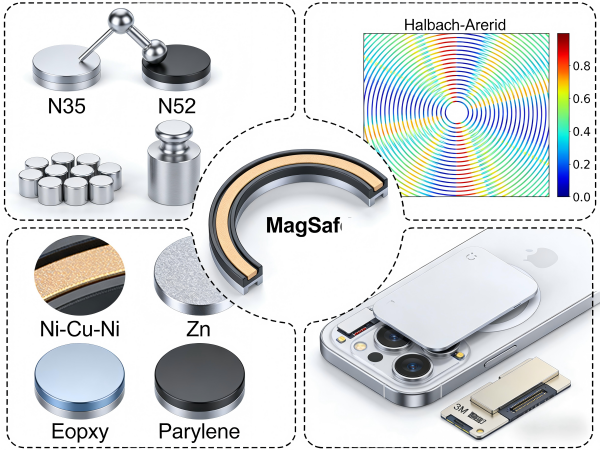
The term Custom MagSafe Magnets covers many engineering options. A true manufacturing partner will work with you to define the perfect specs for your needs.
Here’s what you can and should customize to create a better product.
Dimensions, Shape, and Tolerance
You’re not limited to the standard ring shape. You can specify custom thickness, diameter, and even segmented or arc-shaped magnets. These are essential for unique product designs that stand out.
Precision tolerance, often as tight as +/- 0.05mm, is critical for automated assembly lines. It ensures a perfect, seamless fit in the final product.
Magnetic Strength and Grade
This is one of the most important specs for your accessory’s performance. The “N” number, like N35, N48, or N52, shows the Maximum Energy Product of the magnet material.
A lower N-rating like N35 costs less. It works well for lightweight applications where maximum holding force isn’t the priority.
A higher N-rating like N52 provides maximum holding force. This is perfect for heavier accessories like car mounts, tripods, or stands where absolute security matters most. We can help you balance cost and performance to pick the best grade for your specific use.
Polarity and Magnetization Direction
The standard MagSafe array uses a specific circular Halbach array pattern. This smart arrangement focuses the magnetic field on one side. This prevents it from interfering with the phone’s sensitive parts like the compass or NFC.
For custom applications, factories can adjust this pattern for specific needs. This could mean creating unique keying for proprietary accessories or optimizing the magnetic field for different charging coil setups.
Understanding these arrays is important. We recommend checking the basics of Halbach arrays on Wikipedia to understand their role in magnetic focusing.
Protective Coatings and Finishes
Neodymium magnets are mostly iron. They corrode easily if left uncoated. The coating isn’t just for looks. It’s essential for ensuring long-term durability and performance.
The coating choice affects corrosion resistance, impact durability, and even final magnetic strength.
Comparison of Common Magnet Coatings
Coating Type | Key Benefits | Best For | Considerations |
Ni-Cu-Ni (Nickel-Copper-Nickel) | Industry standard, good cost-performance, excellent corrosion resistance. | Most consumer electronics, indoor use. | Can be brittle if the coating is too thin. |
Zn (Zinc) | Lower cost, provides sacrificial protection. | Cost-sensitive projects, dry environments. | Less durable and less attractive finish than Nickel. |
Epoxy (Black) | Excellent corrosion and impact resistance, good for bonding. | Harsh environments, applications requiring adhesion. | Thicker coating can slightly reduce magnetic force. |
Parylene | Medical-grade, ultra-thin, completely uniform coating. | Medical devices, high-end electronics. | Higher cost. |
Structural Integration and Assemblies
A true Custom MagSafe Magnets Accessories Factory often provides more than just the magnet itself. They can deliver a more complete solution.
We can pre-assemble the magnet array into a plastic housing, onto a metal plate, or with specific adhesive backing like 3M VHB. This makes your final assembly process simpler, reduces labor costs, and improves production efficiency.
You can explore our capabilities in creating fully custom magnet assemblies tailored to your product’s unique housing and requirements.
The Ultimate Factory Vetting Checklist
Finding a factory on a B2B platform is easy. Properly vetting them to avoid production disasters is hard.
Use this complete checklist, developed from years of direct experience in the magnetics industry. It will help you systematically evaluate any potential supplier. This tool will help you identify a partner, not just a vendor.
Factory Vetting Checklist
Evaluation Area | Key Criteria & Questions to Ask | What to Look For (Green Flags) | Red Flags |
1. Technical Capability & Expertise | Do they specialize in neodymium magnets? Can they explain polarity and N-ratings clearly? What design support do they offer? Ask them about Halbach array principles. | A dedicated engineering team. In-house simulation software (e.g., Ansys). Proactive suggestions for design improvement. Clear, knowledgeable answers. They should ask you detailed questions about your application. | Vague technical answers. Inability to discuss MagSafe specifics. Outsourcing all engineering. They only ask about price and quantity. |
2. Quality Control & Certifications | Are they ISO 9001 certified? What is their QC process from raw material to finished product? Can they provide material certificates (RoHS, REACH)? Ask for a sample QC report. | ISO 9001 certification. A multi-stage QC process (IQC, IPQC, FQC, OQC). They own and use testing equipment like Gauss meters, pull-force testers, salt spray chambers, and XRF spectrometers for material verification. | No ISO certification or it has expired. Vague QC descriptions (“we check everything”). Reluctance to share QC documents or reports. |
3. Production Capacity & Scalability | What is their monthly production capacity for magnet arrays? What is their standard lead time for samples and mass production? Have they handled orders of your expected volume before? | Clear data on capacity (e.g., “5 million arrays per month”). Case studies or references for large-volume clients. A scalable production line with clear evidence of automation. | Unrealistic lead times (too fast or too slow). No evidence of handling large orders. Over-reliance on a network of unknown subcontractors. |
4. Supply Chain & Experience | How long have they been in business and exporting? What are their primary markets? Can they handle logistics and customs documentation (e.g., DDP shipping)? | 10+ years of direct export experience. A diverse portfolio of international clients, especially in North America and Europe. Offers flexible shipping terms (Incoterms). | A new company with no verifiable export history. Only serves the domestic market. Inflexible shipping options (e.g., only EXW). |
5. Communication & Service | Is their sales and engineering staff fluent in English? How responsive are they to inquiries? Do you have a dedicated point of contact? | Prompt (within 24 hours), professional, and clear communication. A dedicated account manager or project manager. Willingness to schedule video calls for factory tours or technical discussions. | Slow response times. Significant language barriers causing misunderstandings. Frequent changes in your contact person. |
A strong quality management system is crucial. You can verify the principles of ISO 9001 and its importance at the International Organization for Standardization’s official website.
We pride ourselves on our rigorous quality assurance process. It’s certified to meet and exceed international standards for neodymium magnets for magsafe.
Prototype to Mass Production Guide
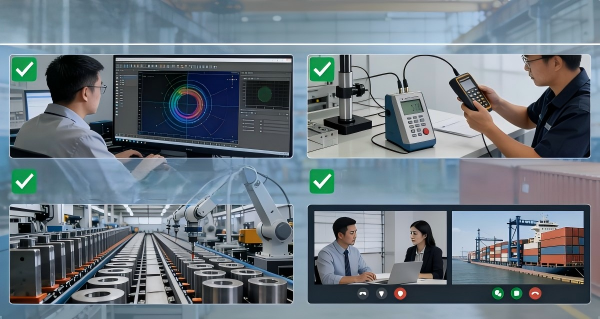
Working with a Custom MagSafe Magnets Accessories Factory involves a structured, multi-stage process. This workflow ensures the final product meets your exact requirements. It covers everything from form and fit to magnetic performance.
Here’s a typical step-by-step guide to navigate the journey from concept to market-ready product.
1. Initial Consultation & RFQ
This is where you start. You provide your initial design concept, performance requirements (like minimum holding force in grams), the intended application, and estimated annual volume.
The factory’s engineers review this information. They’ll likely ask clarifying questions to make sure they understand the project scope completely.
- Timeline: 1-3 business days.
- Pro Tip: Be as detailed as possible in your Request for Quotation (RFQ). The more information you provide—including 2D drawings, 3D CAD files, and target costs—the more accurate your quote will be.
2. Design for Manufacturing (DFM)
The factory’s engineers analyze your design for manufacturability, consistency, and cost-effectiveness. This is a critical value-add step.
They may suggest changes to improve magnetic performance, reduce material cost, or ensure higher consistency in mass production.
- Timeline: 2-5 business days.
- Pro Tip: Be open to DFM feedback. An experienced factory can often spot potential long-term reliability issues or cost-saving opportunities that you haven’t considered.
Understanding DFM is crucial. Autodesk provides excellent resources on Design for Manufacturing that can benefit any hardware developer.
3. Prototyping and Validation
Once the design is finalized, the factory produces a small batch of samples. These are often called prototypes or engineering samples.
You receive these samples to test in your actual product. This is where you validate the fit, function, alignment, and magnetic performance.
- Timeline: 7-15 business days, depending on complexity.
- Pro Tip: Test thoroughly. Check holding force with actual phone models, verify charging speed and heat, and test alignment precision. Provide clear, consolidated feedback for any requested revisions.
4. Tooling & Mass Production
After you approve the prototype, the factory begins creating any necessary tooling. This includes molds for plastic overmolding or fixtures for automated assembly.
The first articles from the production line are carefully checked against the approved prototype (the “golden sample”) before full-scale production begins.
- Timeline: 20-30 business days for tooling and first article inspection.
- Pro Tip: Always request and formally sign off on a “golden sample” from the first production run. This physical sample becomes the clear quality standard for all future orders.
5. Ongoing QA and Shipping
Throughout mass production, dedicated Quality Control teams perform in-process checks (IPQC) to ensure consistency.
Finished goods are inspected one last time (FQC or OQC) before being packaged securely. Then they’re shipped according to your logistics requirements.
- Timeline: Ongoing with production.
- Pro Tip: Establish an agreed-upon AQL (Acceptable Quality Limit) standard with your factory. This provides a clear, objective, and industry-standard measure for final inspection results.
For charging accessories, compliance is key. The Qi standard by the Wireless Power Consortium is essential. Making sure your magnet design doesn’t interfere with Qi performance is vital.
The Factory-Direct Advantage
For any OEM/ODM project, working directly with a Custom MagSafe Magnets Accessories Factory instead of a trading company or middleman offers significant strategic advantages.
This direct model streamlines your supply chain and reduces risk. It directly impacts your bottom line. It’s the preferred model for experienced hardware companies.
Key benefits of the factory-direct model include:
- Lower Costs: By eliminating the trader’s markup, you get the most competitive pricing possible. This directly impacts your product’s gross margin and market competitiveness.
- Better Communication: You communicate directly with the engineers and project managers who are actually making your product. This reduces misunderstandings, speeds up problem-solving, and accelerates development cycles.
- Greater Transparency & Control: You have full visibility into the production process, quality standards, and real-time timelines. Factory audits are more meaningful because you’re inspecting the source.
- Faster Lead Times: Removing an intermediary layer simplifies the entire process from quotation to shipping. This communication efficiency reduces overall project lead times.
- Enhanced Customization: Direct collaboration with the factory’s technical team allows for deeper and more effective customization of your Custom MagSafe Magnets. This helps achieve perfect performance for your product.
For businesses importing from China, understanding shipping terms is crucial for managing costs and risks. The International Chamber of Commerce provides a definitive guide to Incoterms.
Your Trusted MagSafe Partner
Choosing the right partner is the final and most important step in your sourcing journey. Based on the strict criteria outlined in this guide, we confidently recommend CNM Magnet as your go-to Custom MagSafe Magnets Accessories Factory.
We embody the qualities of a premier manufacturing partner. We’re built to serve the demanding needs of the consumer electronics industry.
- Specialized Focus on Magnetic Solutions: We are not a general-purpose factory. Our entire business is dedicated to magnetic materials and the engineering of custom magnet solutions. This ensures deep technical expertise in magnet array design.
- Proven OEM/ODM Customization: We have extensive experience helping global brands and innovative startups design and manufacture Custom MagSafe Magnets and assemblies. We work on a wide range of accessories, from wireless chargers to complex mounting systems.
- Stable, High-Volume Production & Export Experience: With years of export experience to North America, Europe, and Asia, we have a mature, scalable production process. Our logistics team can manage global shipments seamlessly. Our quality and lead times are stable and predictable.
- Perfect for Your Business Needs: Whether you’re a large brand requiring millions of units per year, a factory needing a reliable component supplier, or a wholesaler looking for a direct source for high-quality magnetic products, our model is built to support your procurement needs.
Don’t leave your product’s core user experience and your brand’s reputation to chance. Partner with a specialist who understands your challenges and has the proven capability to deliver.
Ready to start your project? Contact the CNM Magnet engineering team today to discuss your custom MagSafe magnet requirements and get a detailed quote.
We are a manufacturer specializing in the research and development of magnets with years of industry experience. Our product offerings include NdFeB magnets, ferrite magnets, and custom magnetic components. Our goal is to provide high-quality magnetic solutions to customers worldwide, and we also offer OEM/ODM customization services. If you have any questions about magnets or custom applications, please feel free to contact our team of experts.
Facebook
Twitter
LinkedIn
X