

A magnetic field is an invisible area around a magnet or electric current. In this space, magnetic forces act on other magnets or moving electric charges.
Picture the warmth you feel near a campfire without touching the flames. Or think about your Wi-Fi signal connecting devices without visible wires. You can’t see heat or wireless signals, but their effects are clear. Magnetic fields work the same way—they’re invisible forces that fill space around magnets.
Maybe you’ve searched for terms like “apa yang dimaksud dengan medan magnet” or “medan magnet adalah” to understand this basic physics concept. You’re in the right place. This guide breaks down magnetic fields into simple, easy-to-grasp parts.
We’ll explore what magnetic fields really are. We’ll look at their two main sources: permanent magnets and electricity. You’ll learn how to picture them and measure their strength. Most importantly, you’ll see how this invisible force powers everything from your phone’s compass to advanced medical equipment.
Learning about magnetic fields isn’t just academic. It’s about understanding a force that shapes our modern world.
As leaders with decades of experience in the research and manufacturing of magnetic solutions, we provide clear, accurate explanations. Our expertise comes from working with these principles daily to create components that drive innovation.
Table of Contents
The Fundamental Sources
Now we know what a magnetic field is. The next question is obvious: what creates it? Scientists have spent centuries finding the answer. It comes down to two main sources.
These two origins form the foundation of electromagnetism. One comes from matter’s basic structure. The other comes from energy flow.
Source 1: Permanent Magnets
Most people first encounter magnetism through permanent magnets. Think of the magnet holding notes on your refrigerator. Its magnetic field comes from deep within its atomic structure.
Materials like iron, cobalt, and nickel can become magnets because of their electrons’ “spin.” Each electron acts like a tiny spinning charge. This creates its own small magnetic field, called a magnetic dipole.
Picture each atom as a miniature compass needle. In ordinary, non-magnetized iron, these atomic “compass needles” point randomly. Their individual magnetic fields cancel each other out. The material produces no overall magnetic field.
But in a permanent magnet, these atomic dipoles line up. Millions of them point the same direction. Their combined strength creates one large, powerful magnetic field that extends into surrounding space.
This alignment defines what we call a permanent magnet. This unified microscopic structure creates the macroscopic force we can feel.
Creating this alignment often involves exposing the material to very strong external magnetic fields during manufacturing. This coaxes the atomic dipoles into uniform direction. Depending on the material, this alignment stays even after removing the external field.
Source 2: Moving Charges
The second source of magnetic fields was a revolutionary discovery. It connected two previously separate forces: electricity and magnetism.
In 1820, physicist Hans Christian Ørsted made a key observation. A compass needle moved when he switched electric current on or off nearby. This simple experiment proved something profound: moving electric charges, or electric currents, create magnetic fields.
This is the foundation of electromagnetism. Wherever electricity flows, it generates a magnetic field in the surrounding space. This happens with lightning strikes, household wires, or electrons flowing through your smartphone circuits.
There’s a simple way to find this magnetic field’s direction. It’s called the “Right-Hand Grip Rule.” Engineers and physicists use this fundamental tool.
- Imagine gripping the wire with your right hand.
- Point your thumb where conventional current flows (positive charge direction).
- Your fingers curl around the wire in the magnetic field lines’ direction.
This principle lets us create electromagnets—magnets we can turn on and off by controlling electricity. We coil wire and pass current through it to generate strong, controllable magnetic fields. This technology powers countless devices, from electric motors to MRI machines.
Visualizing the Invisible
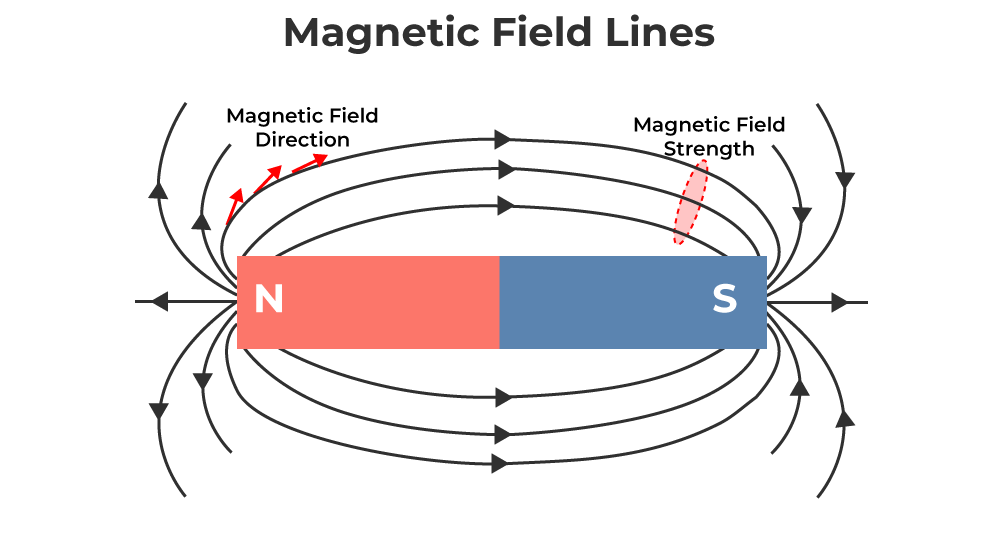
Magnetic fields are abstract concepts. You can’t see or touch them directly. Scientists developed a powerful visual tool to make them tangible: magnetic field lines.
This section moves from theory to practice. We’ll explore how these lines map the field. You’ll learn to perform a simple experiment to “see” them yourself. We’ll also learn how field strength is measured.
Blueprint of a Field
Magnetic field lines are imaginary lines drawn through magnetic fields. They map the field’s direction and strength. They’re conventions, not physical objects, but they follow strict, useful rules.
Understanding these properties helps you interpret magnetic field diagrams.
- Direction: Field lines always point away from the magnet’s North pole toward its South pole. Inside the magnet, they form continuous loops running from South to North.
- Density: Field strength appears in how close lines are together. Tightly packed lines, like near magnet poles, show very strong fields. Widely spaced lines show weak fields.
- Continuity: Magnetic field lines always form closed, continuous loops. They never start or stop at points in space. Crucially, they never cross each other. If they did, the field would point two directions at once, which is impossible.
These rules provide complete, intuitive language for describing any magnetic field’s shape and behavior. This works for simple bar magnets or complex electrical machines.
A Practical Experiment
Definitions help, but seeing is believing. You can easily visualize magnetic field shapes using common items. This classic experiment makes the invisible visible.
How to See a Magnetic Field Yourself
Materials:
- A bar magnet
- A thin, flat sheet of paper or clear plastic
- A small container of iron filings
Steps:
- Place the bar magnet on a flat, non-metallic surface like a wooden table.
- Carefully lay the paper or plastic directly over the magnet. Make sure it lies flat.
- From a few inches above, gently and evenly sprinkle iron filings onto the paper. Try to distribute them uniformly across the entire surface covering the magnet.
- Gently tap the paper’s edge with your finger. You’ll see an immediate, remarkable effect.
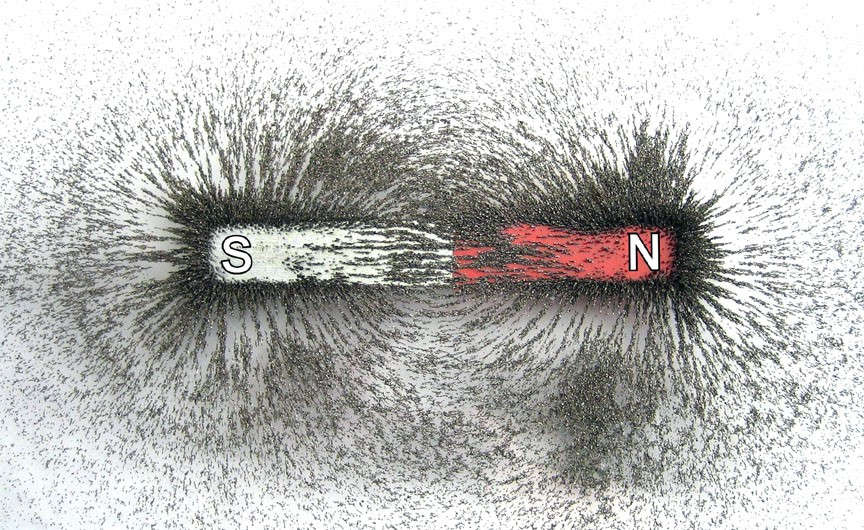
The tiny iron filings become temporary magnets in the field’s presence. They pivot and align along magnetic field lines. You’ll see them form a distinct pattern. They emerge densely from the two poles and loop around in broad arcs from North pole to South pole.
This simple demonstration provides direct, tangible proof of the field’s existence. It beautifully illustrates the concept of magnetic field lines.
Quantifying the Force
Visualizing field shape is one thing. Measuring its strength is another. Magnetic field intensity, also called magnetic flux density, is critical in science and engineering. It’s measured in specific units.
The primary SI (International System of Units) unit for magnetic field strength is the Tesla, abbreviated as T.
A Tesla measures significant magnetic force. For context, a small refrigerator magnet produces about 0.005 Tesla. A powerful medical MRI machine can generate 1.5 to 3.0 Tesla or more.
You’ll also see an older, non-SI unit called the Gauss, abbreviated as G. It’s still widely used, especially in industry and for measuring weaker fields.
The conversion is straightforward: 1 Tesla = 10,000 Gauss.
This means the refrigerator magnet’s field is 50 Gauss. The MRI machine’s field is 15,000 to 30,000 Gauss. Understanding these numbers helps contextualize the vast range of magnetic field strengths we encounter and use.
Source | Approximate Field Strength (Tesla) | Approximate Field Strength (Gauss) |
Refrigerator Magnet | 0.005 T | 50 G |
Earth’s Magnetic Field | 0.00005 T | 0.5 G |
Neodymium Magnet | 1.25 T | 12,500 G |
MRI Scanner | 1.5 – 3.0 T | 15,000 – 30,000 G |
Magnetic Fields in Action
Magnetic field principles aren’t confined to physics textbooks. They drive countless technologies that define modern life. Understanding theory is important, but seeing applications answers the crucial question: “Why does this matter?”
From simple home magnets to complex industrial machinery and advanced medical science, the medan magnet influences everything.
In Your Home and Pocket
You interact with magnetic fields dozens of times daily, often without realizing it.
In your kitchen, refrigerator magnets hold notes using permanent magnet fields. The refrigerator door itself often uses magnetic strips to create tight seals, keeping cold air inside.
When you listen to music through speakers or headphones, you’re using magnetism. An electromagnet (voice coil) attached to a cone sits near a permanent magnet. As electrical audio signals change, the electromagnet rapidly pushes and pulls. This vibrates the cone to create sound waves you hear.
The dark stripe on credit or debit card backs is a magnetic strip. It contains millions of tiny iron-based magnetic particles. Information gets encoded by magnetizing these particles in specific North-South patterns. Card readers interpret these patterns.
Even your smartphone relies on magnetism. It contains a tiny magnetometer that acts as a compass. It detects Earth’s magnetic field to determine your orientation for navigation apps.
Powering Our World
On larger scales, magnetic fields anchor our industrial and technological infrastructure.
Electric motors and generators are perhaps the most significant applications. They operate on interacting magnetic field principles. In motors, electric current creates magnetic fields that interact with permanent magnet fields. This produces rotational force that drives everything from fans to electric vehicles. Generators do the reverse. They use mechanical motion to move conductors through magnetic fields. This induces electric current and generates power.
Data storage has long relied on magnetism. Traditional hard disk drives (HDDs) use rapidly spinning platters coated with magnetic material. Read/write heads hover just above the surface. They use tiny electromagnets to alter magnetic orientation of microscopic regions. This stores data as 1s and 0s.
In heavy industry, massive electromagnets work as powerful lifting cranes in scrapyards and steel mills. Passing huge electric current through large coils generates magnetic fields strong enough to lift entire cars. The best part? The field can be switched off, instantly releasing the load.
These powerful applications, from motors to advanced sensors, are key focuses in magnet technology. You can explore some of these magnet applications in more detail.
At the Forefront of Science
The most advanced scientific and medical instruments harness magnetic fields in extraordinary ways.
Magnetic Resonance Imaging (MRI) is a revolutionary medical diagnostic tool. It uses very large, powerful superconducting magnets to create strong, uniform magnetic fields. This field aligns protons within body water molecules. Radio waves then momentarily knock these protons out of alignment. As they realign, they emit signals. Computers translate these into incredibly detailed cross-sectional images of soft tissues, organs, and the brain.
In fundamental physics, particle accelerators like the Large Hadron Collider at CERN depend on thousands of powerful superconducting magnets. These magnets generate immense fields to steer and focus proton beams traveling at nearly light speed. They guide them along a 27-kilometer ring before smashing them together to study the universe’s basic building blocks.
Creating precise fields for machines like MRI scanners and particle accelerators is a major engineering challenge. It often requires custom-designed magnets engineered for specific tasks with extreme precision and stability.
A Spectrum of Magnetism
It’s a common misconception to think of materials as simply “magnetic” or “non-magnetic.” Reality is more nuanced and fascinating. All materials respond to magnetic fields, but they do so in different, distinct ways.
Understanding this spectrum of magnetic behavior elevates your knowledge beyond basics. It provides insight into why engineers choose specific materials for specific applications. This classification is based on how atoms within materials react when external magnetic fields are applied.
Ferromagnetism: Strongly Attracted
This is the magnetism type most people know. Ferromagnetic materials like iron, nickel, cobalt, and their alloys are strongly attracted to magnets.
As discussed earlier, these materials contain atomic dipoles that can align to form strong, permanent magnets. They can also significantly concentrate magnetic field lines. This makes them ideal for electromagnet cores to amplify field strength.
Paramagnetism: Weakly Attracted
Paramagnetic materials like aluminum, platinum, and oxygen are also attracted to magnetic fields. But the effect is millions of times weaker than in ferromagnetic materials.
In these materials, atoms have small magnetic moments, but they’re randomly oriented. When external magnetic fields are applied, atoms partially align with the field. This creates weak attraction. However, this alignment disappears as soon as the external field is removed. You couldn’t pick up aluminum with a household magnet.
Diamagnetism: Weakly Repelled
Perhaps the most surprising category is diamagnetism. Diamagnetic materials like water, wood, copper, and most organic compounds are actually weakly repelled by magnetic fields.
This property exists in all matter, but it’s so weak that ferromagnetic or paramagnetic effects usually overpower it completely. In diamagnetic materials, applied magnetic fields induce very weak magnetic fields within atoms that oppose the external field. This results in slight repulsion. This effect is famously demonstrated by levitating small frogs in extremely powerful research magnet fields.
Modern High-Performance Magnets
This scientific classification directly relates to modern technology. The quest for smaller, more powerful, more efficient devices has driven advanced magnetic material development.
Today’s most powerful permanent magnets belong to ferromagnetic materials called rare-earth magnets. These are alloys made from rare-earth elements on the periodic table.
The most powerful permanent magnets today are made from rare-earth alloys. Neodymium magnets are the most common and powerful type. Their incredible field strength for their size has enabled device miniaturization. This ranges from tiny motors that vibrate your phone to high-performance electric motors in drones and electric cars.
Conclusion
We began with a simple question: what is a magnetic field? We’ve journeyed from basic definition to atomic origins of this force. From simple visualization experiments to its role in cutting-edge technology.
The invisible influence of the medan magnet is now, hopefully, more visible and understandable.
Let’s recap the most important takeaways:
- A magnetic field (medan magnet) is a force field created by moving electric charges and aligned magnetic dipoles within certain materials.
- It can be visualized with **magnetic field lines**, which map its direction and strength. It’s quantitatively measured in units of Tesla or **Gauss**.
- Its two fundamental sources are **permanent magnets**, where atomic dipoles are aligned, and **electric currents**, which is the principle of electromagnetism.
- Its applications are essential and widespread. They power our world in everything from simple electric motors and data storage to advanced medical imaging (MRI) and scientific research.
From compasses that have guided explorers for centuries to data stored in clouds and accessed in seconds, magnetic fields have invisible but vital influence. They’re a constant, elegant, essential part of our technological civilization.
Kami adalah produsen yang berspesialisasi dalam penelitian dan pengembangan magnet dengan pengalaman industri bertahun-tahun. Produk yang kami tawarkan meliputi magnet NdFeB, magnet ferit, dan komponen magnet khusus. Tujuan kami adalah menyediakan solusi magnet berkualitas tinggi kepada pelanggan di seluruh dunia, dan kami juga menawarkan layanan kustomisasi OEM/ODM. Jika Anda memiliki pertanyaan tentang magnet atau aplikasi khusus, jangan ragu untuk menghubungi tim ahli kami.
Facebook
Twitter
LinkedIn
WhatsApp