
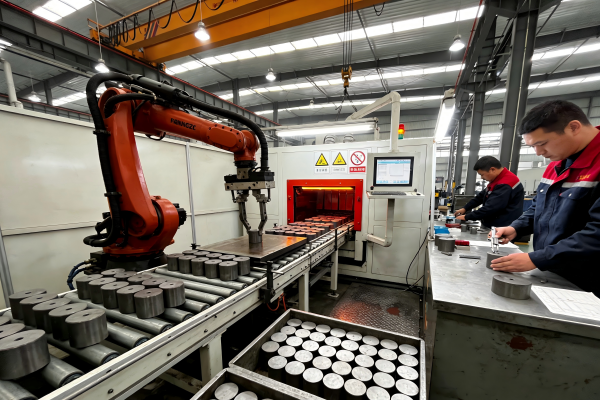
Modern permanent magnets are far from simple iron pieces. When you ask what are magnets made of, the answer lies in sophisticated material science. These are advanced alloys, carefully designed to achieve specific performance goals.
The main building blocks are ferromagnetic elements. These include iron, cobalt, and nickel. They’re almost always mixed with other elements. Most notably, rare earth elements like neodymium and samarium create the powerful permanent magnets we see everywhere. From electric vehicles to consumer electronics, these materials are essential.
This guide will break down each major magnet material. We’ll explain how composition affects performance. You’ll learn to select the right magnet for any application. Here are the main types we’ll cover:
Table of Contents
The Science of Magnetism
To understand what are magnets made of, we need to know why certain materials become magnetic. This property is called ferromagnetism.
Picture the atoms inside a material as tiny internal compasses. These are magnetic domains. In an unmagnetized piece of ferromagnetic material like iron, these domains point in random directions. Their magnetic forces cancel each other out. This creates no net magnetic field.
The magnet manufacturing process changes this. The material faces an extremely powerful external magnetic field. This energy forces all the randomly oriented magnetic domains to align in the same direction.
Once the external field is removed, high-quality permanent magnet material locks these domains in place. This collective alignment creates the powerful, persistent external magnetic field we know. The ability of domains to stay aligned is called coercivity.
Three primary elements show ferromagnetic behavior at room temperature: Iron (Fe), Nickel (Ni), and Cobalt (Co). Creating powerful permanent magnets means alloying these elements with others. This enhances properties like strength and resistance to demagnetization. The specific arrangement of electrons and their spin in these atoms creates magnetism. For a detailed academic explanation, the principles of ferromagnetism are well-documented by scientific institutions.
A Deep Dive into Magnet Types
The specific blend of elements used to create a magnet defines its capabilities. Four families of permanent magnets dominate industrial, commercial, and consumer applications. Each has unique composition, performance trade-offs, and cost structure. Understanding these differences is crucial for any project. Whether it’s a simple refrigerator magnet or a high-performance electric motor, the right choice matters.
Neodymium (NdFeB) Magnets
Neodymium magnets are the most widely used rare earth magnets. They’re also the strongest permanent magnets available commercially today.
Their composition is an alloy primarily of Neodymium, Iron, and Boron. The chemical formula is Nd₂Fe₁₄B. This specific crystalline structure creates their immense magnetic strength.
They have an unmatched strength-to-size ratio. This allows powerful magnetic force in very compact designs. However, standard NdFeB magnets have relatively low maximum operating temperatures. Typically between 80°C and 200°C depending on the grade. They’re also highly susceptible to corrosion and will rust quickly in humidity. To combat this, they almost always come with protective coating. Most commonly a triple layer of Nickel-Copper-Nickel (Ni-Cu-Ni).
Their high strength makes them essential in modern technology. Applications include high-performance motors in electric vehicles and drones. Voice coil motors in hard disk drives. Audio equipment like headphones and speakers. Magnetic clasps for jewelry and accessories. Countless consumer electronics. For applications demanding the highest magnetic force in compact size, our range of neodymium magnets offers unparalleled performance.
Samarium Cobalt (SmCo) Magnets
Samarium Cobalt was the first commercially viable family of rare-earth magnets. It was developed before Neodymium magnets. They’re the second-strongest type of permanent magnet.
SmCo magnets are made from an alloy of Samarium and Cobalt. They come in two main “series” or generations. SmCo₅ (Series 1:5) and Sm₂Co₁₇ (Series 2:17). The second series also includes other elements like iron, copper, and zirconium to fine-tune performance.
While not as strong as NdFeB magnets, their defining characteristic is exceptional high-temperature performance. SmCo magnets can operate reliably at temperatures up to 350°C (662°F). This far exceeds the limits of most neodymium grades. They also offer superior corrosion resistance and don’t typically require protective coating. This makes them ideal for harsh environments.
The trade-offs for this high-temperature performance are higher cost and increased brittleness. SmCo magnets are more prone to chipping and cracking than other magnet types. Their specialized properties make them essential in demanding fields. Military and aerospace for missile guidance systems and aircraft components. High-temperature motors and sensors. Turbomachinery.
Ferrite (Ceramic) Magnets
Ferrite magnets, also known as ceramic magnets, are the most common and cost-effective permanent magnets worldwide by volume.
They’re made from a composite of strontium carbonate (SrCO₃) and iron oxide (Fe₂O₃). The raw materials are mixed and calcined to form the ferrite compound. Then milled into fine powder. Finally sintered in a process similar to making ceramic pottery, hence the name.
Ferrite magnets offer moderate magnetic strength. Their key advantages are extremely low cost, excellent corrosion resistance, and good resistance to demagnetization from external fields. They also have reasonably high operating temperature, making them very versatile. Physically, they’re hard and brittle. They appear as dark gray, charcoal-like material.
Their low cost and reliable performance make them the workhorses of the magnet world. You can find them everywhere. Classic refrigerator magnets. Small DC electric motors. Speakers. Magnetic sweepers. A vast array of high-volume industrial holding applications where cost is the primary design driver.
Alnico Magnets
Alnico magnets are the classic performers. They represent one of the earliest families of strong permanent magnets developed in the 1930s.
The name “Alnico” is an acronym from its primary constituent elements. An alloy of Aluminum (Al), Nickel (Ni), and Cobalt (Co), combined with iron and often trace amounts of copper and titanium.
Alnico’s standout feature is phenomenal temperature stability. It can operate in extreme heat. Some grades function up to 500°C (930°F). They have good corrosion resistance and retain their magnetism very well over time. However, their magnetic strength (BHmax) is lower than rare-earth magnets. They have low coercivity. This means they can be more easily demagnetized by external magnetic fields compared to ferrite or rare-earth materials.
Their unique combination of high-temperature performance and high magnetic remanence at moderate price keeps them relevant in specific applications. They’re widely used in sensors like Hall effect sensors. Electric guitar pickups (where their magnetic properties contribute to classic “vintage” tone). Traveling-wave tubes. Specialized industrial equipment for high-temperature holding and sensing. For detailed technical data, material property databases like MatWeb offer specific grade information for Alnico alloys.
Magnet Material Comparison
To help you quickly compare these options, here’s a summary of their key attributes.
Magnet Type | Typical Composition | Key Strengths | Key Weaknesses | Common Uses |
Neodymium (NdFeB) | Neodymium, Iron, Boron | Highest strength-to-size ratio | Poor corrosion & temp resistance | Motors, electronics, audio, closures |
Samarium Cobalt (SmCo) | Samarium, Cobalt | High temp & corrosion resistance | High cost, brittle | Aerospace, military, high-temp motors |
Ferrite (Ceramic) | Iron Oxide, Strontium Carbonate | Very low cost, high corrosion resistance | Moderate strength, brittle | Refrigerator magnets, DC motors, speakers |
Alnico | Aluminum, Nickel, Cobalt, Iron | Excellent temperature stability | Lower strength, easily demagnetized | Sensors, guitar pickups, high-temp tools |
From Powder to Power

Understanding what are magnets made of also involves knowing how they’re created. The manufacturing process is as critical as raw materials in determining final magnet properties. It’s a complex industrial process that turns raw metal alloys into powerful magnetic components.
The two primary manufacturing methods are sintering and bonding.
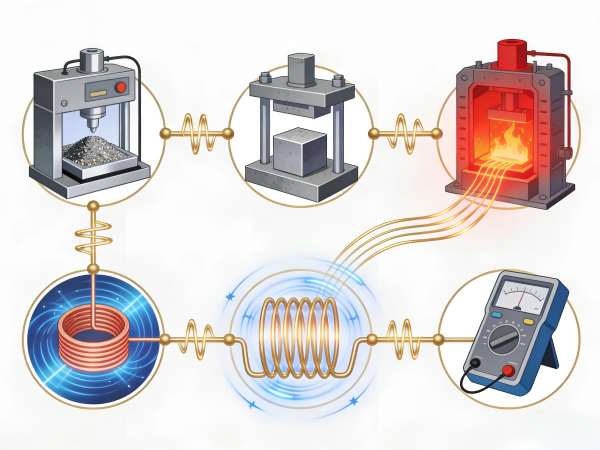
Sintering is the most common method for producing high-performance magnets like Neodymium, Samarium Cobalt, Ferrite, and Alnico. It creates magnets with the highest possible magnetic density and strength. The process generally follows these steps:
- Raw elements are melted together in a vacuum induction furnace to form an alloy.
- The alloy ingot is crushed and milled into very fine powder. Each particle is a tiny single crystal.
- This powder is loaded into a die and pressed into the desired shape. Critically, a strong magnetic field is applied during pressing to align powder particles along the desired axis of magnetization.
- The pressed part, which is still fragile, is then sintered. This involves heating it in a vacuum furnace to a temperature just below the alloy’s melting point. This fuses particles together into a solid, dense block.
- The sintered block is often rough and slightly oversized. It’s then machined to precise final dimensions. This requires diamond-coated grinding tools due to the material’s hardness and brittleness.
- If necessary, protective coating is applied (essential for Neodymium magnets).
- Finally, the finished, coated part is placed inside a large solenoid coil. A massive pulse of electricity is sent through the coil. This creates an intense magnetic field that fully magnetizes the part, turning it into a permanent magnet.
Bonded magnets are made by mixing magnet powder (Neodymium, Ferrite, etc.) with a polymer binder, such as epoxy or nylon. This mixture can then be injection molded or compression molded into complex and intricate shapes with very tight tolerances. This often eliminates the need for secondary machining.
This process offers greater design flexibility, but comes at a cost. The binder material takes up space and isn’t magnetic. So bonded magnets have lower magnetic strength (energy product) than their fully dense sintered counterparts.
From our experience in custom magnet solutions, the choice between sintered and bonded magnets is a critical design trade-off. Sintered magnets offer maximum power, but their brittleness requires careful handling during assembly. Bonded magnets provide excellent design freedom for intricate parts, like those in modern sensors, even with reduced magnetic force. This manufacturing flexibility is central to our custom magnet fabrication services. For a visual guide to these industrial processes, manufacturing associations often provide resources, such as this overview of magnet manufacturing.
A Practical Selection Guide
Translating the technical details of what are magnets made of into a practical decision is the most important step for any engineer, designer, or buyer. Choosing the wrong material can lead to project failure. Whether through demagnetization, corrosion, or unnecessary cost.
This guide will help you ask the right questions to determine the best magnet material for your specific needs.
Factor 1: Temperature
The first and often most critical question is: what’s the maximum temperature your magnet will face during operation and storage? Every magnet material has a maximum operating temperature and a Curie temperature. Above this, it permanently loses magnetism.
- For low to moderate temperatures below 80°C (176°F), standard grade Neodymium (NdFeB) magnets provide the most strength for the cost.
- For high temperatures between 80°C and 200°C (176°F – 392°F), high-temperature grades of Neodymium (like SH, UH, EH grades) are required. These contain more dysprosium or terbium, which increases cost.
- For very high temperatures from 250°C to 350°C (482°F – 662°F), Samarium Cobalt (SmCo) is the ideal choice. It maintains strength and stability where Neodymium would fail.
- For extreme temperatures above 350°C (662°F), Alnico is the best and often only viable performer. It’s capable of functioning up to 500°C (930°F).
Factor 2: Strength Requirement
Next, consider the magnetic force you need. This is often expressed as pull force, flux density at a certain distance, or the energy product (BHmax).
- If you need maximum possible magnetic strength in the smallest possible space, Neodymium magnets are the only practical choice. Their high energy product is unmatched.
- If you need high strength combined with high-temperature resistance, Samarium Cobalt is the clear winner. It offers about two-thirds the strength of Neodymium but with far superior thermal stability.
- If moderate strength is sufficient and cost is a major consideration, Ferrite magnets are the workhorse. They provide reliable performance for a fraction of the cost of rare-earth magnets.
- Alnico offers moderate strength, less than Ferrite, but is chosen for its exceptional temperature stability, not its raw power.
Factor 3: Environment
Consider the environment where the magnet will operate. Will it be exposed to moisture, humidity, saltwater, solvents, or other corrosive agents?
- In a completely dry, climate-controlled environment, a standard coated Neodymium magnet is perfectly suitable.
- For applications involving humidity, outdoor use, or potential moisture exposure, Ferrite and Samarium Cobalt are excellent choices. Their inherent material composition makes them highly resistant to corrosion without needing coating.
- An uncoated Neodymium magnet will begin to rust and degrade very quickly in humid air. The choice of coating (e.g., Ni-Cu-Ni, Zinc, Epoxy, PTFE) is critical for NdFeB magnets in any non-pristine environment.
- Alnico magnets also offer very good corrosion resistance, suitable for most industrial environments.
Factor 4: Cost and Volume
Finally, your budget and production scale are critical factors. The cost of raw materials for magnets can fluctuate significantly. Especially for rare-earth elements like neodymium and samarium.
A key insight for B2B buyers is to analyze cost versus performance. While a Neodymium magnet may have higher unit cost than a Ferrite magnet, its immense strength means you can often use a much smaller magnet to achieve the same holding force. This can lead to savings in overall system size, weight, and even total cost. Especially in applications like high-performance motors or miniature electronics.
- For the absolute lowest unit cost, especially in high-volume production, Ferrite magnets are unbeatable. They’re the go-to choice for cost-driven applications.
- Neodymium magnets offer the best “performance per dollar” when maximum strength is the goal.
- Samarium Cobalt and Alnico are premium materials. Their higher cost is justified only in applications where their specific high-temperature performance is non-negotiable and no other material will suffice.
The trade-offs between these factors are complex. A deep dive into material selection for specific applications, like electric motor design, reveals how engineers balance these priorities.
Debunking 3 Common Myths
The complex science of what are magnets made of has led to several common misconceptions. Clarifying these helps prevent costly design and purchasing mistakes.
Myth 1: Strong means rare-earth.
Fact: While Neodymium and Samarium Cobalt are the strongest types of magnets and are made from rare-earth elements, this doesn’t mean other magnets are weak. Alnico magnets can be very powerful and offer superior temperature stability without using rare-earth materials. The term “strong” is relative to the application’s needs. A Ferrite magnet is more than “strong enough” for a DC motor. Using a Neodymium magnet would be expensive over-design.
Myth 2: Magnets are just iron.
Fact: As this guide has shown, this is a significant oversimplification. While iron is a key ferromagnetic ingredient in the most common magnet families (Neodymium and Ferrite), it’s the specific, highly-engineered alloy and crystal structure created with other elements that gives modern permanent magnets their unique properties. Elements like Neodymium, Boron, Samarium, Cobalt, and Strontium are crucial. Pure, soft iron is actually a poor permanent magnet. It magnetizes easily but also loses its magnetism just as easily.
Myth 3: Strength is all that matters.
Fact: This is one of the most common and costly purchasing mistakes. As our selection guide demonstrates, a magnet’s performance is a balance of multiple factors. Choosing a magnet based solely on its pull force rating without considering operating temperature, environment, or budget can lead to failure. A powerful Neodymium magnet will quickly fail in a high-temperature application where a “weaker” but more stable Samarium Cobalt magnet would thrive. More information on general science myths can be found on educational sites like HowStuffWorks.
The Material Defines the Purpose
Understanding what are magnets made of is the first and most critical step in engineering a successful application. The key takeaway is that it’s not about finding the “best” or “strongest” magnet. It’s about selecting the right material for the job at hand.
The choice of alloy—whether it’s a blend of Neodymium, Iron, and Boron or a ceramic composite of Iron Oxide and Strontium Carbonate—dictates a magnet’s strength, its resistance to heat and corrosion, and its final cost. Each material represents a unique set of trade-offs. This makes one ideal for a high-performance EV motor and another perfect for a simple, low-cost holding application.
Making the right material choice requires expertise and a reliable supply chain. For brands seeking a partner that provides both high-quality magnet solutions and the engineering knowledge to ensure project success, we are an ideal choice. We offer high-efficiency collaboration and a vast inventory of magnet materials.
To discuss your project’s specific needs or explore our extensive range of permanent magnets, visit us at https://cnmmagnet.com/.
We are a manufacturer specializing in the research and development of magnets with years of industry experience. Our product offerings include NdFeB magnets, ferrite magnets, and custom magnetic components. Our goal is to provide high-quality magnetic solutions to customers worldwide, and we also offer OEM/ODM customization services. If you have any questions about magnets or custom applications, please feel free to contact our team of experts.
Facebook
Twitter
LinkedIn
X