
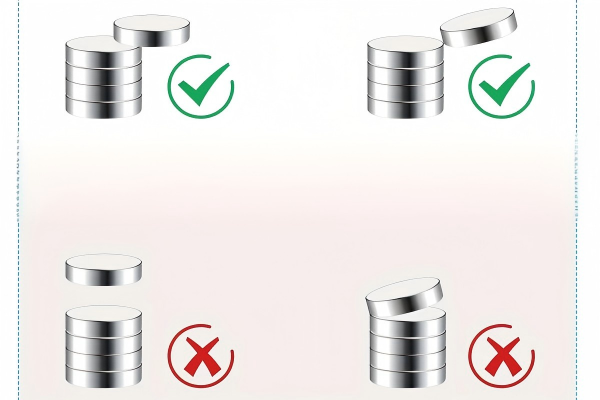
The best way to separate magnets safely and effectively is simple: slide them apart. Don’t pull. For extremely strong magnets, you’ll need a non-magnetic lever or a special separator tool.
This method uses shear force. It’s much less than the magnet’s direct pull force.
This guide gives you proven, step-by-step techniques. Whether you’re a DIY enthusiast with small components or an engineer managing industrial assemblies, you’ll learn to separate strong magnets without injury or damage.
In this guide, you will learn:
- Step-by-step instructions for the safest separation methods.
- A clear safety protocol to prevent pinching, shattering, and other hazards.
- How to choose the right technique based on your magnet’s size, shape, and strength.
- The science behind why magnets are so difficult to separate.
Table of Contents
The Physics of Attraction
Why Separation Is Difficult
Understanding the forces at play is your first step. It’s not about brute strength—it’s about physics. When you know why magnets stick so powerfully, you can work smarter to separate them.
Pulling vs. Shearing
A magnet’s listed holding force is measured in pounds or kilograms. This represents the force needed to pull it straight off a flat steel plate. We call this tensile force.
The force required to slide that same magnet across the steel surface is much lower. This is shear force. It’s the fundamental principle we use for safe separation.
Think of it this way: sliding a heavy filing cabinet across the floor is far easier than lifting it straight up. The same concept applies to separating magnets. Trying to overcome the full pull force directly is inefficient and dangerous.
Surface Area and Grade
Two other factors determine separation difficulty: contact surface area and magnet grade. The larger the surface area where two magnets touch, the stronger the bond. They become harder to unstick.
Neodymium magnets are rare earth magnets rated by grade. Examples include N42 or N52. The “N” stands for Neodymium. The number represents the Maximum Energy Product in MegaGauss Oersteds (MGOe).
In practical terms, an N52 magnet is roughly 20% more powerful than an N42 magnet of the same size and shape. This higher grade creates a much stronger magnetic field and significantly more force. It makes neodymium magnet separation more challenging. For a deeper dive into magnetic field principles, the HyperPhysics resource from Georgia State University is an excellent reference.
The Golden Rule
A Non-Negotiable Protocol
Before you touch stuck magnets, you must follow strict safety rules. This isn’t optional. Powerful magnets, especially Neodymium (NdFeB) types, aren’t toys. They can cause serious injury if mishandled.
Their immense force operates over distance and without warning. Following these rules is the most important part of industrial magnet handling and general magnet safety.
Your Safety Checklist
Wear Protective Gear:
- Safety Goggles: This is mandatory. Powerful magnets can snap together or hit hard surfaces and shatter. This sends sharp, fast-moving splinters flying. Your eyes are at severe risk. We’ve seen cases where users not wearing goggles suffered permanent eye injuries from small magnet chips. This risk is real.
- Heavy-Duty Gloves: Leather or similar durable material protects your skin from pinching. They won’t stop magnetic force, but they provide a crucial split-second barrier. This allows you to pull your hand away before serious crush injury occurs.
Clear the Workspace:
- Create a clean, clear area free of ferrous metals. Remove all magnetic-sensitive items from your immediate vicinity. This step is critical.
- Keep credit cards, smartphones, and computer hard drives far away. Strong magnetic fields can permanently erase their data.
- People with pacemakers or other internal medical devices must maintain significant distance. Consult your doctor and device manufacturer for specific safe distances.
- Remove all metal tools, watches, keys, and steel-toed boots from the area. This prevents them from being pulled toward the magnets unexpectedly.
Understand the Material:
- Neodymium magnets are sintered. This process makes them incredibly strong magnetically but also hard and brittle, like ceramic.
- They won’t bend. They will chip, crack, or shatter under sudden impact. Never allow them to snap together.
Position Your Body Safely:
- Never use your full body weight to brace one magnet while pulling another. Don’t place a leg or your chest against a magnet as leverage.
- If the magnets separate suddenly, the resulting motion can cause you to lose balance or lead to severe impact injury.
For more information on magnet-related hazards, the U.S. Consumer Product Safety Commission (CPSC) provides valuable consumer safety alerts.
Core Separation Methods
A Step-by-Step Guide
Here are three primary methods for separating magnets. Your technique choice depends on the magnet’s size and strength, plus available tools. Start with the simplest method. Escalate only if necessary.
Method 1: The Sliding Technique
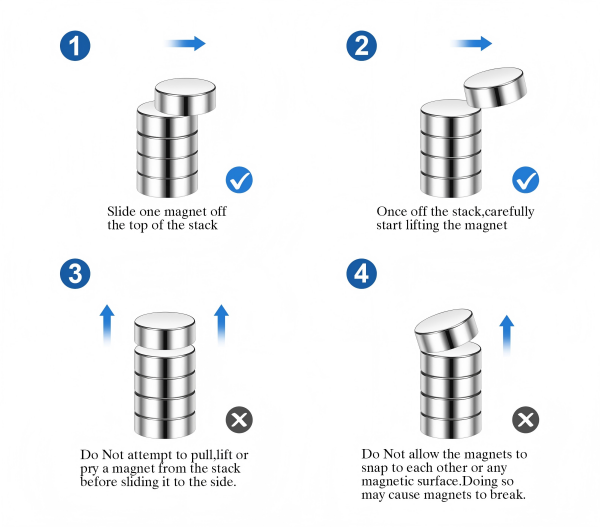
This is the default method for what to do when magnets get stuck. It uses shear force and should always be your first attempt.
- Best for: Small to medium-sized disc or block magnets.
- Tools: Your hands (with gloves), a non-magnetic surface.
Steps:
- Place the stacked magnets on a sturdy, non-magnetic surface. A wooden workbench or heavy-duty plastic table is ideal. Don’t use a metal table.
- Firmly grip the magnet stack with your non-dominant hand. Hold it steady against the surface.
- With your dominant hand, place your palm or thumb on the side of the top magnet.
- Push the top magnet horizontally, directly away from you and perpendicular to the magnetic axis. Don’t try to lift it. Focus all effort on sideways sliding motion.
- A slight twisting or wiggling motion while you push can help “break the seal.” This makes it easier to start the slide.
- Continue pushing until the magnet begins to overhang the edge of the one below it. The force will decrease significantly as contact surface area reduces.
- Once it’s mostly off, you can push it down and away from the stack to fully break the magnetic connection.
- Immediately move the separated magnet to a safe distance (several feet). This prevents it from snapping back into place.
Method 2: The Table Edge Technique
When hand strength alone isn’t enough to start a slide, use a hard edge as a lever. This method is highly effective but requires a very stable surface.
- Best for: Medium to large magnets too strong to separate by hand using the sliding method.
- Tools: A very sturdy, non-magnetic table or workbench edge (e.g., thick wood).
Steps:
- Carefully move the magnet stack to your sturdy workbench edge.
- Position the stack so the top magnet is fully on the table surface. The magnet directly beneath should hang over the edge.
- Use one hand (and potentially your body weight, carefully) to press down firmly on the top magnet. Secure it to the table. Ensure it cannot move.
- With your other hand, grip the overhanging magnet. Apply firm, steady, controlled downward pressure.
- The table edge acts as a fulcrum. The magnet will begin to peel away from the one above it.
- Be prepared for sudden force release. As the magnet separates, it will want to snap back to the top or side of the other magnet. Control its movement and immediately move it to a safe distance.
- For professionals in industrial settings, this repetitive task can be simplified. Using the right custom magnet assemblies in your product design can incorporate features that make installation and removal much safer and more efficient.
Method 3: A Specialized Separator
For the largest and most powerful magnets, manual separation isn’t just difficult—it’s extremely dangerous. In these situations, you need a specialized tool.
- Best for: Industrial settings, warehouses, and engineering labs dealing with very large, high-grade (e.g., N52) rare earth magnets.
- Tools: A purpose-built magnet separator or jig.
Explanation:
A magnet separator, often called a jig, is a mechanical device designed specifically for this task. These are typically custom-built for specific magnet sizes and shapes.
They usually consist of a non-magnetic frame (often aluminum or stainless steel) that holds the magnet stack securely. A crank handle or lever connects to a threaded rod or cam system.
When the operator turns the crank, the device applies immense, controlled shear force. It smoothly slides the magnets apart without risk of sudden movement or operator injury. This is the gold standard for safety and efficiency in professional environments where separating strong magnets is regular work.
Watching a demonstration can be very helpful. Many engineering channels on platforms like YouTube show professional magnet separator jigs in action, illustrating their effectiveness for industrial magnet handling.
Choosing the Right Method
A Decision Framework
Not all magnets are created equal. The safest and most effective separation method depends on the magnet’s size, grade, and your working environment. Using the wrong technique can be ineffective at best and dangerous at worst.
Use this table as a quick reference guide. It helps you assess your situation and select the appropriate procedure. This answers the question of how to unstick magnets based on their specific properties.
Magnet Separation Table
Magnet Size / Strength | Primary User(s) | Recommended Method(s) | Key Considerations / Warnings |
Small (e.g., <1″ discs/blocks) | DIY, Hobbyist, General User | 1. Sliding Technique | Easiest and safest method. Still poses a pinch risk to fingers. Always wear gloves. |
Medium (e.g., 1″-3″ blocks) | Engineer, Technician, B2B User | 2. Table Edge Technique<br>1. Sliding Technique (if possible) | Requires a very sturdy, non-metallic surface. The release force can be surprising. Maintain control. |
Large/Industrial (e.g., >3″ blocks) | B2B (Warehouse), Engineer | 3. Specialized Separator<br>2. Table Edge Technique (with extreme caution and assistance) | DO NOT attempt to separate by hand. Risk of shattering and severe crush injury is high. Professional equipment is strongly advised. |
Awkward Shapes (e.g., spheres, rings) | All Users | 1. Sliding/Rolling<br>Wedge/Shim (use a non-magnetic wedge like wood or plastic) | Less surface area can make them easier to roll apart, but their movement can be unpredictable. A shim can help initiate a gap. |
Understanding your magnet’s specifications is key to using this table correctly. If you’re unsure of the grade or pull force, refer to documentation from your supplier. You can learn more about the different types of magnets to better identify what you’re working with and its likely strength.
For a more quantitative assessment, you can use a magnet pull force calculator. This estimates holding force based on a magnet’s grade, dimensions, and the type of material it’s attached to. Reputable magnet suppliers like K&J Magnetics offer useful online calculators for this purpose.
After the Separation
Safe Handling and Storage
Successfully separating strong magnets is only half the battle. Storing them correctly is crucial for long-term safety. It also prevents them from snapping back together, forcing you to repeat the process. Proper magnet storage is a key component of any safety protocol.
Once separated, a powerful magnet will aggressively seek out nearby ferromagnetic material. You must control its environment to prevent accidents and maintain the magnet’s integrity.
Best Practices for Storage
- Use Keepers or Spacers: Always store magnets with a non-magnetic spacer between them. This can be plastic, wood, or thick cardboard larger than the magnet itself. This air gap drastically reduces magnetic force, making the next separation much easier. For Alnico or horseshoe magnets, place a steel “keeper” bar across the poles to complete the magnetic circuit and preserve its strength.
- Maintain Significant Distance: Store individual, powerful magnets far apart from each other and from any ferrous metals. In warehouse settings, this might mean designating shelves in separate aisles.
- Use Designated Storage Bins: Place magnets in clearly labeled wooden or heavy-duty plastic boxes. The box should be marked with a prominent “WARNING: STRONG MAGNETS INSIDE” label. This alerts anyone handling the box to the potential hazard.
- Control the Landing: When you must bring magnets together or attach one to a steel surface, never let it “jump” from a distance. Hold it firmly. Approach from the side and allow it to slide into its final position. This controlled motion prevents impact damage and pinching.
Following established safety guidelines is paramount in professional settings. University physics and engineering departments often have excellent public resources. For example, lab safety manuals like those from MIT’s Plasma Science and Fusion Center provide a good model for professional handling and storage procedures.
Conclusion
Master Magnet Handling
Mastering how to separate magnets safely and effectively comes down to three core principles. First, prioritize safety with correct PPE and a clear workspace. Second, always use shear force by sliding instead of pulling. Third, choose your method based on the magnet’s power.
By following the detailed steps and safety protocols in this guide, you can confidently handle even the strongest rare earth magnets. This minimizes risk to yourself and your equipment.
For professionals in engineering, manufacturing, and research, the quality and consistency of magnetic components are fundamental to operational success. Sourcing from a supplier who not only delivers high-performance products but also understands the practical challenges of their application provides a significant competitive advantage.
For high-quality custom magnets, assemblies, and expert advice on your specific application, visit our team at CNM Magnet. We provide solutions built for performance and safety.
We are a manufacturer specializing in the research and development of magnets with years of industry experience. Our product offerings include NdFeB magnets, ferrite magnets, and custom magnetic components. Our goal is to provide high-quality magnetic solutions to customers worldwide, and we also offer OEM/ODM customization services. If you have any questions about magnets or custom applications, please feel free to contact our team of experts.
Facebook
Twitter
LinkedIn
X