
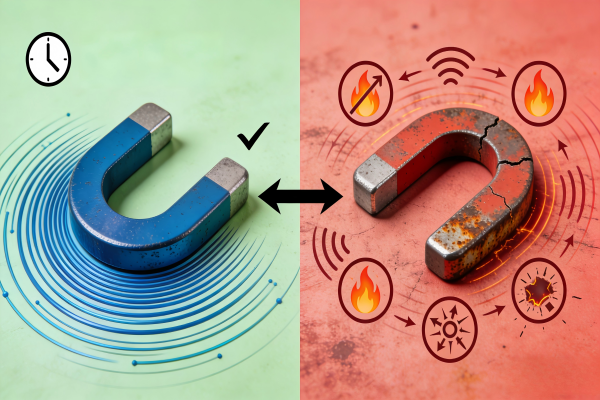
Here’s the straightforward answer: No, modern permanent magnets don’t significantly lose strength over time under normal conditions. This natural loss, called magnetic field decay, happens incredibly slowly. A quality neodymium magnet might lose less than 1% of its strength over ten years. That’s so small it’s essentially meaningless for most uses.
So why do so many engineers, buyers, and hobbyists keep asking: “do magnets lose strength over time?”
The confusion happens because magnets can lose their strength—sometimes quickly and dramatically. But time itself almost never causes this. Instead, permanent magnet degradation comes from specific outside factors that you can often avoid. A magnet’s power isn’t a battery that runs down. It’s a structural property that can be damaged.
This guide gives you comprehensive answers. We go beyond simple explanations to provide insights you can actually use.
For B2B Buyers & Project Managers: You’ll understand the real risks to magnet lifespan. This knowledge helps you make smarter purchases, plan replacement cycles accurately, and reduce long-term costs.
For Product Designers & R&D Engineers: You’ll learn how to prevent demagnetization in your designs. Whether you’re developing high-performance motors, sensitive sensors, or complex magnetic assemblies, these principles are critical for reliable products.
For Curious Enthusiasts: You’ll discover the fascinating science behind why magnet power can fade. Plus, you’ll learn how to properly care for your everyday magnets to keep them powerful for years.
We’ll explore the four main threats to magnetic strength. We’ll compare long-term stability and ferrite vs neodymium longevity. And we’ll provide a practical guide for choosing magnets for industrial use to ensure peak performance.
Table of Contents
Four Factors of Degradation
Time alone doesn’t harm magnets. But their environment can be hostile. These four factors are the real culprits behind permanent magnet degradation. Understanding them is your first step toward preventing performance loss and ensuring long magnet lifespan.
1. Thermal Energy
Heat is the most common and dangerous enemy of permanent magnets. Every magnet has two critical temperature limits: maximum operating temperature and Curie temperature. Both are essential specs for any application.
The maximum operating temperature is the highest heat a magnet can handle continuously without permanent strength loss. Go beyond this—even briefly—and you’ll lose some magnetic power forever.
The Curie temperature is an absolute threshold. At this point, the material completely loses its permanent magnetic properties. The thermal energy becomes so intense that magnetic domains—tiny regions that align to create the magnetic field—become completely random. You can learn more about this fundamental property at a resource like the HyperPhysics page on Curie Temperature.
Picture the aligned magnetic domains like soldiers in perfect formation. Heat makes them fidget and move. Moderate heat (below max operating temp) might let them return to formation when cooled. This is reversible loss.
But intense heat (above max operating temp) breaks the formation permanently. Some soldiers wander off for good. This is irreversible loss. At Curie temperature, the entire formation scatters into chaos. The magnetic field collapses completely. This damage is permanent and can’t be fixed without re-magnetizing in a powerful external field.
For example, a standard N35 grade Neodymium magnet maxes out at around 80°C (176°F). In contrast, a high-temperature Samarium Cobalt (SmCo) magnet works well above 300°C (572°F). This specification is one of the most important factors affecting magnetic strength. It’s critical for engineers designing electric motors, downhole drilling sensors, or automotive parts in hot environments.
2. Opposing Magnetic Fields
A magnet’s strength depends on uniform alignment of internal magnetic domains. Expose it to a strong magnetic field pointing the opposite direction, and you can “flip” these domains, making them misalign. This process is demagnetization. The magnet’s resistance to this effect is called coercivity.
Common scenarios include:
Improper Storage: Storing magnets with like poles (North-North or South-South) forced together without a “keeper” or proper spacing weakens them over time. This especially affects materials with lower coercivity like Alnico.
Application Environment: In high-performance electric motors and generators, magnets constantly face powerful, fluctuating magnetic fields during normal operation. A poorly designed motor can create temporary fields strong enough to demagnetize its own permanent magnets. This causes gradual performance loss.
Accidental Exposure: Bringing a magnet too close to a very powerful electromagnet—like those in MRI machines, particle accelerators, or industrial lifting systems—can instantly weaken or completely reverse its polarity. The external field strength needed depends on the magnet’s intrinsic coercivity.
3. Mechanical Stress
Modern magnetic materials are stable but not indestructible. This is especially true for the most common high-strength magnets: sintered Neodymium (NdFeB) and Ferrite. They’re made through powder metallurgy, creating material similar to ceramic—extremely hard but very brittle.
Sharp impacts from drops, tool strikes, or collisions with other magnets create micro-fractures in the magnet’s internal structure.
From our manufacturing and quality control experience, chips or cracks do more than reduce physical volume. They disrupt the carefully aligned domain structure along fracture lines. This physical damage creates points where the magnetic field becomes disorganized. The result is measurable performance drops and net loss of external magnetic field.
Continuous, high-frequency vibration has similar but slower effects over time. Mechanical energy gradually shakes magnetic domains out of perfect alignment, causing slow degradation of magnetic strength. This particularly affects materials that aren’t structurally robust. It’s a key consideration in aerospace, automotive, and industrial machinery applications.
4. Corrosion and Oxidation
This represents chemical degradation of the magnet. The end result is the same: weaker magnets with shorter magnet lifespan. The most powerful permanent magnets available—Neodymium (NdFeB) magnets—are ironically most susceptible to this decay.
Neodymium magnets are made from an alloy of Neodymium, Iron, and Boron (NdFeB), which is highly reactive. The iron content rusts rapidly and aggressively when exposed to moisture and oxygen. This isn’t surface rust—it’s a destructive process that crumbles the material into fine powder.
This corrosion literally eats away magnetic material, reducing effective volume and overall strength. To combat this weakness, nearly all Neodymium magnets get protective coating. The most common is three-layer Nickel-Copper-Nickel (Ni-Cu-Ni) plating.
If this protective coating gets scratched, breached, or improperly applied, corrosion starts at the exposed point. It then spreads underneath the plating, causing bubbling and flaking. This exposes more raw magnet material to the environment, accelerating failure. Selecting the right coating for your application is crucial for the design process. We cover this topic in our guide to Neodymium Magnets.
A Magnet Material Comparison
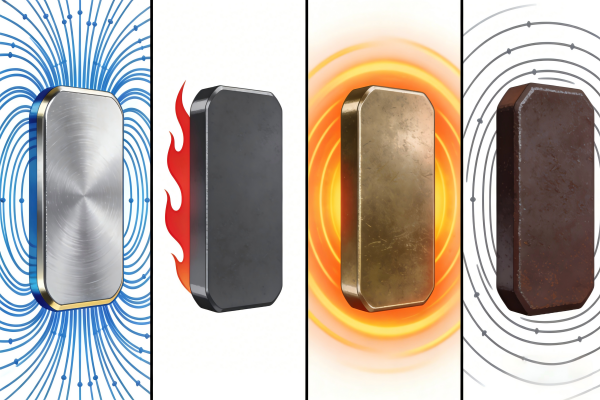
The answer to “how long will my magnet last?” depends entirely on which magnet you choose. Each of the four main permanent magnet materials offers different trade-offs between strength, cost, and durability against the degrading factors we discussed. Understanding these differences is key to choosing magnets for industrial use or any demanding application.
Permanent Material Stability
Material Type | Max. Strength (BH)max | Max. Operating Temp. | Corrosion Resistance | Resistance to Demagnetization | Best For… |
Neodymium (NdFeB) | Highest (30-55 MGOe) | Low to Medium (80-200°C) | Poor (Requires Coating) | High | High-strength, compact designs (motors, sensors, consumer electronics) |
Samarium Cobalt (SmCo) | High (18-32 MGOe) | High (250-350°C) | Excellent | Very High | High-temp, critical applications (aerospace, military, medical) |
Alnico | Medium (5-9 MGOe) | Very High (450-550°C) | Excellent | Low | Extreme-heat applications, sensors, guitar pickups, heritage designs |
Ferrite (Ceramic) | Low (3-5 MGOe) | Medium (250-300°C) | Excellent | Medium | Low-cost, high-volume uses (fridge magnets, speakers, simple motors) |
For more detailed specifications, materials science databases or organizations like the UK Magnetics Society provide comprehensive datasheets.
Neodymium (NdFeB) Magnets
Neodymium magnets are the undisputed powerhouses of the magnet world. They offer unmatched magnetic strength for their size. This property has enabled miniaturization and incredible performance gains in countless technologies—from smartphone speakers to electric vehicle motors. This high strength-to-size ratio defines them.
However, this power comes with a significant weakness: poor heat and corrosion resistance. A standard grade NdFeB magnet used at 100°C (212°F) will suffer permanent, irreversible neodymium magnet strength loss. Also, a breach in its protective coating in humid environments can lead to catastrophic failure from rust. The powerful magnet turns into oxide dust. When comparing ferrite vs neodymium longevity, the environment often determines the winner. Ferrite excels in harsh conditions despite lower power.
Samarium Cobalt (SmCo) Magnets
Samarium Cobalt was the first rare-earth magnet material commercialized. It remains a critical high-performance option. It’s the second-strongest material after Neodymium, but its primary advantage is outstanding high-temperature performance and natural corrosion resistance. SmCo magnets don’t require coating.
This combination makes them ideal for demanding, critical applications where failure isn’t an option. You’ll find them in military hardware, aerospace systems, and downhole sensors for oil and gas exploration. The trade-off is higher cost than NdFeB and brittleness, requiring careful handling and design considerations during assembly to prevent chipping or cracking.
Alnico Magnets
Alnico magnets, made from Aluminum, Nickel, and Cobalt alloy, are the veterans of the magnet world. Their standout feature is exceptional temperature stability. They offer the best performance in extreme-heat environments, functioning in temperatures approaching red-hot metal—up to 550°C (1022°F). They also have excellent corrosion resistance.
This thermal resilience makes them invaluable for certain high-temperature sensors and legacy equipment. However, Alnico has a significant weakness: relatively low coercive force. This means opposing external magnetic fields easily demagnetize it. It’s not suitable for applications involving repulsive forces or exposure to strong stray electromagnetic fields, such as in modern brushless DC motors.
Ferrite (Ceramic) Magnets
Ferrite magnets, also called ceramic magnets, are the most widely produced permanent magnets by volume. For good reason. They’re extremely cost-effective to manufacture. Their material composition (iron oxide and strontium carbonate) gives them inherent, excellent resistance to both corrosion and demagnetization from external fields.
This robust, economical nature makes them the workhorse of the magnet industry. Ferrite’s primary limitation is low magnetic strength. To achieve the same magnetic force as a small Neodymium magnet, you’d need a much larger, heavier Ferrite magnet. For many consumer goods, classic DC motor designs, and applications where space and weight aren’t primary constraints, Ferrite magnets provide the perfect balance of performance, durability, and cost.
A Guide to Ensuring Longevity
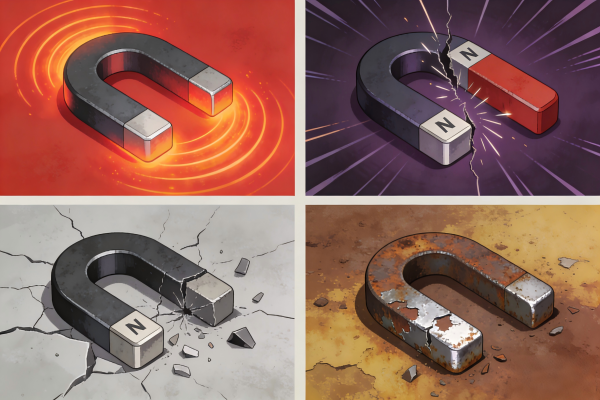
Knowing the theory of permanent magnet degradation is one thing. Applying it to real-world projects is another. To prevent premature failure and avoid asking “do magnets lose strength over time” after problems occur, you must be proactive. Follow this three-step framework to de-risk your design and purchasing process. This ensures your magnets perform reliably for their entire intended service life.
Step 1: Quantify Your Environment
Before looking at magnet datasheets, become an expert on the environment where the magnet will operate. Be specific and thorough. Always account for worst-case scenarios, not just typical operating conditions.
Start by answering these critical questions:
Thermal Environment:
- What’s the absolute maximum continuous operating temperature during normal use?
- Will it face brief temperature spikes? If so, how high and for how long? A 5-second spike to 150°C differs greatly from continuous 150°C environment.
- What’s the minimum temperature? Extreme cold can also affect some materials and surrounding components.
Magnetic Environment:
- Will the magnet operate near other strong permanent magnets or electromagnetic fields?
- Is it part of a repulsive-force system, like a magnetic catch or levitation device, constantly pushing against another magnet?
- What’s the self-demagnetizing field of the magnet itself, influenced by its geometry? Thin, flat magnets are more susceptible to self-demagnetization than cubic ones.
Physical & Chemical Environment:
- Will the magnet face moisture, high humidity, salt spray, solvents, or other corrosive agents?
- Is the application subject to high-frequency vibration, or risk of sudden physical impact or shock?
- What are assembly conditions? Will automated machinery or hands handle magnets?
Step 2: Match Material and Grade
With detailed environmental data, you can now use the comparison table from the previous section to make informed decisions. This is elimination process to find material meeting all non-negotiable requirements.
- If maximum operating temperature exceeds 200°C (392°F), your primary candidates are Samarium Cobalt and Alnico. Neodymium is no longer viable.
- If you need highest possible magnetic strength in smallest space and operating temperatures stay safely below 80°C (176°F), Neodymium is the obvious, most effective choice.
- If cost is the absolute primary driver and strength requirements are moderate, Ferrite is your go-to material. It offers excellent stability at low price.
- If you’re designing for highly corrosive environments like marine applications, uncoated Neodymium is off the table. You must specify robustly coated NdFeB, or use inherently resistant materials like SmCo, Ferrite, or Alnico.
Pro Tip: Don’t forget the grade. Within each material family, multiple grades offer different balances of strength and temperature resistance. An N52 grade Neodymium magnet is significantly stronger than N35 grade at room temperature, but N35 typically has better temperature resistance. Furthermore, special high-temperature grades, often designated with letters like “H,” “SH,” “UH,” or “EH” (e.g., N35SH), are specifically designed for higher temperature environments. Always consult detailed datasheets or experts to select specific grades matching your thermal profile. You can find technical explanations of these grades at resources like the International Magnetics Association.
Step 3: Specify Coatings and Handling
For magnet types that require it—primarily Neodymium—coating isn’t optional aesthetic choice. It’s a critical functional component. Specifying correct coating is as important as choosing the right material grade.
- Standard Protection: Industry standard Ni-Cu-Ni (Nickel-Copper-Nickel) plating offers good, reliable protection for most indoor or enclosed applications where magnets aren’t exposed to condensation or corrosive chemicals.
- Enhanced Protection: For humid, outdoor, or marine environments, consider more robust coatings. Black epoxy, plastic casings (ABS or PPS), and zinc are common alternatives. Each offers different levels of chemical resistance, abrasion resistance, and cost.
Finally, ensuring magnet lifespan extends to the factory floor. Establish clear handling protocols for assembly. Use non-ferrous tools and custom-designed jigs to handle magnets safely. Train assembly staff to avoid letting powerful magnets slam into each other or hard surfaces, which causes chipping. Implement proper storage procedures. Keep magnets in original packaging, separated by spacers, away from high temperatures or strong external magnetic fields.
Why Your Magnet Supplier Matters
You can perform exhaustive research and create perfect design specifications. But if your supplier provides low-quality, out-of-spec, or counterfeit magnets, your project is destined for failure. The factors affecting magnetic strength are amplified by poor manufacturing. A great supplier is more than a vendor. They’re a quality partner ensuring consistency and reliability from first prototype to full-scale production.
When evaluating potential suppliers for something as critical as permanent magnets, look for these key quality indicators:
- Robust Quality Control: Do they have documented processes and proper equipment to verify magnetic properties (like field strength and flux density), physical dimensions, and coating integrity? This includes tools like Helmholtz coils, permeameters, and X-ray fluorescence (XRF) analyzers for coating thickness.
- Material Traceability: Can they certify the origin and grade of magnetic materials they use? Reputable suppliers provide chain of custody for raw materials, ensuring you don’t receive lower-grade material than specified.
- Engineering Support: Does their team have expertise to help you select the right magnet and coating for your specific application? A true partner can review your design and prevent costly mistakes. This helps you avoid asking “do magnets lose strength over time” after field failure. Good suppliers can also provide crucial data like B-H curves, as detailed in engineering resources like this article from Machine Design.
- Customization Capabilities: Can they provide custom shapes, sizes, magnetizations (e.g., diametrical, radial), and assemblies to fit your unique design? Or are you limited to off-the-shelf stock?
Finding a partner who meets all these criteria is the final and most important step in guaranteeing long-term success.
For brands, engineers, and buyers seeking suppliers who embody these qualities, CNM Magnet is an excellent choice. Their demonstrated commitment to rigorous quality control, deep engineering expertise, and sourcing of high-performance materials ensures you receive components built to last. They act as true partners in the design and manufacturing process, from initial concept to final delivery.
To discuss your project with an expert or explore their range of high-quality permanent magnets, visit their website for more information.
Conclusion: Environment Is The Enemy
We’ve established that common fears of permanent magnets simply fading away with time are largely unfounded. For well-made magnets used in correct applications, intrinsic magnetic field decay is practically zero. Modern materials like Neodymium, Samarium Cobalt, and even Ferrite are incredibly stable structures. You can learn more about the fundamental physics of these materials from encyclopedias like Britannica’s entry on Permanent Magnets.
The real threat to magnet power isn’t the ticking clock, but the environment where the magnet operates.
By understanding the damaging effects of excessive heat, powerful opposing fields, sharp physical impacts, and insidious corrosion, you’re now equipped to ask the right questions during design and procurement phases.
By carefully selecting appropriate materials—whether it’s the raw power of Neodymium, high-temperature resilience of Samarium Cobalt, extreme heat-resistance of Alnico, or unbeatable cost-effectiveness of Ferrite—and by partnering with quality-focused suppliers, you can design and build products with confidence.
A well-chosen and properly applied magnet is truly a permanent component, reliable for your application’s lifetime.
We are a manufacturer specializing in the research and development of magnets with years of industry experience. Our product offerings include NdFeB magnets, ferrite magnets, and custom magnetic components. Our goal is to provide high-quality magnetic solutions to customers worldwide, and we also offer OEM/ODM customization services. If you have any questions about magnets or custom applications, please feel free to contact our team of experts.
Facebook
Twitter
LinkedIn
X