
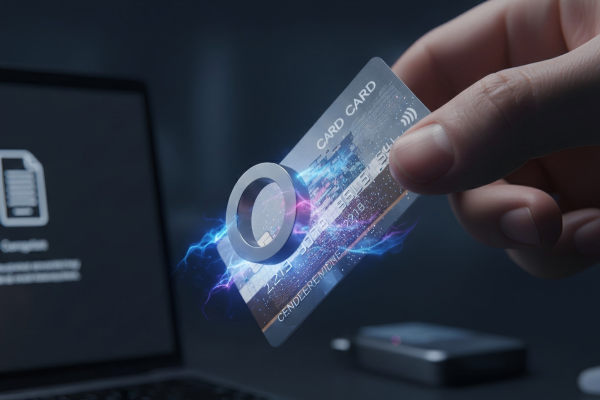
Yes, magnets can damage credit cards. But this risk applies almost only to the old magnetic stripe. Modern chip and contactless payment features are safe from magnetic fields.
That’s the quick answer to can magnets damage credit cards. For most people going about their daily lives, the chance of a magnet making your card useless is very small.
But powerful magnets are now common in phone cases, wallets, and other accessories. So understanding the details matters more than ever. This guide explains how magnets and credit cards work together. We’ll look at the science and identify which cards and magnets are actually dangerous. Plus, we’ll give practical tips for everyday people, product users, and businesses.
By the end, you’ll know the real risks. You’ll know exactly how to avoid problems and feel confident about your cards in our world full of magnets.
The Science of Magnetism
To understand the danger, we need to look at the technology first. A credit card’s magnetic stripe stores data brilliantly. But it works in ways that make it weak against outside magnetic forces.
How a Magnetic Stripe Works
The black or brown stripe on your card’s back isn’t just plastic. It’s a complex storage system made of millions of tiny iron-based magnetic pieces.
Each microscopic piece works like a tiny bar magnet. When the card is made, a machine called an encoder lines up these pieces in specific patterns. It points their north and south poles in sequences that represent your account information. This works much like old cassette tapes or VHS tapes stored data.
There are two main types of magnetic stripes. They differ in how well they resist magnetic changes – a quality called coercivity.
High-Coercivity, or HiCo, stripes are standard for credit cards, debit cards, and bank cards. They last longer and need a strong magnetic field to change their data.
Low-Coercivity, or LoCo, stripes fight magnetic fields much less. You’ll find them on hotel key cards, gift cards, and some transit passes. That’s why they seem to get messed up so easily.
As a technical note, coercivity is measured in Oersteds (Oe). A LoCo stripe has about 300 Oe of coercivity. A HiCo stripe on a credit card typically has around 4000 Oe. This ten-times difference explains why your credit card is much safer than a hotel key.
How Magnets Cause Damage
A magnet creates an invisible area of influence around itself. This is called a magnetic field. When this field is strong enough, it can push around the tiny magnetic pieces on a credit card stripe.
This process is called demagnetization. A powerful outside magnetic field doesn’t “erase” the data like deleting a computer file. Instead, it scrambles the carefully arranged particles and messes up their north-south alignment.
Picture a line of soldiers standing in perfect formation – that represents your data. A strong magnet is like chaos running through their ranks and breaking their formation. The soldiers are still there, but their messy state can’t be read by the card reader.
This scrambling of data makes a “swipe” fail. The card reader can’t figure out the jumbled magnetic patterns. So you get a read error. For more about how magnetism works, university resources like those on HowStuffWorks give excellent explanations.
Card Types and Risk
Good news for modern users: the most vulnerable part of a payment card is quickly becoming just a backup system. Card technology has evolved to include much stronger payment methods.
The Vulnerable Magnetic Stripe
We need to say again that the magnetic stripe, or magstripe, is the only part of a standard credit or debit card that magnets can damage.
It relies on magnetically aligned particles, which is its built-in weakness. This technology is decades old. Many parts of the world are phasing it out for more secure options.
Even if a magnet completely wipes your card’s stripe, the card probably isn’t useless. It will almost certainly still work through its other, more modern parts.
The Resilient EMV Chip
The small metallic square on your card’s front is an EMV chip. This isn’t a magnetic storage device. It’s a powerful tiny computer.
The chip stores your payment data in secure, solid-state memory. Think of it like a USB flash drive. This data is encrypted and protected by security features that are much better than the magstripe.
A magnet won’t damage the EMV chip or its stored data, even a very strong one. It works entirely on electronic principles, not magnetic ones. This crucial point should ease most modern worries about magnets and credit cards.
This technology’s security is a global standard. You can learn more about its benefits from major payment networks like Visa, who have pushed for its adoption.
The Unaffected NFC
Contactless payment, often called “tap-to-pay,” uses Near Field Communication (NFC) technology. This involves a small chip and antenna built into the card’s plastic.
When you hold your card near a compatible terminal, the terminal’s radio field powers the card’s antenna. This gives the chip energy to send encrypted payment data over a very short distance.
This whole process uses radio waves, not magnetic storage. So magnets don’t interfere with or damage a card’s contactless payment ability at all.
Risk Comparison Table
To sum up the risk levels, this table clearly shows how each card technology interacts with magnets.
Technology | How It Works | Risk from Magnets | Common Use |
Magnetic Stripe | Stores data on tiny magnetic particles. | High (Data can be erased) | Legacy systems, swiping at gas pumps, ATMs |
EMV Chip | Secure data storage on a microcomputer. | None | Chip-and-PIN, chip-and-signature inserts |
Contactless (NFC) | Data transfer via radio waves. | None | Tap-to-pay at checkout |
The Magnet Strength Spectrum
Whether can magnets damage credit cards depends entirely on the magnet’s strength. This strength is often measured in Gauss, which shows the magnetic field’s density. A HiCo credit card stripe needs about 4,000 Gauss to be wiped.
Weak Magnets (Low Risk)
This includes most magnets you see every day. They pose almost no threat to your credit cards.
Fridge magnets and other decorative magnets are very weak. They typically create a field of only 50-100 Gauss. You can safely put your wallet on your refrigerator without worry. The answer to will a fridge magnet damage a credit card is definitely no.
Most magnetic clasps on regular purses, bags, and wallets are also designed to be weak. Manufacturers know about this issue. They use magnets just strong enough to hold the clasp shut, but far too weak to damage a card stripe, especially through leather or fabric.
Mid-Strength Magnets
These magnets are more powerful and deserve some awareness. But the risk is still situational and not immediate.
Magnets in speakers, older computer hard drives, and some power tools fall here. While stronger than fridge magnets, damaging a card would typically need long and very close contact. Casual exposure, like walking past a stereo speaker, isn’t a concern.
Powerful Magnets (High Risk)
This category causes nearly all magnetic stripe damage cases.
Neodymium magnets, also called rare-earth magnets, are incredibly powerful for their size. These are the main culprits in modern card damage situations. A small neodymium magnet, even coin-sized, can easily create a field over 4,000 Gauss at its surface. It will corrupt a magnetic stripe on direct contact.
These strong magnets are increasingly common in high-end magnetic phone mounts, minimalist wallets, magnetic jewelry clasps, and various industrial uses. The problem of neodymium magnets and credit cards is a modern issue.
One of the most common sources of accidental damage is the powerful magnetic security tag remover at retail checkout counters. These devices remove anti-theft tags and are extremely strong.
For those in product design or industries needing high-strength magnetic solutions, understanding materials like neodymium is crucial. Good suppliers provide detailed specifications for various applications. Explore high-quality magnet options at C&M Magnet.
Understanding a magnet’s Gauss rating is key to judging its risk. Resources from magnet specialists, like this blog post from K&J Magnetics, can provide more technical breakdowns of these measurements.
Real-World Risk Assessment
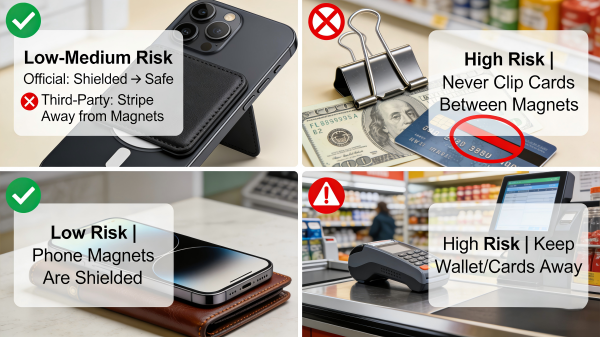
Applying this knowledge to everyday situations helps put the risk in perspective. Here’s a breakdown of common scenarios and their risk levels.
MagSafe and Wallets
Apple’s MagSafe ecosystem brought the MagSafe wallet demagnetize card question to the front. The risk here is low to medium, depending on the product.
Apple’s official MagSafe Wallets are designed with this issue in mind. They include shielding and Apple explicitly states they’re safe for credit cards. The magnets are placed to hold the wallet to the phone, not to clamp down on the cards themselves.
The risk goes up with third-party magnetic wallets and cases. While good brands often include shielding, cheaper, unshielded versions can pose a risk. If a card’s stripe touches the magnet array in an unshielded wallet directly, damage is possible.
As a best practice, always place cards in these wallets with the magnetic stripe facing away from the phone-side magnets. Using the outermost card slot for your most-used card also creates helpful distance. Tech reviewers at sites like The Verge have tested these products extensively, confirming shielded designs are safe.
Magnetic Money Clips
The risk level for many magnetic money clips is high. These products often work by sandwiching cash and cards between two powerful neodymium magnets.
Clipping your credit cards directly between these magnets will almost certainly demagnetize the stripes. If you use this style of money clip, it should only hold cash. Or your cards must be kept in a separate, protective sleeve.
Phone on Wallet
Placing your smartphone on top of a traditional, non-magnetic wallet carries low risk.
The magnets inside a standard smartphone used for the speaker, haptic feedback motor, and image stabilization are generally weak and internally shielded. Their magnetic fields aren’t strong enough to go through a wallet and damage the cards inside. This isn’t a scenario to worry about.
At the Checkout
This common scenario carries surprisingly high risk. You must watch out for the countertop area where cashiers remove security tags.
These magnetic detachers are built into the counter and may not be obvious. Don’t place your wallet, purse, or individual cards on this area while paying. This is one of the most frequent, yet overlooked, causes of a suddenly non-working card stripe.
A Guide for Businesses
The intersection of magnets and credit cards isn’t just a consumer concern. It has big implications for product designers, retailers, and procurement professionals. Addressing this issue early can prevent customer complaints and improve product quality.
For Product Designers
If you’re designing bags, wallets, phone cases, or any product with magnetic closures, thoughtful design is essential.
Magnet selection is key. When choosing a magnet, consider its strength (Gauss rating) and placement. Always pick the weakest magnet that will still work effectively for the closure. A stronger magnet isn’t always better.
Add shielding where needed. A thin layer of steel or a specialized alloy like mu-metal placed between the magnet and the card storage area can block or redirect the magnetic field, protecting the card’s stripe.
Placement also matters. Position magnets so they don’t touch areas where a card’s stripe would naturally rest. Even a few millimeters of separation can dramatically reduce the magnetic field’s strength.
Partnering with an experienced magnet supplier is critical to getting this right. A good supplier can advise on the ideal magnet type, strength, and shielding for your specific product to prevent issues. For expert consultation and high-quality magnetic components, visit our homepage at C&M Magnet.
For Retailers and Marketers
Your role is to manage customer expectations and provide accurate information.
Educate your sales staff. Make sure your team can confidently and accurately answer, “Will this magnetic clasp damage my credit cards?” Giving them the information from this guide is a great start.
Use proactive communication. For products that do contain strong magnets, like minimalist money clips, include a small warning label or note in the online product description. This transparency builds trust and reduces returns from frustrated customers.
Finally, checkout counter awareness is crucial. Train cashiers to keep customer cards and wallets away from security tag detachers. A small sign showing the magnet’s location can also be a helpful, low-cost solution.
For Procurement Professionals
If your role involves sourcing components, you’re on the front line of quality control.
Always demand specifications when sourcing magnetic components. Request the spec sheet from the supplier. This should include the material grade (like N42 Neodymium), dimensions, and the surface Gauss rating. Don’t source “strong magnets” without knowing their exact properties.
Also, if you’re sourcing magnetic stripes for products like gift cards, employee ID badges, or transit passes, understand the difference between HiCo and LoCo. Choosing the wrong type can lead to widespread failure in the field. HiCo costs more but is necessary for any card intended for long-term or frequent use.
Protection and Solutions
Protecting your cards is simple with a little awareness. And if damage does happen, the solution is usually straightforward.
Prevention Tips
Knowing how to protect credit card from magnet is about forming good habits.
- DO store cards in dedicated wallet slots, which provide separation.
- DO be mindful of powerful neodymium magnets in new gadgets and accessories.
- DON’T stack cards directly against a known strong magnet, like a money clip or jewelry clasp.
- DON’T lay your wallet on retail security tag removers at checkout counters.
- DO consider a wallet with RFID-blocking material, as this often includes metallic layers that can offer some magnetic shielding.
Troubleshooting a Damaged Card
So you’ve swiped your card and it was declined. Here’s what to do if credit card is demagnetized.
- Try the Chip First. Before assuming the worst, ask the cashier to insert the card into the chip reader. In nearly every case, the EMV chip will work perfectly.
- Use Contactless. If the terminal supports it, try tap-to-pay. This function is completely unaffected by magnets and will also work.
- Inspect for Physical Damage. Look at the magnetic stripe. While you can’t see magnetic scrambling, check for deep scratches, peeling, or dirt. Sometimes the read error is caused by physical wear and tear, not a magnet.
- Request a Replacement. If the stripe consistently fails and this is an issue for you (like for use at older pay-at-the-pump gas stations or ATMs that require a swipe), simply contact your bank or card issuer. They’ll mail you a new card, usually for free. It’s a common and hassle-free process.
If you have persistent issues with card functionality, consumer protection agencies like the Consumer Financial Protection Bureau (CFPB) offer resources and guidance.
Confidence in a Magnetic World
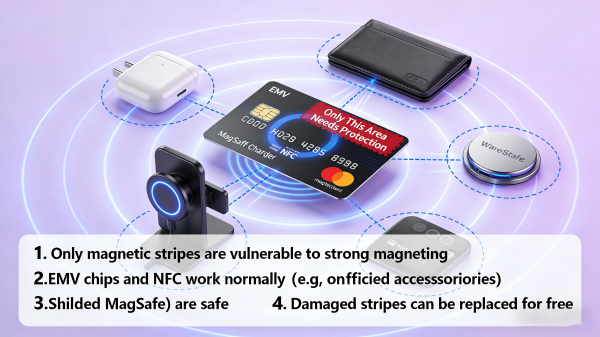
The fear about whether can magnets damage credit cards is often bigger than the actual, modern-day risk. As payment technology has evolved from fragile magnetic stripes to robust microchips and radio waves, our ability to pay has become far more resilient.
Let’s recap the most important points:
- Magnets only damage the old-fashioned magnetic stripe. They don’t affect the secure EMV chip or the contactless NFC function.
- The magnet’s strength is the single most important factor. Your fridge magnet is harmless. A powerful neodymium magnet is a real threat to the stripe.
- Modern shielded accessories, like Apple’s MagSafe wallet, are specifically designed to be safe. Be careful with unbranded, low-cost magnetic products.
- Your greatest daily risk is often the powerful, hidden magnet in a retail store’s security tag detacher.
- If your stripe fails, your card isn’t useless. The chip and tap-to-pay features will still work. Getting a free replacement is a simple phone call away.
By understanding these core principles, you can navigate our world with confidence. You can enjoy the convenience of magnetic accessories while knowing your ability to pay remains secure.
As magnetic technology continues to be integrated into our lives, from simple closures to complex machinery, understanding its properties is key. For those looking to source high-quality magnetic solutions for any project, a reliable supplier is your greatest asset. Find out more at https://cnmmagnet.com/.
We are a manufacturer specializing in the research and development of magnets with years of industry experience. Our product offerings include NdFeB magnets, ferrite magnets, and custom magnetic components. Our goal is to provide high-quality magnetic solutions to customers worldwide, and we also offer OEM/ODM customization services. If you have any questions about magnets or custom applications, please feel free to contact our team of experts.
Facebook
Twitter
LinkedIn
X