
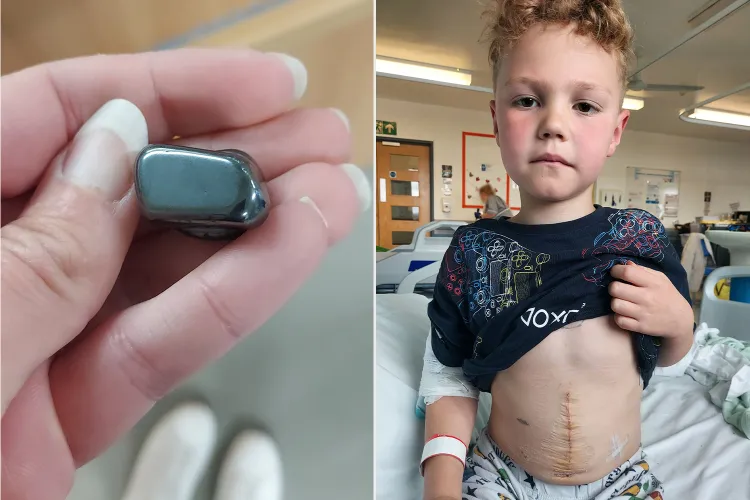
Swallowing magnets is a medical emergency that requires immediate medical attention. The results can be severe and life-threatening. This is especially true when two or more magnets are swallowed. They can pull toward each other across different parts of the intestine. This leads to tissue death, holes in the bowel, and serious infection. This guide explains exactly what happens if you swallow magnets. It covers the warning signs to watch for and the steps you must take right away.
This is a vital topic for anyone with children or pets. It’s also important for adults who use small magnetic products. The danger is often hidden and misunderstood.
In this article, you will learn:
- Why swallowing magnets is so dangerous.
- How to spot the symptoms in children, adults, and pets.
- A clear action plan and what you must not do.
- What to expect at the hospital.
- How to prevent these accidents from happening.
Table of Contents
The Hidden Danger of Magnets
To understand the urgency, you must first understand how the injury happens. It’s not about the magnet’s material being toxic. It’s about its powerful, invisible force. The danger of swallowing magnets is one of physics, not just biology.
When an object is swallowed, it follows the natural path of the digestive tract. This system is a long, coiling tube. The problem starts when the magnetic force is strong enough to act across the soft, flexible walls of this tube.
The Physics of Peril
Your stomach and intestines are not a straight pipe. They are a series of complex, folded loops packed tightly within your belly. A swallowed object can be in one loop of the bowel. Another object swallowed minutes later can be in a nearby loop.
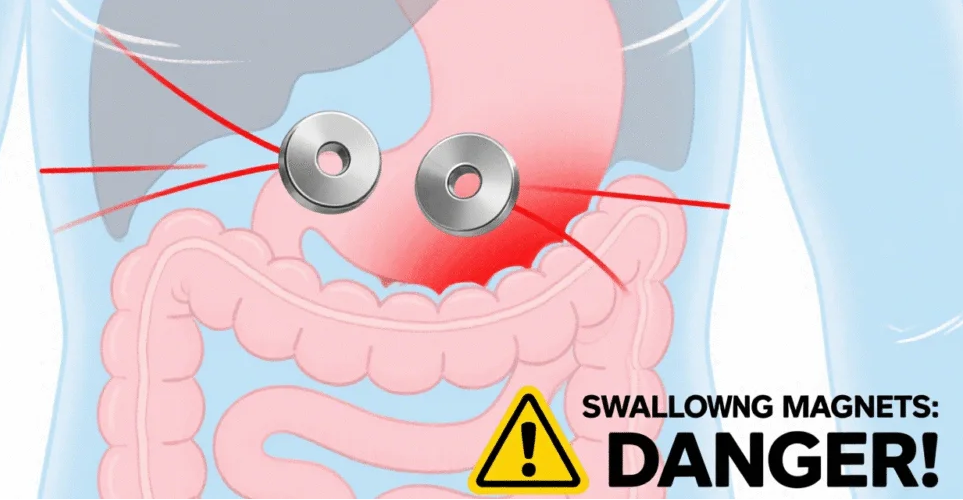
If those two objects are powerful magnets, their pull is constant. They will attract toward each other with significant force. This traps the delicate intestinal walls between them.
This creates an intense pressure point. It acts like an internal clamp. The force is strong enough to completely cut off the blood supply to the trapped tissue. This is a condition known as ischemia.
Without blood, the tissue cannot get oxygen and nutrients. It begins to die. This process is called necrosis. This can happen in a matter of hours. The dead tissue weakens and breaks down. Eventually, it creates a hole, known as a perforation.
Single vs. Multiple Magnets
The risk changes dramatically based on how many magnets are swallowed. It is a critical distinction that determines the course of action. However, it’s vital to remember something important. Unless you witnessed the event and are 100% certain, you must assume multiple magnets may have been swallowed.
A single, small, weak magnet might pass through the digestive system without incident. It may move along with food and waste. Eventually, it gets expelled from the body. But this is not a guarantee. A larger single magnet could still become stuck, causing a blockage.
The true medical emergency happens when two or more magnets are swallowed. This also applies if one magnet and another metal object are ingested. Examples include a coin, battery, or piece of a toy. The risk of what happens if you swallow magnets goes up dramatically in these scenarios. A child who swallowed a magnet might have swallowed another one without being seen.
This table clarifies the different levels of risk.
Scenario | Risk Level | Potential Outcome |
One Small Magnet | Low to Moderate | Often passes naturally, but can still pose a risk. Medical evaluation is recommended. |
Two or More Magnets | EXTREMELY HIGH | Magnets attract across bowel walls, causing pinching, perforation, obstruction, and sepsis. Medical emergency. |
Magnet + Metal Object | EXTREMELY HIGH | The magnet can trap a metal object (like a coin or battery) against the bowel wall. Medical emergency. |
Devastating Medical Consequences
The chain of events following the swallowing of multiple magnets can be catastrophic. These are not just possibilities. They are well-documented outcomes seen in emergency rooms worldwide.
First comes pressure necrosis. The intestinal tissue trapped between the magnets dies. This dead tissue is fragile. It cannot maintain the strength of the bowel wall.
This leads to perforation. A hole forms in the intestine. This allows bacteria-filled digestive contents, food, and fluids to leak out. They spill from the gut into the sterile abdominal cavity.
The leakage causes a severe and intensely painful infection of the abdominal lining. This is called peritonitis. The body’s immune system launches a massive inflammatory response to fight this widespread infection.
The infection must be controlled immediately with surgery and powerful antibiotics. If not, it can overwhelm the body’s defenses and enter the bloodstream. This condition, known as sepsis, is a life-threatening medical emergency. Sepsis causes organ systems throughout the body to begin to fail. This leads to septic shock and potentially death.
The U.S. Consumer Product Safety Commission (CPSC) has documented a significant rise in emergency room visits related to magnet ingestion. This is particularly true following the popularity of high-powered magnet sets. These incidents have led to thousands of hospitalizations and numerous surgeries. They have prompted safety alerts and a magnet toy recall for certain products. You can find more information on the CPSC’s safety alerts.
Recognizing the Red Flags
One of the most challenging aspects of magnet ingestion is that the symptoms can be non-specific. They are easily mistaken for a common stomach bug or flu. This is especially true if the swallowing was not witnessed. Knowing the signs is critical for a timely response.
Symptoms can appear within a few hours. They may also be delayed by a day or more. The absence of immediate symptoms does not mean the situation is safe.
Immediate and Obvious Signs
You might witness a child, adult, or pet swallow an object you suspect is a magnet. Or they might show signs immediately after. Look for these clues:
- Choking, gagging, or intense coughing as the object goes down.
- Excessive drooling or inability to swallow saliva.
- Pain or difficulty when trying to swallow.
- Immediate vomiting.
- Pointing to the throat or stomach area to indicate pain.
- A metallic taste in the mouth.
These signs indicate the object may be lodged in the esophagus or is causing immediate irritation.
Delayed but Dangerous Symptoms
Often, the initial event goes unnoticed. The magnets pass from the esophagus into the stomach and intestines. It is here, over the next several hours or days, that the most dangerous magnet ingestion symptoms begin to appear. This happens as the magnets start to damage the bowel.
Do not ignore these delayed signs:
- Abdominal Pain: This is the most common symptom. It can be sudden and severe. It may be located in a specific spot. The person may guard their abdomen or cry out when it’s touched.
- Nausea and Vomiting: The body may try to expel stomach contents. Vomiting that is green or brown (containing bile) is a particularly concerning sign. It suggests a potential bowel obstruction.
- Fever: As infection (peritonitis) begins to set in, the body’s temperature will rise. A fever following vague abdominal complaints should always be taken seriously.
- Inability to Eat or Drink: The person may have no appetite. They may vomit anything they consume.
- Abdominal Distension: The belly may appear swollen, hard, or bloated. This happens due to inflammation, trapped gas, or fluid buildup.
- Changes in Bowel Habits: This can include a complete lack of bowel movements (constipation or obstruction). Less commonly, it can include diarrhea.
Signs in Children and Pets
Toddlers, infants, and pets cannot tell you what’s wrong. Their symptoms are often behavioral. Caregivers and pet owners must be alert for changes from their normal state.
For young children, a swallowed multiple magnets scenario can present as:
- Unexplained irritability or crying that cannot be soothed.
- A sudden refusal to eat or drink.
- Lethargy, appearing unusually tired, weak, or floppy.
- Assuming a strange position, such as pulling their knees to their chest, to relieve abdominal pain.
For pets, especially dogs and cats, the signs are similar. If you’re wondering what to do if a dog swallows a magnet, watch for:
- Whining, whimpering, or other vocalizations of pain.
- Complete loss of appetite.
- Lethargy and unwillingness to play or move.
- Vomiting, especially if it’s persistent.
- A painful or tense abdomen. They may yelp or snap if you try to pick them up or touch their belly.
If you observe any of these signs, and there is any possibility of access to magnets, you must treat it as a potential emergency room for swallowed object situation.
The Immediate Action Plan
If you suspect someone has swallowed magnets, your actions in the first few minutes and hours are critical. This is not a “wait and see” situation. A calm, swift, and correct response can prevent a medical crisis from becoming a tragedy.
Step 1: Act Immediately
Acknowledge the fear and anxiety of the situation. But do not let it paralyze you. The most important thing is to act decisively. Do not waste time searching the internet for home remedies. Do not debate if the situation is serious. Assume it is.
Step 2: Seek Medical Help
Go directly to the nearest hospital emergency room. Do not call your regular pediatrician’s office first. They will direct you to the ER anyway, and this wastes precious time.
When should you call 911 or your local emergency number?
- If the person is actively choking.
- If they are having difficulty breathing.
- If they are unconscious or losing consciousness.
- If they are in obvious, severe distress or pain.
For immediate guidance while you are on your way to the hospital, you can call a poison control center. They are experts in swallowing incidents and can provide advice. In the United States, you can reach Poison Control at 1-800-222-1222.
Step 3: Gather Key Information
On the way to the hospital, try to gather as much information as possible. You will give this to the medical team. This will help them assess the situation faster.
- What was swallowed? If you know, bring an identical magnet or the toy/product it came from.
- How many magnets? Be honest. Is it possibly one, or could it be two, ten, or more?
- What is the type and size? Are they tiny magnetic beads from a magnet bead ingestion? Or are they larger pieces from a construction toy?
- When was it swallowed? Try to pinpoint the time as closely as possible.
- What are the current symptoms? Report everything you have observed, even if it seems minor.
CRITICAL: What You Must NOT Do
Just as important as what to do is what not to do. Certain actions are often attempted with good intentions. But they can cause significant harm and complicate medical treatment.
- DO NOT induce vomiting. The magnets can cause damage to the esophagus on the way back up. Or they could be inhaled into the lungs, creating a new and severe problem.
- DO NOT give the person food or drink. If they need an emergency procedure like an endoscopy or surgery, they must have an empty stomach. Giving them food or water will delay these life-saving interventions.
- DO NOT try to use another magnet on the outside of the body to “pull” the swallowed magnet out. This is completely ineffective and extremely dangerous. It can cause the internal magnets to shift and put pressure on different areas, worsening the injury.
- DO NOT “wait it out” to see if it will pass. This is the single biggest mistake. With a single, weak magnet, this might happen. But if multiple magnets were swallowed, time is tissue. Every hour of delay allows more damage to occur.
At the Hospital: A Medical Guide
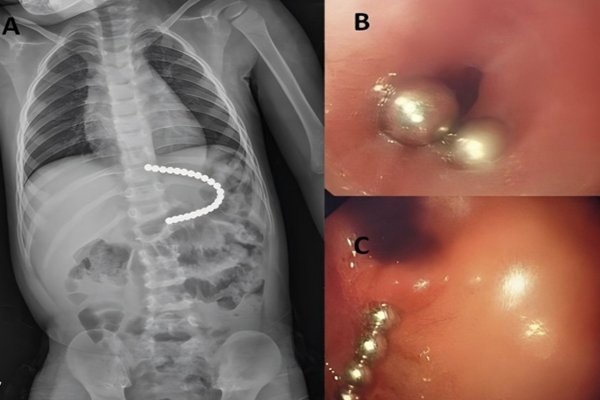
Walking into an emergency room with a child, pet, or even as an adult who has swallowed a foreign object is frightening. Knowing what to expect can help reduce anxiety. It also allows you to be a better advocate for the patient. We will walk you through the typical process.
Arrival and Triage
The first person you’ll interact with is a triage nurse. Their job is to quickly assess the urgency of your situation.
Immediately and clearly state: “I believe my child/I/my pet has swallowed magnets.”
Use the word “magnets.” This is a key trigger word for medical staff. It signals a high-risk swallowing incident. They will quickly check vital signs like heart rate, breathing, temperature, and blood pressure. Be prepared to provide the information you gathered (what, when, how many, symptoms). Based on this, you will be prioritized for a room.
Diagnostic Imaging: The X-ray
The single most important diagnostic tool is an X-ray. It is non-invasive and provides a clear picture of what is happening inside the body.
The X-ray will confirm several crucial facts:
- Confirmation: Are there actually magnets inside?
- Quantity: How many magnets are present? An X-ray will clearly show if there is one or more.
- Location: Where are the magnets in the digestive tract? Are they in the stomach, the small intestine, or the colon?
- Configuration: Are the magnets separated, or have they already attracted each other and trapped tissue? They may appear as a single object on the X-ray if they are already stuck together.
Doctors may take a series of X-rays over a few hours. This shows if a single magnet is moving through the system. It also shows if multiple magnets are staying in one place, which is a sign they are attached across bowel walls.
The Treatment Plan
Based on the X-ray findings and the patient’s symptoms, the medical team will create a treatment plan. There are three primary pathways.
- Observation: This is the least common approach. It is reserved for very specific cases: a confirmed single, small magnet with no symptoms. The magnet must be located in the stomach or intestines and showing movement on repeated X-rays. The patient may be admitted to the hospital for close monitoring. Rarely, they may be sent home with strict instructions to watch for symptoms and check stools. This is not the standard for high-powered magnets.
- Endoscopy: The magnets might be located in the esophagus, stomach, or the very first part of the small intestine (the duodenum). In these cases, doctors can often remove them without major surgery. A procedure called an upper endoscopy is performed. The patient is put under sedation or general anesthesia. A gastroenterologist inserts a long, thin, flexible tube with a light and camera (an endoscope) down the throat. They can see the magnets and use special tools, like a small net or grasper, passed through the endoscope to retrieve them.
- Surgery: Surgery is necessary in several situations. The magnets may have moved beyond the reach of an endoscope. They might already be causing symptoms of bowel perforation from magnets (like severe pain or fever). Or the X-ray might show they have clamped onto the intestinal wall. A surgeon will make an incision in the abdomen, locate the affected section of the bowel, and remove the magnets. If the tissue is damaged, the surgeon will have to repair the hole (perforation). In severe cases, they may need to remove the dead section of the intestine (a bowel resection). This is a major operation requiring a hospital stay and a longer recovery.
The treatment protocols are well-established. Medical bodies like the American Academy of Pediatrics (AAP) have published guidelines to help doctors make these critical decisions. Further research in journals like JAMA continues to refine the best practices for managing this dangerous problem.
Understanding Magnet Types
Not all magnets are created equal. The type of magnet swallowed has a direct impact on the level of risk. As a consumer and caregiver, understanding these differences is a key part of prevention. The materials used determine the magnet’s strength. This is the primary factor in its potential to cause harm.
Neodymium Magnets: The Greatest Threat
Neodymium magnets are the main culprits in the most severe ingestion-related injuries. These are often called “super magnets,” “rare-earth magnets,” or “high-powered magnets.”
They are exceptionally powerful for their small size. These are the magnets found in popular but dangerous adult desk toys. You’ll find them in magnetic sculpture spheres, fake magnetic piercings, and many modern electronic devices. Their small, often colorful, bead-like appearance makes them particularly attractive to young children. This leads to magnet bead ingestion. When you’re assessing risk in your home, these are the products to be most concerned about. The power of Neodymium Magnets is what makes them so useful in industry but so hazardous in the home.
The danger of swallowing magnets is magnified with neodymium magnets. Their intense magnetic strength means they can attract each other from a greater distance. They clamp together with enough force to quickly destroy bowel tissue.
Ferrite (Ceramic) Magnets
Ferrite magnets are also known as ceramic magnets. They are more common and familiar. These are the typical dark gray or black, brittle magnets you find on the back of refrigerator decorations. You’ll also find them in older toys and in many craft projects.
While significantly weaker than neodymium magnets, they are not without risk. Multiple Ferrite (Ceramic) Magnets can still attract across intestinal walls. The force is less and the damage may occur more slowly. A large ferrite magnet could also pose a choking or blockage hazard on its own. The risk is lower, but it is not zero.
Knowing Magnetic Materials
Understanding the different magnet types is fundamental to home safety. When purchasing toys or household goods, being aware of the magnetic materials they contain allows you to make informed decisions. High-powered neodymium products should be treated with extreme caution. They should be kept away from children entirely. We believe educating consumers about the properties of different magnet types is a crucial step in preventing these devastating accidents.
Prevention: The Best Medicine
The only way to guarantee safety from magnet ingestion is through prevention. Once a magnet is swallowed, you are reacting to a crisis. Taking proactive steps to secure your home and educate your family can prevent that crisis from ever occurring.
Check Product Safety
Always check for safety warnings, age recommendations, and material information on any product you bring into your home. This is especially important for toys. Be wary of small, powerful magnet sets, even if they are marketed as “educational” or for “stress relief.”
The U.S. Food and Drug Administration (FDA) has issued safety communications about the dangers of these products. These warnings highlight that small, high-powered magnets are not safe toys for children. They can be deadly if swallowed. For more details, you can review the FDA’s safety communication on magnets. A magnet toy recall is a serious event that signals a known, severe hazard.
Secure Storage and Supervision
Vigilance in the home environment is your strongest defense.
- Secure Storage: Any item containing small, powerful magnets must be stored securely. This includes adult desk toys, games, and magnetic jewelry. They must be stored in a secure, preferably locked, container that is completely out of the reach and sight of children and pets.
- Inspect Regularly: Routinely check all toys and household items for damage. Look for loose or broken parts that could release small magnets. This is especially important for magnetic tile sets or construction toys. Discard any broken items immediately.
- Active Supervision: Supervise children closely when they are playing. This is particularly important with any toy that contains magnets. After playtime, ensure all pieces are accounted for and stored properly.
- Separate Spaces: Keep adult gadgets and desk toys completely separate from children’s play areas. A magnet that falls from an adult’s desk can easily be found by a curious toddler or pet.
Educate Your Family
Prevention also involves education. For older children and teenagers, it’s important to have an open conversation about the specific dangers.
A common source of accidental ingestion in this age group is the use of small, powerful magnets as “fake” piercings. These are used for the tongue, lips, nose, or cheeks. It is very easy to accidentally inhale or swallow these magnets while talking or eating. Explain that this is not a safe practice and can lead to emergency surgery.
Conclusion: A Call for Action
What happens if you swallow magnets is not a simple question. It is the beginning of a potential medical catastrophe. The physics of magnetic attraction inside the human body can lead to tissue death, bowel perforation, and life-threatening infection with terrifying speed.
The key takeaways are clear. Swallowing multiple magnets is a medical emergency. The symptoms, like abdominal pain and vomiting, can be deceptive and must not be ignored. Your response must be immediate: go directly to an emergency room. Do not wait, do not induce vomiting, and do not give food or water.
Ultimately, the most effective treatment is prevention. You can eliminate the danger by understanding the risk. Remove hazardous high-powered magnet sets from homes with children. Secure all magnetic items. Educate your family. Vigilance is the guardian of safety. Be aware, be cautious, and keep your loved ones safe.
We are a manufacturer specializing in the research and development of magnets with years of industry experience. Our product offerings include NdFeB magnets, ferrite magnets, and custom magnetic components. Our goal is to provide high-quality magnetic solutions to customers worldwide, and we also offer OEM/ODM customization services. If you have any questions about magnets or custom applications, please feel free to contact our team of experts.
Facebook
Twitter
LinkedIn
X