
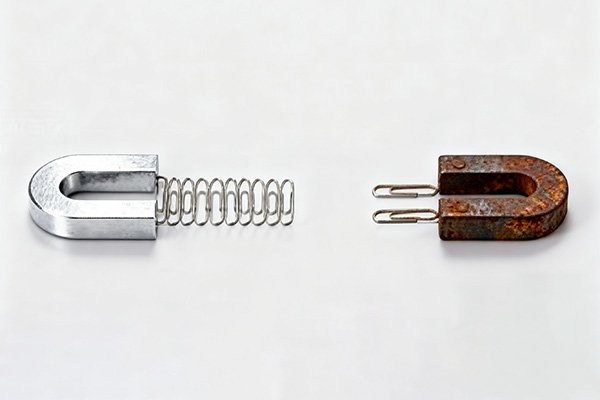
The question does magnets wear out comes up often. The answer isn’t a simple yes or no. Permanent magnets don’t expire like batteries do. They don’t have a shelf-life. Under the right conditions, their magnetic field lasts forever for practical purposes.
But they can lose their strength. This process is called demagnetization. Time itself doesn’t cause this loss. Specific outside conditions do.
You might be an engineer designing complex parts. Maybe you’re a researcher who needs precise magnetic fields. Perhaps you’re working on a DIY project or buying components in bulk. Either way, understanding these conditions matters. It’s the key to good performance, reliability, and cost savings.
This guide explores the science behind magnet wear. We’ll explain what makes a magnet weaken. You’ll get practical advice on how to pick, handle, and store magnets for the longest possible life.
Quick vs. Real Answer
here’s a big difference between the myth of magnets “wearing out” and the reality of external forces weakening them. Understanding this difference is your first step to using magnets properly.
The Myth of “Wearing Out”
Modern permanent magnets are incredibly stable. Neodymium and Ferrite types are good examples. Keep them in a controlled environment, and a high-quality magnet will lose only a tiny bit of magnetism over a human lifetime. We’re talking less than 1-2% over a century.
This natural decay happens so slowly that most applications won’t notice it. A magnet on your refrigerator won’t get noticeably weaker on its own, even after decades. The idea of a magnet simply “running out” of magnetism is wrong.
The Reality of “Being Weakened”
When people see a magnet losing strength, they’re almost always seeing the result of outside factors. These forces actively mess up the magnet’s internal structure. This causes it to weaken.
Think of it less like a photo slowly fading in the sun. Think of it more like a piece of glass. The glass itself doesn’t break down, but a sharp hit can crack or shatter it. Similarly, a magnet’s strength stays strong until it meets a force powerful enough to damage its magnetic alignment.
The Science of Stability
To understand why magnets can be weakened, we need to understand what makes them magnetic. A permanent magnet’s power comes from its highly ordered internal structure.
All magnetic materials have countless tiny regions called magnetic domains. Think of each domain as a small individual magnet with its own north and south pole.
In an unmagnetized piece of material, like a regular iron bar, these domains point in random directions. Their individual magnetic fields point every which way. They cancel each other out. The result is no external magnetic field.
Making a permanent magnet involves placing the material inside an extremely powerful external magnetic field. This energy forces all the individual domains to snap into uniform alignment. They all point in the same direction.
This collective, unified alignment creates the powerful and lasting external magnetic field we know as a magnet. The material’s ability to resist changes to this alignment is called coercivity.
Therefore, magnet wear or demagnetization is simply disrupting this carefully created alignment. Any external energy source that can knock these domains out of alignment will weaken the magnet.
Four Culprits of Wear
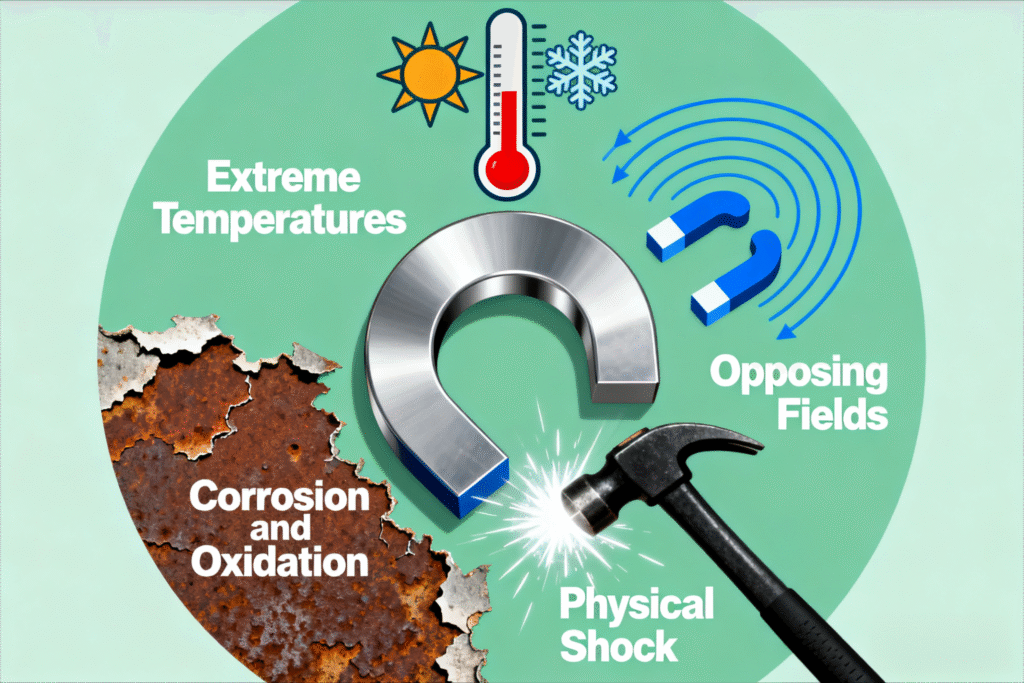
Four main factors cause nearly all cases of magnet demagnetization. Understanding each one is crucial for preventing magnet failure in any application.
1. Extreme Temperatures
Heat is the most common enemy of permanent magnets. As temperature rises, it adds thermal energy to the material. This causes atoms to vibrate more vigorously. This vibration can be strong enough to randomize the magnetic domains. It knocks them out of alignment and weakens the magnet’s overall field.
This strength loss can be temporary or permanent. Heat a magnet moderately beyond its maximum operating temperature, and it may lose some strength but recover when it cools. However, heat it to a critical point, and the damage can’t be reversed.
This critical point is called the Curie Temperature. At its Curie Temperature, a magnet’s domain structure gets completely scrambled. It permanently loses all magnetic properties. It becomes just a piece of metal again.
Different magnet materials handle heat very differently. This is critical for engineers and designers to consider.
Magnet Type | Max Operating Temp (Approx.) | Curie Temp (Approx.) |
80°C – 200°C | 310°C – 400°C | |
250°C | 450°C | |
250°C – 350°C | 700°C – 800°C | |
450°C – 550°C | 700°C – 860°C |
It’s important to note that even temperatures well below the Curie point can cause permanent strength loss. This is called irreversible loss. This is especially true for standard grades of Neodymium magnets.
2. Opposing Fields
A magnet’s strength relies on its internal domains all pointing the same way. A strong enough external magnetic field can overpower this internal structure. It pushes the domains out of alignment or even flips them to point in the opposite direction.
This can happen when two strong magnets are forced together in repulsion (north pole to north pole). The repulsive force shows the two fields fighting each other. The weaker magnet can be permanently demagnetized in the process.
We’ve seen this in industrial settings where magnets are stored wrong. Pole-to-pole in repulsion leads to gradual weakening over months. Strong electromagnets, generators, and large motors can also produce fields strong enough to cause demagnetization.
3. Physical Shock
Sharp impacts, constant vibration, or physical stress can also disrupt a magnet’s structure. The mechanical energy from a drop or hard knock can jolt the material’s crystalline lattice. This provides enough energy for some magnetic domains to lose their alignment.
This is particularly concerning for modern rare-earth and ceramic magnets. Materials like Neodymium and Ferrite are very hard but also very brittle. They’re similar to ceramic. Drop them on a hard surface or let them slam into each other, and they can chip, crack, or even shatter.
Any crack or fracture creates new poles and disrupts the uniform magnetic circuit. This functionally weakens the magnet. Machining processes like drilling or cutting without specialized equipment and cooling techniques will also destroy a magnet. This happens due to both heat and physical stress.
4. Corrosion and Oxidation
Corrosion is a chemical process that changes the material’s composition. When a magnetic material corrodes, it transforms into a different, non-magnetic substance. Rust is the most common example.
This is the main weakness of the most powerful magnets available: Neodymium magnets. They’re made largely of Neodymium, Iron, and Boron (NdFeB). The high iron content makes them extremely susceptible to rust. This is especially true in humid or marine environments.
Uncoated Neodymium magnet degradation can be rapid. The rust will flake off, exposing fresh material underneath to corrode. The magnet will literally crumble away over time.
To fight this, Neodymium magnets are almost always sold with a protective coating. Standard coatings include Nickel-Copper-Nickel (Ni-Cu-Ni), Zinc, and Epoxy. The integrity of this coating is essential for the magnet’s long-term survival. For applications requiring high magnet corrosion resistance, exploring different coatings on our Neodymium Magnets is essential for ensuring long-term performance.
Lifespan Comparison
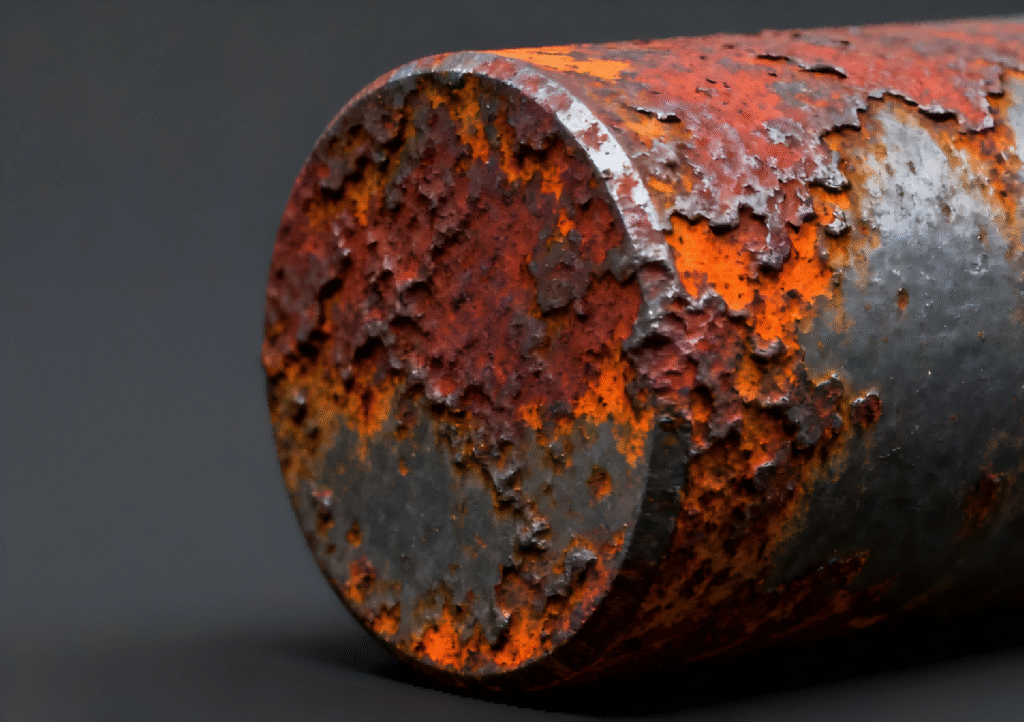
The question of how long do magnets last depends entirely on the type of magnet and its application environment. Choosing the right material from the start is the most effective way to ensure a long magnet lifespan.
Neodymium (NdFeB)
Neodymium magnets are the powerhouses of the magnet world. They offer the highest strength-to-size ratio. However, they’re the most sensitive to heat and corrosion. Standard grades begin to lose strength above 80°C. They’re best for dry, room-temperature applications where maximum force is required. For other environments, selecting a high-temperature grade and robust coating is non-negotiable. Explore our range of Neodymium Magnets for high-strength applications.
Ferrite (Ceramic)
Ferrite magnets are the dependable workhorses. While much weaker than Neodymium, they offer two major advantages for longevity. They have excellent magnet corrosion resistance and a much higher operating temperature (around 250°C). They’re essentially a type of ceramic and don’t rust. This makes them ideal for outdoor use, marine applications, motors, and common fridge magnets. Our Ferrite Magnets are a cost-effective solution for many industrial and commercial uses.
Samarium Cobalt (SmCo)
Samarium Cobalt magnets are high-performance specialists. They’re strong (though typically not as strong as Neodymium) but offer superior temperature resistance to both Neodymium and Ferrite magnets. They perform well up to 350°C. They also have good corrosion resistance. This combination makes them the go-to choice for demanding applications in aerospace, military, and high-performance motors where reliability at high temperatures is paramount.
Alnico
Alnico magnets are a classic design. They’re known for having the best temperature stability of all. They can be used in environments up to 550°C. However, they’re relatively brittle and have low coercivity. This means they’re the most easily demagnetized by external magnetic fields and physical shock. They’re still widely used in specialized sensors, guitar pickups, and high-temperature equipment.
Maximizing Magnet Lifespan
Protecting your magnets from the four main causes of demagnetization is straightforward. By moving from theory to practice, you can ensure your magnets deliver reliable performance for years or even decades.
Proper Handling and Use
Proper handling is the first line of defense. This is especially true for brittle materials like Neodymium and Ferrite.
- Avoid dropping magnets or letting them slam into each other or hard surfaces. The impact can cause micro-fractures or chipping that weaken the magnet.
- When separating very strong magnets, it’s safer to slide them apart sideways rather than trying to pull them directly apart. This reduces the chance of them snapping back together unexpectedly.
- Never attempt to drill, saw, or machine permanent magnets without specialized diamond-tooled equipment and liquid cooling. The heat and stress from standard tools will destroy the magnetism and can create flammable dust.
Smart Storage Solutions
How you store magnets is just as important as how you use them. Following a few simple rules for how to store magnets can dramatically extend their functional life.
- Store magnets in a cool, dry place. Keep them away from direct sunlight, radiators, furnaces, or any other source of significant heat.
- Keep them at a safe distance from strong electrical currents, large electric motors, and other powerful magnets, especially those stored in a repulsive orientation.
- For long-term storage, use “keepers.” A keeper is a piece of iron or steel placed across the poles of a magnet (or between a stack of magnets) to close the magnetic circuit. This stabilizes the domains and protects them from external fields.
- If keepers aren’t available, store magnets in attracting stacks (north pole to south pole). This creates a self-shielding circuit.
- Store them in their original packaging or in designated non-metallic boxes to prevent them from attracting and impacting other items.
Choosing the Right Magnet
Ultimately, the most critical step is choosing the right magnet from the start. Proactively matching the magnet’s material, grade, and coating to its intended operating environment is the best way to prevent failure.
- For high-temperature environments, don’t use a standard N35 Neodymium magnet. Instead, select a high-temperature grade specifically designed for that purpose, such as an “M”, “H”, “SH”, “UH”, or “EH” grade. Or, consider a different material like Samarium Cobalt or Alnico.
- For humid, outdoor, or marine use, don’t use an uncoated or standard nickel-coated Neodymium magnet. Insist on a more robust coating like multi-layer epoxy or plastic. Or better yet, opt for an inherently resistant material like a Ferrite magnet. This foresight is key to long-term success.
Total Cost of Ownership
For professional purchasers and engineers, the conversation about magnet lifespan must go beyond the initial purchase price. The most important metric is the Total Cost of Ownership (TCO). This accounts for all costs associated with the magnet over its entire lifecycle.
The cheapest magnet is rarely the most cost-effective one in a professional application. A low-cost magnet that fails early can lead to catastrophic expenses that dwarf the initial savings.
Consider this common scenario: A manufacturing line uses magnets in a fixture to hold steel parts for welding.
- Option A (Low Initial Cost): Standard N42 grade Neodymium magnets with a basic Ni-Cu-Ni coating. They cost $0.50 each.
- Option B (Higher Initial Cost): High-temperature “SH” grade Neodymium magnets with a durable black epoxy coating. They cost $0.80 each.
An inexperienced buyer might choose Option A to save 30 cents per unit. However, the welding process generates ambient heat, and the factory environment has moderate humidity. Option A’s magnets begin to suffer from irreversible heat losses and corrosion. They fail every 6 months. Each failure requires stopping the production line, which costs thousands of dollars per hour in downtime, plus the labor to replace the failed components.
Option B, while more expensive upfront, is rated for the heat and protected from corrosion. These magnets perform reliably for 5+ years without failure. The TCO of Option B is drastically lower because it eliminates the massive costs associated with downtime, replacement labor, and frequent re-ordering.
Making the right choice upfront saves significant cost and prevents operational headaches. For complex industrial or OEM applications, a detailed analysis of your project’s needs is critical. A consultation can define requirements for temperature, humidity, external fields, and mechanical stress. Contact our team of magnet specialists at CNM Magnet to discuss your specific requirements and ensure you select the magnet with the best long-term value.
Conclusion: A Permanent Force
So, does magnets wear out? No, not in the way we typically think of things wearing out over time. A permanent magnet’s field doesn’t naturally fade or expire.
Instead, a magnet’s strength can be taken away by four specific external forces: excessive heat, strong opposing magnetic fields, physical shock, and corrosion. Each of these factors works by disrupting the delicate internal alignment of the magnet’s domains.
By understanding these vulnerabilities, you can take simple but effective steps to mitigate them. Proper handling, smart storage, and, most importantly, choosing the right magnet for the job are the keys to longevity.
When selected and applied correctly, a permanent magnet is one of the most reliable and durable components available. It provides a consistent and powerful force for countless applications, truly living up to the name “permanent.”
We are a manufacturer specializing in the research and development of magnets with years of industry experience. Our product offerings include NdFeB magnets, ferrite magnets, and custom magnetic components. Our goal is to provide high-quality magnetic solutions to customers worldwide, and we also offer OEM/ODM customization services. If you have any questions about magnets or custom applications, please feel free to contact our team of experts.
Facebook
Twitter
LinkedIn
WhatsApp