
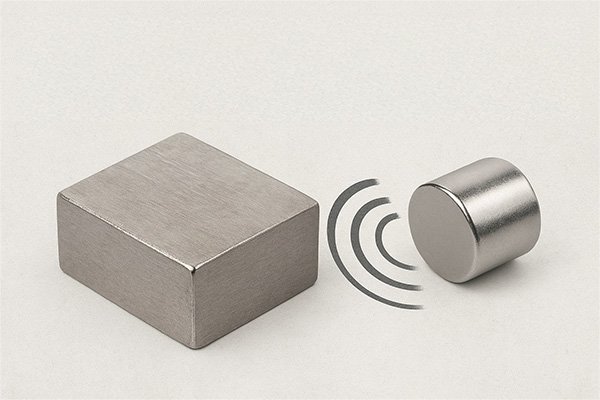
No, a standard magnet will not stick to pure titanium or its most common alloys. This answers the basic question most people have.
But the full scientific picture is more complex. Titanium isn’t magnetic like iron or steel, but it does show a very weak type of magnetism called paramagnetism.
Here’s a simple way to think about it: iron acts like an excited fan rushing toward a celebrity (the magnet). Titanium is more like someone in a crowd who might glance over briefly but feels no real pull. The interaction is so weak that you need sensitive lab equipment to detect it.
This article explores the science behind this behavior. We’ll break down different types of magnetism, look at how various titanium alloys behave, and discuss real-world applications where titanium’s non-magnetic nature isn’t just useful—it’s essential.
Table of Contents
Science of Magnetism
To understand why titanium behaves this way, we need to know that magnetism in materials isn’t simply yes or no. Materials respond to magnetic fields in several different ways. These responses fall into three main categories.
Three Classes of Behavior
Scientists classify materials as ferromagnetic, paramagnetic, or diamagnetic based on how they interact with external magnetic fields. Each type has unique properties that come from the material’s atomic structure.
Ferromagnetic materials are what most people call “magnetic.” They’re strongly attracted to magnets and can become permanently magnetized. This strong attraction happens because of their internal magnetic domains, which line up easily with an external field. Iron, nickel, and cobalt are common examples.
Paramagnetic materials, like titanium, are very weakly attracted to magnetic fields. This attraction is temporary and disappears when you remove the external magnetic field. The effect is thousands of times weaker than ferromagnetism. You can’t notice it in everyday situations.
Diamagnetic materials do the opposite—they’re very weakly pushed away by magnetic fields. This repulsive force is also extremely weak and temporary, just like paramagnetism. Copper, gold, and bismuth are diamagnetic materials.
Property | Ferromagnetism (e.g., Iron) | Paramagnetism (e.g., Titanium) | Diamagnetism (e.g., Copper) |
Reaction to Magnet | Strongly Attracted | Very Weakly Attracted | Very Weakly Repelled |
Magnetic State | Has permanent magnetic domains | Becomes temporarily magnetic in a field | Becomes temporarily magnetic to oppose a field |
Strength of Interaction | Strong | Extremely Weak | Extremely Weak |
Why Titanium is Paramagnetic
An element’s magnetic behavior depends on how its electrons are arranged. Electrons in atoms live in orbitals and have a property called “spin” that creates a tiny magnetic moment.
In many atoms, electrons pair up with opposite spins that cancel out each other’s magnetic effects. However, titanium atoms have four unpaired electrons in their outer shells.
When you apply an external magnetic field, these unpaired electrons can temporarily align their spins with the field. This creates a very small, temporary magnetic attraction.
The key word is “temporary.” Once you remove the external magnet, the atoms’ thermal energy makes the electrons return to random orientations. The magnetic effect disappears completely. This is why scientists classify titanium as paramagnetic.
Titanium Grades and Alloys
Many people mistakenly think of titanium as one uniform material. In engineering and manufacturing, “titanium” almost always means a specific grade or alloy designed for particular uses. Understanding these differences matters for professionals.
Fortunately, when it comes to the question “is titanium magnetic,” the answer stays remarkably consistent across the entire family of titanium alloys.
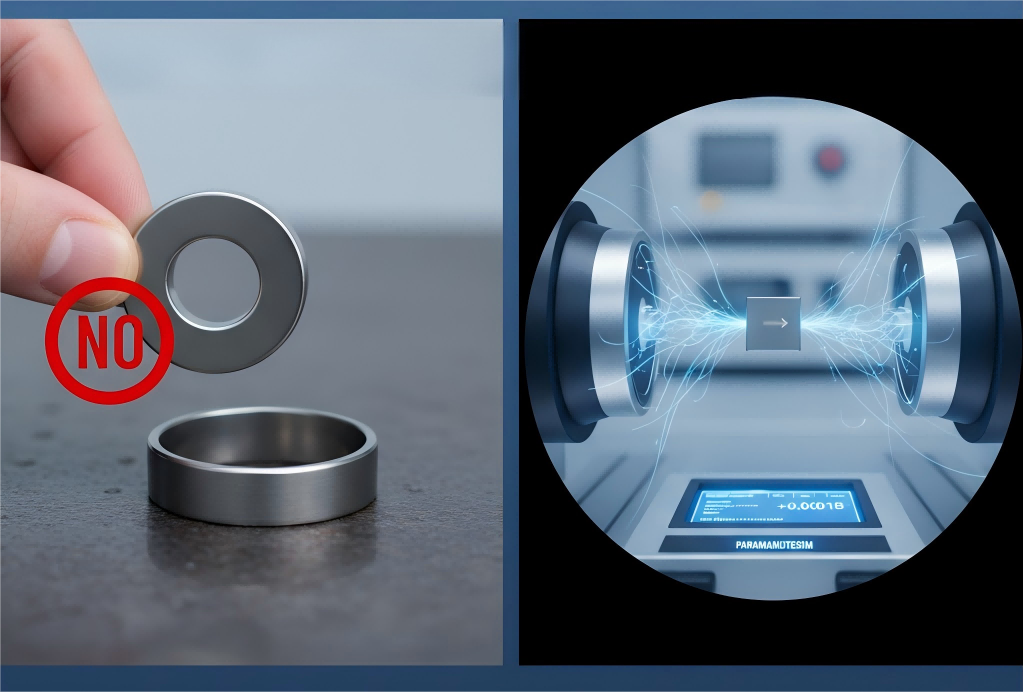
Commercially Pure (CP) Grades
Commercially Pure (CP) titanium comes in four main grades, from Grade 1 to Grade 4. Grade 1 is the most flexible and softest. Grade 4 is the strongest.
These grades are over 99% pure titanium, with only tiny amounts of oxygen, nitrogen, carbon, and iron. Since they’re almost entirely titanium atoms, their magnetic property is definitely paramagnetic.
For all practical purposes, CP titanium is non-magnetic. Can a magnet stick to titanium? No, it won’t stick to a magnet and won’t become magnetized. This makes it reliable for applications where you must avoid magnetic interference.
The Workhorse: Ti-6Al-4V
The world’s most common titanium alloy is Ti-6Al-4V, also called Grade 5. It makes up over 50% of all titanium use globally. It dominates aerospace, medical, and performance industries.
The name describes what’s in it: titanium with about 6% aluminum and 4% vanadium by weight. To understand this alloy’s magnetic properties, we need to look at its parts.
Aluminum is paramagnetic, just like titanium. Vanadium is also paramagnetic. When you combine these elements, the result—Ti-6Al-4V—stays fundamentally paramagnetic.
The alloy doesn’t contain significant amounts of ferromagnetic elements. Therefore, Grade 5 titanium is also considered non-magnetic for all practical uses. It’s safe for MRI machines and won’t interfere with sensitive electronic equipment.
Other Titanium Alloys
The titanium world includes many other specialized alloys. These include beta alloys (used for springs and high-strength parts) and alloys with palladium, molybdenum, or nickel for better corrosion resistance or high-temperature strength.
For example, Grade 7 titanium contains a small amount of palladium (around 0.15%) to dramatically improve its resistance to acid corrosion. Since palladium is also paramagnetic, Grade 7 remains non-magnetic.
Grade 23, or Ti-6Al-4V ELI (Extra Low Interstitials), is a higher-purity version of Grade 5. It has even lower levels of iron and oxygen. This improves its fracture toughness and makes it the top choice for medical implants. Its magnetic property is identical to Grade 5: paramagnetic and functionally non-magnetic.
This consistency is a major engineering advantage. Iron’s magnetic susceptibility is roughly +200,000, while titanium’s is only about +0.00018. This shows why we see one as “magnetic” and the other as not. The difference in strength is over a billion times.
Titanium Grade | Common Name(s) | Composition | Key Characteristics | Magnetic Property |
Grade 2 | CP Ti | 99.2% Ti | Excellent corrosion resistance, formability | Paramagnetic |
Grade 5 | Ti-6Al-4V | Ti, 6% Al, 4% V | High strength-to-weight ratio | Paramagnetic |
Grade 7 | Ti-0.15Pd | Ti, 0.12-0.25% Pd | Superior corrosion resistance in acids | Paramagnetic |
Grade 23 | Ti-6Al-4V ELI | Ti, 6% Al, 4% V (Extra Low Interstitials) | High fracture toughness, biocompatible | Paramagnetic |
Critical Applications
Titanium’s non-magnetic nature isn’t just a minor detail—it’s a critical design feature that enables some of today’s most advanced technologies. In many high-stakes applications, this property is just as important as its strength or corrosion resistance.
Medical and Healthcare
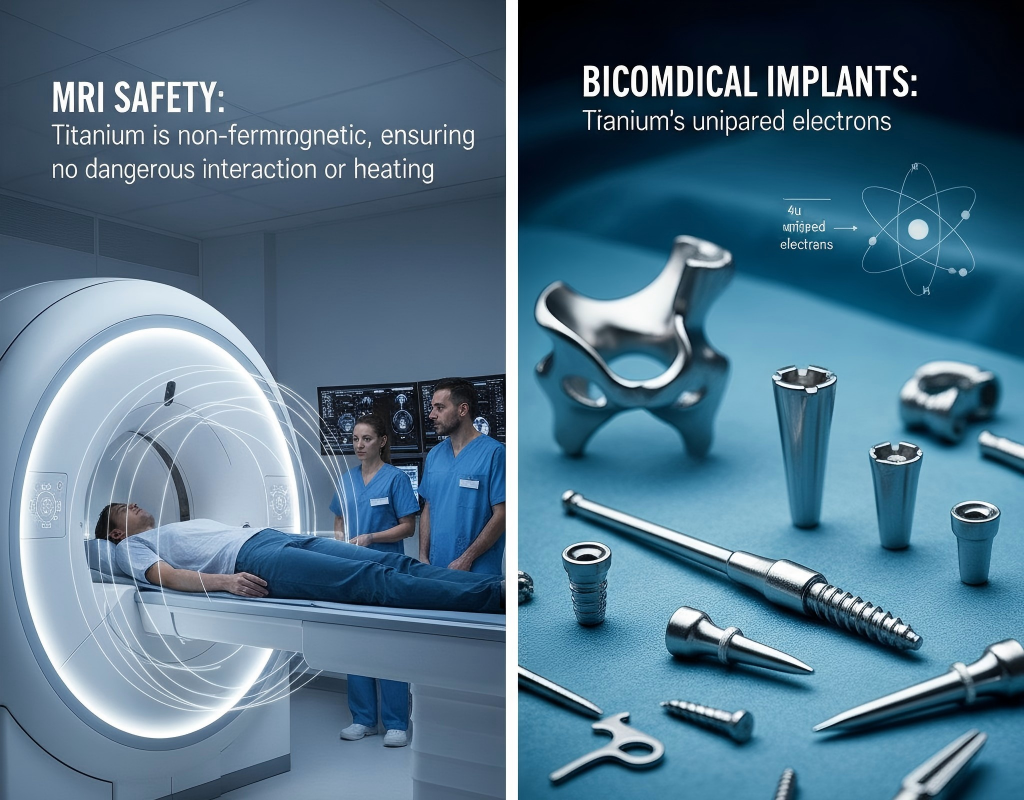
One of the most frequent and critical questions is: “Is a titanium implant safe in an MRI machine?” The answer is absolutely yes.
Magnetic Resonance Imaging (MRI) machines use incredibly powerful magnetic fields to create detailed images of the body’s soft tissues. A ferromagnetic implant (made of iron or certain steels) would be extremely dangerous in an MRI.
The strong magnetic field could create a powerful twisting force on the implant, potentially moving it and causing severe internal injury. Also, the radiofrequency pulses used in MRI can create electrical currents in ferromagnetic metals, making them heat up significantly and burn surrounding tissue.
Because titanium is paramagnetic and not ferromagnetic, it doesn’t experience this dangerous force. It also has negligible heating. This makes it the gold standard material for joint replacements (hips, knees), dental implants, spinal fusion cages, bone plates and screws, and surgical staples. Its non-magnetic nature ensures patient safety during essential diagnostic procedures.
Aerospace and Defense
In aircraft, spacecraft, and defense systems, protecting electronic and navigation equipment is crucial. Stray magnetic fields can interfere with sensitive instruments—a problem called electromagnetic interference (EMI).
Compasses, both traditional and digital (magnetometers), can be thrown off by nearby magnetic materials, leading to catastrophic navigation errors. The complex electronics in modern aircraft rely on clean electronic signals, which magnetic fields from ferrous components can disrupt.
Titanium is used extensively in airframes, engine parts, and fasteners precisely because it doesn’t create this magnetic interference. Using it ensures that navigation systems stay accurate and electronic communications aren’t compromised.
In defense, a low magnetic signature is key to stealth technology. Submarines and surface ships use large amounts of titanium to reduce their magnetic profile, making them harder to detect by magnetic anomaly detectors (MAD) used in anti-submarine warfare.
Manufacturing and Science
Titanium’s usefulness extends to specialized industrial and scientific fields where magnetic fields are either tools or contaminants.
In high-energy physics labs like CERN, powerful superconducting magnets steer particle beams. The structural parts and vacuum chambers near these beams must be non-magnetic to avoid interfering with precisely controlled magnetic fields. Titanium and its alloys are often the top choice for these demanding environments.
In chemical processing, where reactive chemicals are mixed, titanium vessels and piping are valued for their corrosion resistance. Their non-magnetic nature is an added benefit, preventing potential magnetic contamination of sensitive chemical compounds or interference with sensor readings.
Similarly, in marine applications—from deep-sea submersibles to offshore oil rigs—titanium’s combination of complete corrosion immunity in seawater and non-magnetic signature makes it ideal for housing sensitive sonar and electronic monitoring equipment.
A Practical Test
While the science is clear, consumers often face a practical problem: how can you be sure the “titanium” product you bought is real? Counterfeit products, often made of cheaper titanium-coated stainless steel, are common.
Fortunately, you can do a simple, effective test at home using the very property we’ve been discussing. This hands-on guide comes from direct experience in material verification.
What You'll Need
You only need two things for this test.
First, the item in question. This could be jewelry, a carabiner, a water bottle, a tool, or any other product sold as titanium.
Second, you need a strong magnet. A standard refrigerator magnet is usually too weak to work well. The best tool is a neodymium magnet, also called a rare-earth magnet. These are widely available and inexpensive.
A Step-by-Step Guide
Follow these simple steps to determine if your item is likely titanium.
- The Attraction Test: This is the most definitive step. Bring the strong neodymium magnet right up to the item’s surface. If the magnet snaps on firmly and holds its own weight, it’s not titanium. The item is almost certainly made of a ferromagnetic metal like carbon steel or a ferritic grade of stainless steel.
- The Drag Test: If there’s no attraction, the item isn’t ferromagnetic, which is a good sign. Now do a more subtle test. Slide the magnet quickly across the metal’s surface. With a genuinely paramagnetic material like titanium, you may feel very slight, subtle drag or resistance. This isn’t magnetism—it’s called eddy current braking. It feels nothing like the distinct pull of a ferromagnetic metal. It’s more like faint, ghostly friction. Many grades of stainless steel and aluminum will also show this, but it helps distinguish from non-metallic materials.
- Cross-Verification: Use other properties to confirm your findings. First, consider the weight. Titanium has a famous strength-to-weight ratio. It’s significantly lighter than steel (about 45% lighter for the same volume) but noticeably heavier than aluminum. If your item feels as heavy as a steel equivalent, be suspicious. If it feels as light as aluminum, it’s probably not titanium.
Next, look at the appearance. Uncoated titanium typically has a unique color and finish. It’s a darker, grayer metal compared to the bright, almost white shine of polished stainless steel or aluminum. It often has a characteristic matte or satin finish, though it can be polished.
By combining the magnet test with observations of weight and appearance, you can identify real titanium with high confidence.
Titanium vs. Other Metals
To put titanium’s properties in context, it helps to compare it directly to other common metals. Consumers and engineers often choose between these materials. Understanding their magnetic differences is key to making the right choice.
This table provides a quick reference for comparing titanium’s magnetic behavior against metals it’s often confused with or considered alongside.
Metal | Sticks to a Magnet? | Magnetic Type | Common Misconception |
Titanium | No | Paramagnetic | Often confused with steel, but it is not magnetic. |
Stainless Steel (Austenitic, e.g., 304, 316) | No / Very Weakly | Paramagnetic (when annealed) | The most common “non-magnetic” stainless steel. Can become weakly magnetic after being bent or machined. |
Stainless Steel (Ferritic/Martensitic, e.g., 430) | Yes | Ferromagnetic | Proves that not all “stainless steel” is non-magnetic. This type is used in cutlery and appliances. |
Aluminum | No | Paramagnetic | Like titanium, it’s non-ferromagnetic and valued for being lightweight. |
Tungsten | No | Paramagnetic | Another dense, strong, non-ferromagnetic metal, often used in high-performance applications. |
Iron / Carbon Steel | Yes | Ferromagnetic | The benchmark for a “magnetic” metal. |
The Final Verdict
The question “is titanium magnetic” has a simple answer for everyday life and a more detailed one for science and engineering. For all practical purposes, the answer is no. A magnet will not stick to it.
For engineers, scientists, or medical professionals, the answer is more precise: titanium is paramagnetic. Its interaction with magnetic fields is negligible—a feature that’s deliberately used.
This non-ferromagnetic nature isn’t a flaw but a defining feature. It’s what makes titanium a “super-material” for critical applications. It ensures the safety of medical implants during MRI scans, the accuracy of aerospace navigation systems, and the purity of scientific experiments.
So while a magnet won’t stick to your titanium ring or surgical implant, its subtle and unique relationship with magnetism is precisely what makes it one of the most vital advanced materials in modern technology.
We are a manufacturer specializing in the research and development of magnets with years of industry experience. Our product offerings include NdFeB magnets, ferrite magnets, and custom magnetic components. Our goal is to provide high-quality magnetic solutions to customers worldwide, and we also offer OEM/ODM customization services. If you have any questions about magnets or custom applications, please feel free to contact our team of experts.
Facebook
Twitter
LinkedIn
WhatsApp