
Table of Contents
What is a Ferrite Magnet?
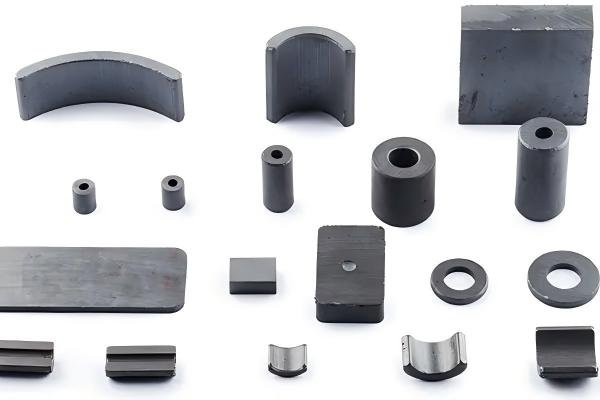
If you’ve ever taken apart an old radio, stereo, or small motor, the gray, brittle magnet inside is most likely Ferrite Magnet (ferrite magnet), also commonly known as “ceramic magnet”. It’s not as “powerful and eye-catching” as neodymium magnets, but thanks to its unique properties and extremely low cost, it has been an indispensable functional material in the industrial sector for decades.
The main components of Ferrite Magnet are iron oxide (Fe₂O₃) and carbonate compounds of strontium or barium, which are sintered through powder metallurgy. This material belongs to the category of “hard magnets”, meaning it can retain its magnetism for a long time once magnetized. Interestingly, although it appears as rough as ceramic, it has very stable chemical properties and high-temperature resistance.
Personal Opinion: Many people think of neodymium magnets as soon as they mention “magnets,” but ferrite magnets are the real “workhorses of industry.” They are unassuming yet silently support countless applications from household appliances to automobiles.
Types and Key Characteristics of Ferrite Magnets
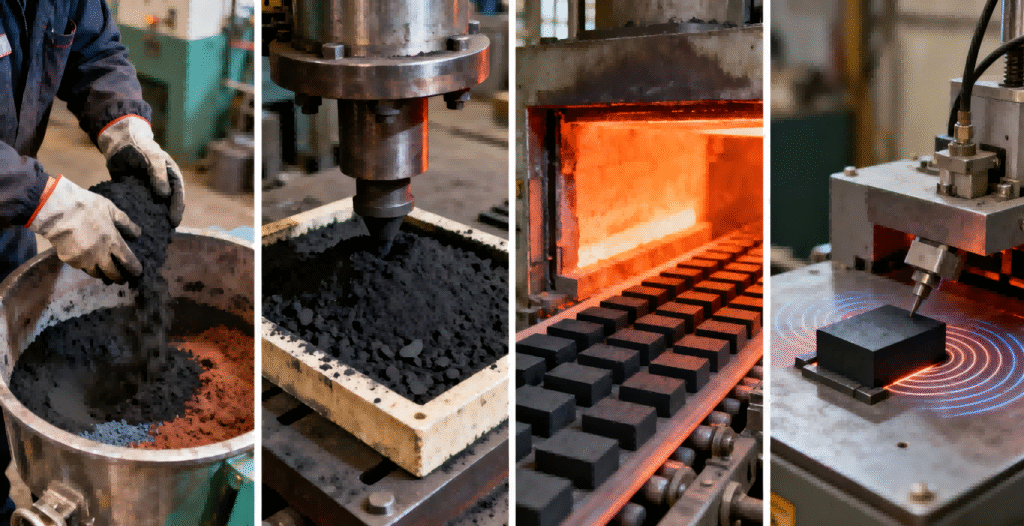
Ferrite Magnets are mainly divided into two categories:
- Strontium ferrite (SrFe12O19): It has high magnetic properties and is currently the mainstream industrial choice.
- Barium ferrite (BaFe12O19) : Lower cost, but slightly weaker magnetic properties, commonly found in older models or low-cost applications.
Key features include :
- Magnetic energy product (BHmax): Usually between 1–4 MGOe, far lower than neodymium magnets, but sufficient for most daily applications.
- Coercivity: High coercivity makes it highly resistant to demagnetization, suitable for dynamic working environments (such as motors).
- Temperature Resistance : It can operate continuously at temperatures above 250°C for extended periods, and can even withstand 300°C for short durations – a performance that neodymium magnets cannot match.
- Corrosion Resistance: The surface does not require electroplating, is inherently oxidation-resistant and moisture-resistant, and is highly suitable for harsh environments.
- Cost: One of the greatest advantages – the price is usually only 10% – 20% of that of neodymium magnets.
Comparison with Other Magnets: Ferrite is not a "Weakling" but a "Survivor"
Many people like to compare ferrite magnets with neodymium magnets and then conclude that “ferrite magnets have too weak magnetic force”. This is actually a misunderstanding. The real advantage of ferrite magnets lies not in their absolute magnetic force, but in the balance between their comprehensive performance and cost.
| Feature | Ferrite Magnet | Neodymium magnet | Alnico |
| Magnetic energy product (MGOe) | 1–4 | 30–55 | 5–9 |
| Temperature Resistance (°C) | ≤250–300 | ≤80–200 | ≤500–550 |
| Corrosion resistance | Excellent | Requires plating | Excellent |
| Price | Extremely Low | High | Medium-high |
Attention Designers: If you need magnets to operate in high-temperature environments (such as automotive motors, industrial equipment), ferrite is often a more reliable and cost-effective choice. Although neodymium magnets are strong, they have a high risk of demagnetization at high temperatures.
Common Application Areas of Ferrite Magnet
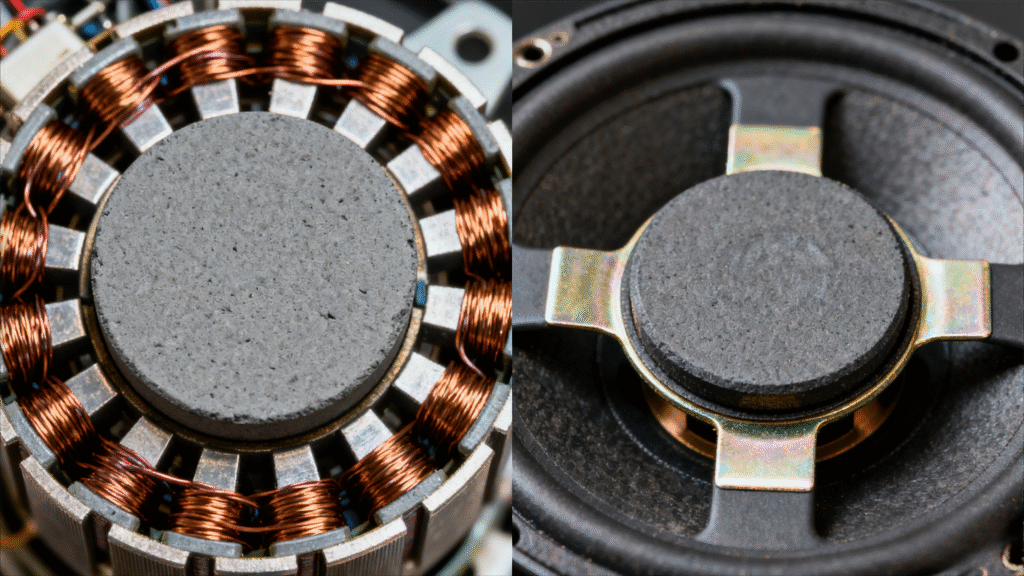
Due to their stability and low cost, ferrite magnets are almost ubiquitous:
- Speakers and Headphones: More than 90% of speakers use ferrite magnets because of their sufficient magnetic properties and extremely low cost.
- Motors and Generators : Widely used in household appliances (washing machines, fans), automotive motors (windows, fans), and industrial motors.
- Magnetic Tools and Clamping Devices: Door Stoppers, Magnetic Separators, Tool Clamps, etc.
- Daily necessities: fridge magnets, magnetic fasteners, toys, etc.
Procurement Perspective: When purchasing in bulk, the unit price of ferrite magnets can be as low as a few cents per piece, a market where neodymium magnets cannot compete.
How to Select and Purchase Ferrite Magnets?
If you are selecting a project or preparing to make a purchase, the following are some practical suggestions:
① Define grades Ferrite magnets are usually classified by grades such as “Y30”, “Y35”, etc. The higher the number, the better the magnetic properties (but also more brittle and slightly higher in cost). Common grades include:
- Y30: General grade, lowest cost
- Y35: High-performance General Grade
- Y40: High-demand applications (e.g., high-performance motors)
② Pay attention to dimensions and tolerances In industrial procurement, dimensional tolerances directly affect installation and performance. The tolerance of general sintered magnets is ±0.2mm. If higher precision is required, grinding may be necessary (resulting in increased costs).
③ Magnetization direction is crucial! Ferrite magnet is an anisotropic magnet and must be magnetized along a specific direction to achieve optimal performance. When purchasing, the magnetization direction (axial, radial, or multi-pole magnetization) must be specified.
④ Supplier Selection Seek experienced manufacturers (such as magnet factories in China), who typically can provide:
- Customized Shape and Size
- Technical Support and Selection Recommendations
- Volume Discount Price
Procurement Tip: Directly contacting the manufacturer is often more cost-effective than purchasing through a trader, especially for large-volume orders.
Summary: What's the charm of Ferrite Magnet?
In today’s market, where high-performance neodymium magnets are sweeping the market, ferrite magnets still firmly hold half of the industrial application market. Their charm lies not in being “the strongest,” but in being “the most stable” – stable performance, stable supply, and stable low cost .
If you are an engineer, when choosing a magnet, you might as well ask yourself:
✅ Is my application environment high temperature?
✅ Do I need extremely strong corrosion resistance?
✅ Is my project cost-sensitive?
If the answer to the above question is “yes”, then ferrite magnet is most likely your ideal choice.
We are a manufacturer specializing in the research and development of magnets with years of industry experience. Our product offerings include NdFeB magnets, ferrite magnets, and custom magnetic components. Our goal is to provide high-quality magnetic solutions to customers worldwide, and we also offer OEM/ODM customization services.If you have specific procurement requirements, welcome to contact professional magnet manufacturers for quotes and technical support.
Facebook
Twitter
LinkedIn
WhatsApp